Wednesday, September 23, 2020

Catalina without the kayak

Unfortunately, this is not an epic blog post about an epic kayak trip. I spent the week leading up to the departure date watching the wind and swell forecasts for San Pedro, Catalina, and the channel between them. My self imposed limit for wind speed was 10 miles per hour. The forecast was showing 12 mph winds and swells of around 3 feet. Those numbers would probably be doable, but I couldn't risk the forecast getting worse after I drove my kayak up to San Pedro. So, I did the prudent thing and bought a round trip ferry ticket on the Catalina Express.


I checked the weather forecast again before getting on the ferry. The winds and swell had both dropped to well below my criteria for kayaking, but it was too late to change my plans. Sure enough, the ferry ride across the channel was calm and pleasant. It would have been the perfect day to solo paddle the roughly 24 miles across.


Several years ago I fished with Eli just off Catalina, but this was my first time stepping foot on the island. The views were beautiful, and it was an enjoyable hike from Two Harbors to the campground where I'd stay for the next three nights.


My pack was already heavy with camping gear, but I stubbornly brought along my mask, snorkel, and flippers so I could snorkel and check out the fish in front of the campground. I went out twice and saw all the usual suspects. I hoped to see something new, such as a bluebanded goby or rainbow scorpionfish, but everything I saw was also common in areas such as La Jolla.

Garibaldi (Hypsypops rubicundus)


Pacific Barracuda (Sphyraena argentea)


California Salema (Haemulon californiensis)


Zebra Chub (Kyphosus azureus)


Topsmelt or Jacksmelt (Atherinopsis sp.)


Giant Kelpfish (Heterostichus rostratus)


Halfmoon (Medialuna californiensis)


The rest of the trip was spent hiking, including a tough hike to the top of the ridge to see the open Pacific on the west side of the island. The weather was great, and I really enjoyed not having a phone signal for three straight days.


The surf was fairly rough the morning I would have paddled back. It would have made the launch before sunrise a challenge, but it looked doable. Out past the surf the ocean looked calm with slow sets of moderate swell.


I'll consider planning a Catalina kayak trip again next year.

Monday, September 14, 2020

Prepping for Catalina

Sept 5, 2020

I've been hinting at a Catalina crossing for a while now, and I suppose it's time to announce my intentions. Weather permitting, I'll kayak from San Pedro (west of Long Beach and Los Angeles) to Catalina, camp for three nights, and then kayak back. There are a lot of variables at play, most importantly the weather and surf forecasts and my wrist, but if everything lines up I'm ready to do it. I've spent all year training, practicing skills, and spending time on the water. I've paddled 330 miles on my Trident, including several days over 20 miles, and I've practiced flipping and self rescuing. I bought a satellite communicator so my friends and family can track my progress during the crossing, and it has an SOS button I can press if I need the Coast Guard.


Letting my wrist heal up after the 30 mile paddle in July has been my biggest concern. To ease back into things I did a relatively short outing in La Jolla. I tried some powerlifting wrist wraps, which kept my wrist from moving, but they also made my fingers go numb. More importantly I'm working on my forward stroke technique, making sure to minimize wrist movement as I lift the paddle blade out of the water. While I was paddling I also did some fishing and caught a good mix of species.

California Salema (Haemulon californiensis)


Kelp Bass (Paralabrax clathratus)


Ocean Whitefish (Caulolatilus princeps)


Honeycomb Rockfish (Sebastes umbrosus)


I tracked my outing both with my watch and with my new Garmin inReach Mini satellite communicator. The tracks lined up well, but the inReach only records the GPS every 20 minutes, so the total distance was a little less than what the watch recorded. I'll use both when I do the Catalina crossing, and I have an external battery pack to recharge everything before the return crossing.


Miles: 8.71
Hours: 6:08
Water Temp: 69 F

Next up will be a "dry" run of the surf launch in San Pedro.

Sept 12, 2020

The following weekend I did my last training paddle before Catalina. I wanted to learn as much as I could about the launch in San Pedro, so I practiced everything exactly how I would for the crossing. I unloaded my kayak on the surf side of Cabrillo Beach, parked my car up the hill where there is multi-day street parking, and then launched at sunrise.


As I paddled out to the shipping lanes I noticed plenty of activity both on the fish finder and on the surface. I could see strong marks below schools of bait on the fish finder, so I dropped an iron down and aggressively reeled it back up. It got hit on every drop.

Kelp Bass (Paralabrax clathratus)


Barred Sand Bass (Paralabrax nebulifer)


Here's what the action looked like on the fish finder.


I planned to fish a few wrecks in 100 feet of water and then fish deeper in the canyon. There was some haze from the wildfires and fog, but visibility was good enough to see the cargo ships using the shipping lanes. I wasn't anywhere near the big ships, but I was in the path between Long Beach and Catalina, so I had to keep my head on a swivel and make sure none of the smaller boats ran me over. As I was approaching the wreck coordinates, I came across a midshipman splashing on the surface. Something seemed to be wrong with its swim bladder, but I didn't see any external trauma.

Specklefin Midshipman (Porichthys myriaster)


Fishing was slow over the wreck. I got a few short bites but didn't connect with anything. The boats going full throttle towards Catalina made it hard to relax, so I didn't fish the wreck for long. I pulled my line up and paddled over the canyon to try for rockfish instead. The bite was slow there as well. I let the current push me along at about 0.5 mph. When I reeled up to check my bait, I felt a little extra weight on the line, but I refused to get my hopes up. That made it all the more exciting when I saw color, and then I saw that it was a new rockfish species for my list!

Blackgill Rockfish (Sebastes melanostomus) - new hook & line species #675


After sending the fish back down with my descending device, a bank of heavy fog rolled in. Visibility was less than 50 yards. The combination of fog and boat traffic made me pretty uncomfortable, so I pointed in the direction of the beach and started paddling.


I passed by a private fishing boat on the way back, and they asked if I needed help getting back to shore. I assured them that I was fine, but it was nice knowing that people are looking out for each other. When I was about the 2 miles from shore the fog began to dissipate, and by the time I landed on the beach it was a bright sunny day. Funny how it worked out that way.


Miles: 10.26
Hours: 5:23
Water Temp: 68 F

That evening I had white perch on my mind, and a friend from Instagram said they were biting in Ventura, so a few of my fellow species hunters and I decided to head up there and try for them. One white perch was caught, but it wasn't by anyone who needed it. I caught shiner perch, topsmelt, jacksmelt, and white croaker.

Shiner Perch (Cymatogaster aggregata)


White Croaker (Genyonemus lineatus)


Sept 13, 2020

The next morning I headed back in the direction of San Diego, but I took a detour into the northeast suburbs of Los Angeles to check out a spot with an invasive population of pond loach (also known as Oriental weatherfish and Dojo loach). The Bobcat forest fire was burning just north of the freeway, and when I pulled up there was white and gray ash falling like snow.


I scouted out the stream before I got my microfishing gear out of the car. To my surprise, there was a HUGE loach just chilling in the middle of one of the deeper pools. I figured they would be hiding during the day. I got the gear out of my car and got to work finding bait. A small crayfish was the best thing I could find. The big loach was nowhere to be seen, but I walked upstream to a spot with more rocks. I saw a set of whiskers poking out from under a rock. The whiskers got excited when I put my bait in front of them, and sure enough their was a loach on the other end of them.

Pond Loach (Misgurnus anguillicaudatus) - new hook & line species #676


After the first I was able to catch two more loaches, and I saw a few that I didn't target. They're definitely one of the most common fish in this stream.


The stream had minnows as well. I guessed that they would be fathead minnows or some other invasive species, but I was happy to find out that they were native arroyo chubs. They were easy to catch, and this one in particular posed nicely for a photo.

Arroyo Chub (Gila orcuttii)


Next up is Catalina!

Monday, August 31, 2020

Southern California micros

Aug 22, 2020

It turns out I'm not invincible. My wrist decided to call it quits after that 31 mile paddle, and as a result I haven't kayaked or fished in the past 4 weeks. Eventually I realized I could still go fishing without using a kayak or my left hand, so I dusted off my Tenkara rod and drove down to South Bay to check out a spot where people had seen sailfin mollies.


I arrived at low tide and saw a huge school of topsmelt out in the open and smaller schools of mollies cruising close to shore. Finding your target is the first challenge, so at least I had that out of the way. The next thing I noticed was that there were small chameleon gobies coating the bottom. I couldn't believe how many there were.


I baited my Tanago hook with a small piece of worm and set to work targeting the mollies. It wasn't a surprise that they wouldn't bite, but I figured if I tried for a few hours maybe one would break character and go for my bait. Every now and then I'd get bored though, so I'd catch one of the other species I saw: chameleon goby, California killifish, and topsmelt.

Chameleon Goby (Tridentiger trigonocephalus)


California Killifish (Fundulus parvipinnis)


Topsmelt (Atherinops affinis)


The mollies refused to eat anything other than microscopic bits of nothing, so finally I dunked my camera under water and took some photos of them pecking at the rocks.

Sailfin Molly (Poecilia latipinna)


I meant to bring bread to chum with and try for bait, but I forgot, so that will have to be something I try next time. Maybe if I chum with enough different baits I can find one that interests them. Honestly, it's kind of nice having a new nemesis, especially one that's easy to find.

Aug 29, 2020

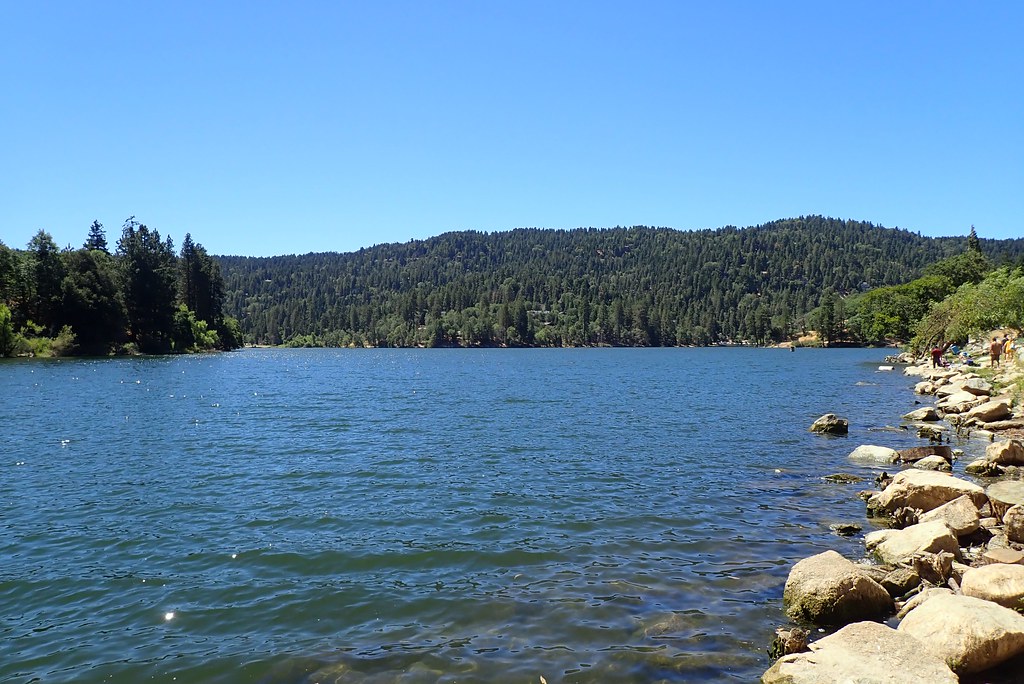
The following weekend I continued my microfishing adventures, this time combining fishing with a road trip. I kept seeing online that Big Bear Lake has a booming population of introduced prickly sculpin, and Lake Gregory, 45 minutes to the west, has a population of introduced tule perch.


Both species seemed like easy targets, and I was in need of a lifelist confidence boost. First stop was Big Bear, which according to the signs has actual bears. I parked near the dam and scrambled down the rocks to the water. It took a minute to tie on a hook, but once my bait was in the water it took around 5 seconds to catch my first sculpin. They were under every rock!

Prickly Sculpin (Cottus asper) - new hook & line species #673


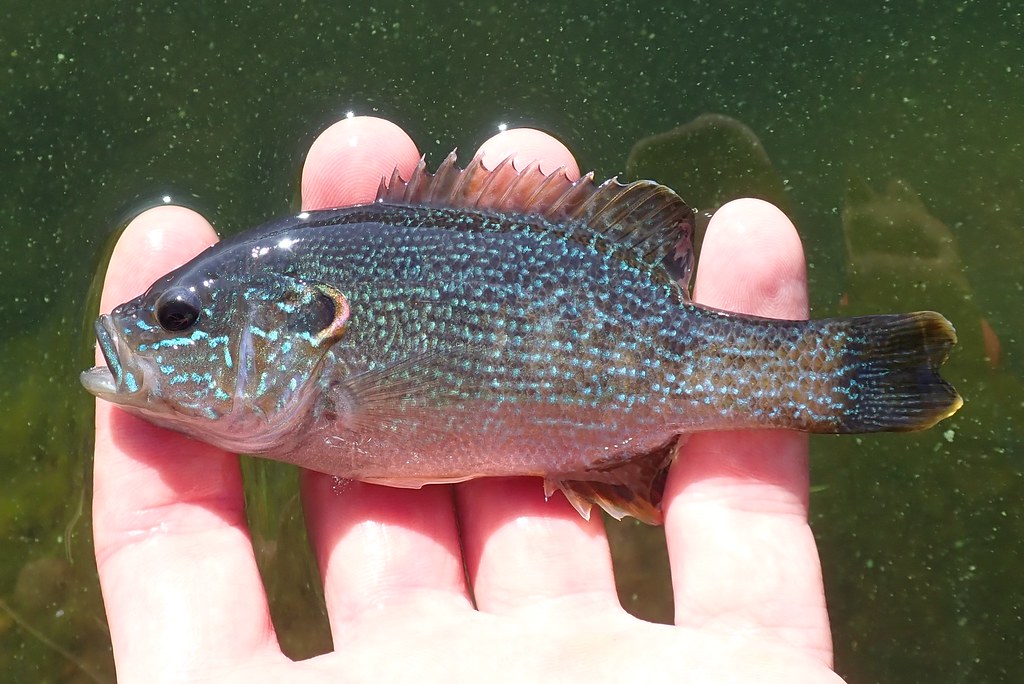
Green Sunfish (Lepomis cyanellus)


After catching about 20 sculpin and a bonus green sunfish, I hit the road again and headed west to Lake Gregory. The drive through the mountains was scenic. Big Bear is at an elevation of 6750 ft, and Gregory is 4550 ft, so the air temperature was noticeably lower than Los Angeles.


Again I parked near the dam and set up in a corner where there was some submerged tree branches. My first tule perch took a little longer than my first sculpin, but it was an easy catch as well. They're small fish with small mouths, but they would come out of heavy cover to investigate my bait. Tule perch are the only freshwater surfperch, and their reproduction and life history is fascinating if you want something to read about online.

Tule Perch (Hysterocarpus traskii) - new hook & line species #674


I had some extra time before I needed to head home, so I stopped by the Santa Ana River in Riverside to check out a spot where I had caught arroyo chubs a few years ago. It's a pretty sketchy area with a number of homeless camps, so I bushwacked into a more isolated stretch of the river to avoid the bridges and areas where I thought people might be. I still came across a few people hanging out by the river, but it was mostly families who had driven in (how I don't know) and parked their trucks by the water to let their kids play. Considering that the Santa Ana River is 100% fed by a waste water treatment plant about a mile upstream, this didn't seem like a great idea.

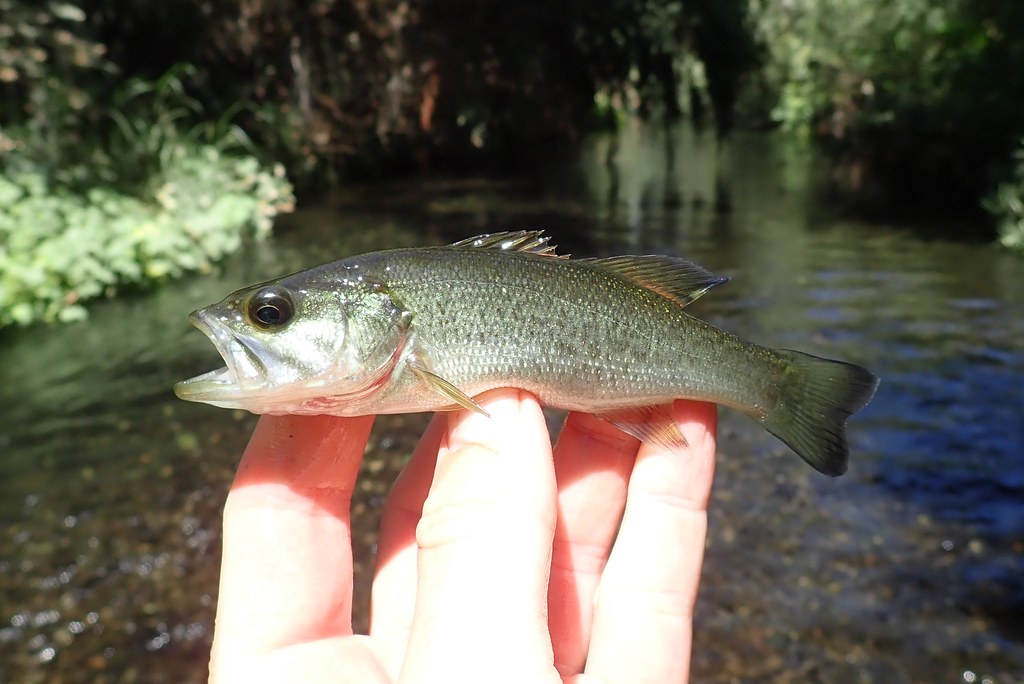
Largemouth Bass (Micropterus salmoides)


Unfortunately I wasn't able to find arroyo chubs this time, but there were plenty of largemouth bass, green sunfish, and black bullheads. Hopefully the chubs are surviving somewhere else in the river. They're one of the few native freshwater fish in southern California, so it would be nice if they stuck around.


Fishing takes you to some crazy places.

Wednesday, July 15, 2020

It's a bonito summer in San Diego

July 11, 2020

Summer is here, and that means warm water and big hungry fish. I just haven't found those big hungry fish yet (unless that pelagic stingray from my last session counts). What I'd really like now is a big yellowtail, small thresher, or small mako. I've been trying to kill two birds with one stone by combining long distance paddling with fishing, but I think I need to finally separate the two. People are catching the fish I'm interested in two miles from the La Jolla launch. I still want to do long distance kayaking to get ready for a Catalina crossing this fall, but those days can be separate from fishing trips from now on.

On Saturday Anthony and I met up at La Jolla again. We agreed to put in some miles, heading north from La Jolla Shores towards Del Mar and back. We hoped to find surface action along the way, but as backup I marked a few rocky spots where we could drop for rockfish and lingcod. We trolled for the first 5 miles without any bites and then stopped and caught some fish off the bottom. I caught vermilion, flag, calico, starry, and greenstriped rockfish. The bigger ones went in the cooler, and the smaller ones were sent back down. Anthony caught a nice legal California halibut.

Vermilion Rockfish (Sebastes miniatus)


Flag Rockfish (Sebastes rubrivinctus)


We reached a good fishing spot a few miles out from Torrey Pines State Beach, but the wind was picking up, so we didn't stay long. I could see bait schools throughout the water column on my fish finder, and on my first drop I caught a big barred sand bass, but I released it without a photo. I'm sure there were plenty more fish to be had, but the wind was pushing hard towards shore, and we decided it wasn't worth fighting against.


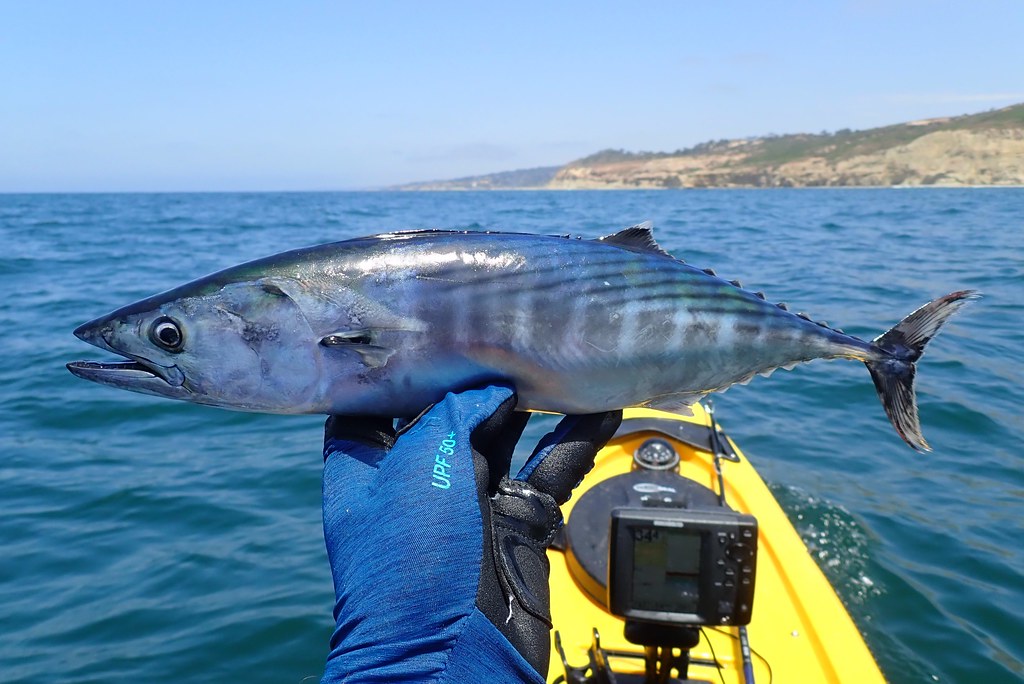
When we were fighting the wind we could barely maintain 2 mph, but as we headed towards shore we were doing close to 5 mph! Even when we turned south and no longer had the wind directly on our backs, we still had no problem maintaining 4 mph. As we cruised past Black's Beach the fish finder screen filled up with a big school of jumbo sized mackerel. I caught about 8 of them to give to one of my shark fishing friends. I also had a small bonito hit my jig, and I was happy to add it to the cooler. It's been a while since I've caught one!

Pacific Bonito (Sarda lineolata)


We weren't ready to call it a day, so we decided to fight the wind again and head back out to one of the morning spots. It was a slow grind, and once we were there we caught a few more rockfish, but we were drifting back towards shore too quickly to make it worthwhile.


Miles: 19.38
Hours: 9:51
Water Temp: 73 F

Back at the launch I was definitely more sore than Anthony. I love my paddle kayak, but I can see why almost everyone else chooses pedals. It'll be nice to do the next few sessions closer to the launch.

July 18, 2020

The next weekend I fished La Jolla again, and this time I did a good job of keeping my mileage low. Mackerel and small bonito were easy to find, but I didn't have any luck with yellowtail. As a proof of concept I also brought a bait container and chopped up some frozen mackerel and sanddabs to use as chum. I paddled north between the kelp and the canyon so I'd have more room to drift. It didn't take long for a pelagic ray to show up. After I put my camera away he tried to climb on top of the bait container and came part way out of the water!

Pelagic Stingray (Pteroplatytrygon violacea)


I'll try chumming for makos again later this summer. When I do, I'll paddle up north of the canyon so I can have several miles of uninterrupted drifting, and I'll make sure to have a good supply of mackerel to keep adding to the container.


Miles: 7.43
Hours: 5:14
Water Temp: 74 F

Next up will be a high mileage day to train for Catalina. I'll bring one rod just in case I come across some surface action, but the plan will be to focus on paddling rather than fishing.

July 25, 2020

The wind and current forecasts looked great this weekend for my first 30+ mile paddle. I launched from La Jolla Shores at 5:15 am and headed northwest, following the contour of La Jolla Canyon. Sunrise wasn't until 6 am, but there was a little bit of light in the sky.


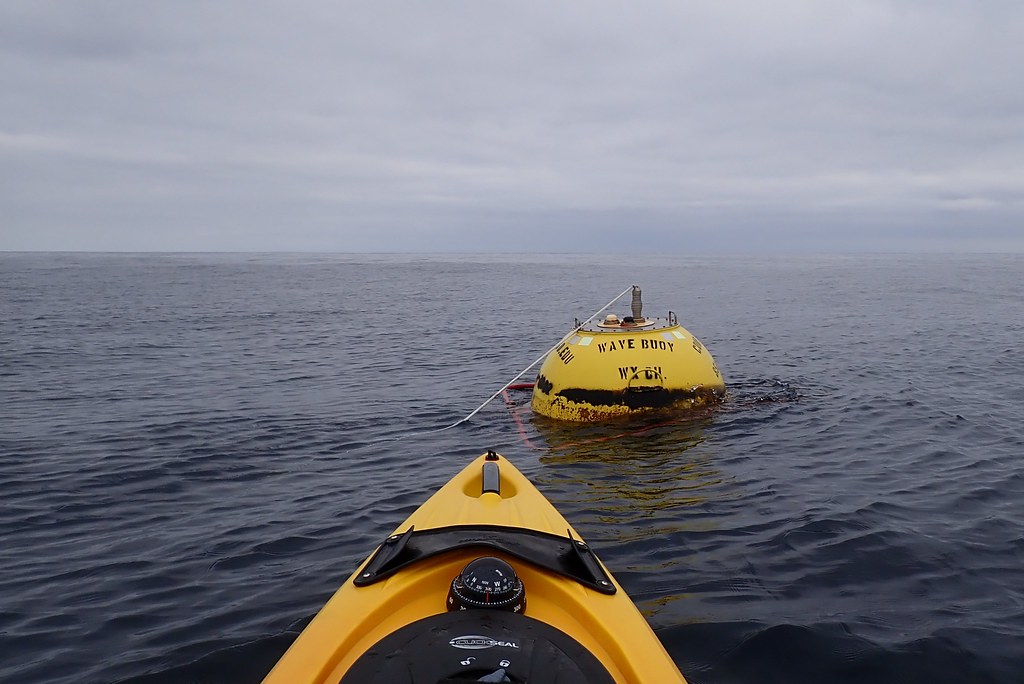
I had several waypoints stored in the fish finder to keep me on track. Around 10 miles in I passed a wave buoy anchored to the bottom. I must have been in over 2000 ft of water by that point, so the cable to the bottom was really long! 


As I went past the buoy, I put my camera below the surface of the water and snapped a few photos looking down. There was a huge school of bait fish beneath me! I had brought one rod with me in case I came across any fish during my paddle. The jig I had on was about the same size as the bait, so I spent a few minutes jigging the first 100 ft of water, but I didn't see anything follow it up.


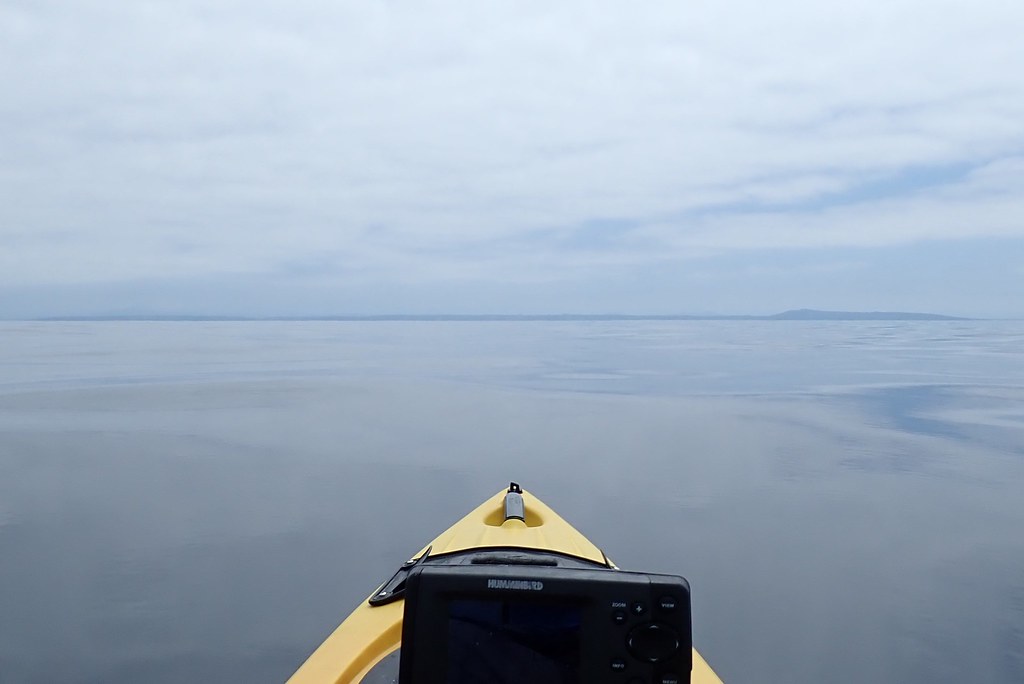
I had to fight the wind and current on the way out. As I was approaching the turnaround point, the wind finally died down, making the surface smooth as glass. It was a strange feeling knowing I was 15 miles from shore. I wouldn't say I was nervous, but I had a healthy respect for how far I was from other people.


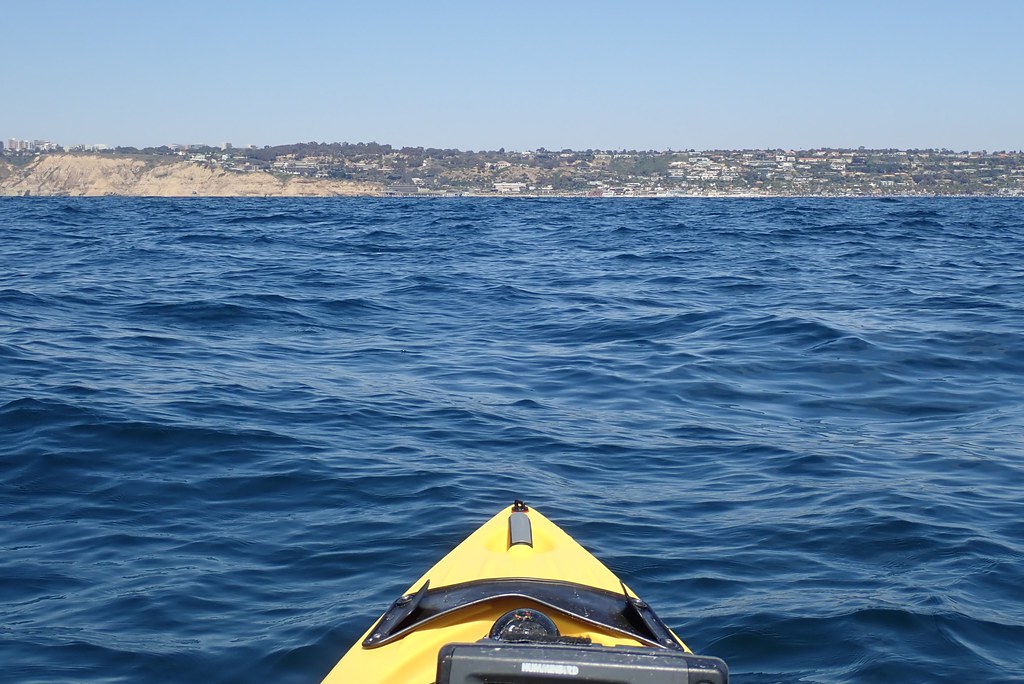
The wind picked back up during the paddle back. It was blowing due east, and the current was moving to the south. The combination of the two meant that when I stopped paddling, I would drift almost exactly towards La Jolla Shores at 1 mph. That wasn't by accident!


The paddle back was pretty uneventful. Once I passed mile 25 muscle soreness finally kicked in, and I started taking a break after each mile. Sea sickness also started to creep in, and I had to force myself to keep drinking water. These sort of things are likely to happen when I cross the Catalina channel, so its good that I experience them during my training paddles.


Miles: 31.13
Hours: 10:32
Water Temp: 69 F

The day was a resounding success. I didn't catch any fish, but I paddled farther than I ever have before. Honestly that might be the longest paddle I ever do!