Saturday, January 11, 2020

Tidepools, mussels, and searching for perch

On Friday I stopped by a much frequented tidepool spot to get some mussels for perch bait. I've heard that white seaperch are starting to show up in Oceanside Harbor, and I wanted to try for them on Saturday with the best possible bait.


With bait secured I spent the remaining daylight microfishing the tidepools. I caught the three most commons species from this spot.

Opaleye (Girella nigricans)


Rockpool / Notchbrow Blenny (Hypsoblennius gilberti)


Woolly Sculpin (Clinocottus analis)


I also saw lots of medium sized zebra chub, but they were too busy freaking out to be interested in eating anything. Usually I encounter largemouth blenny and spotted kelpfish in this area, but I didn't see either of them this time.

On Saturday my friend Emerson met me at Oceanside Harbor to look for white seaperch. We launched our kayaks from a public dock. There were some fish in the mid water column on the fish finder that turned out to be topsmelt, but I didn't see any schools of fish near the bottom. We fished pieces of mussel on small hooks, and within the first 30 minutes Emerson caught a white seaperch in about 12 ft of water near the rocky shoreline.

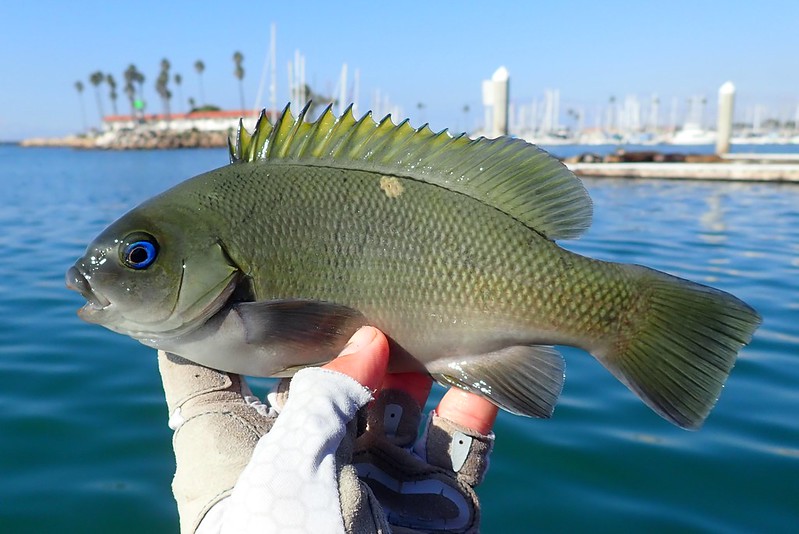
White Seaperch (Phanerodon furcatus)
Photo courtesy of Emerson Sims.

Sadly though I spent the next 6 hours trying to duplicate his success, but I couldn't get a perch of my own, and he didn't catch any others. Bycatch included garibaldi, rock wrasse, topsmelt, and opaleye.

Garibaldi (Hypsypops rubicundus) - caught incidentally and quickly released


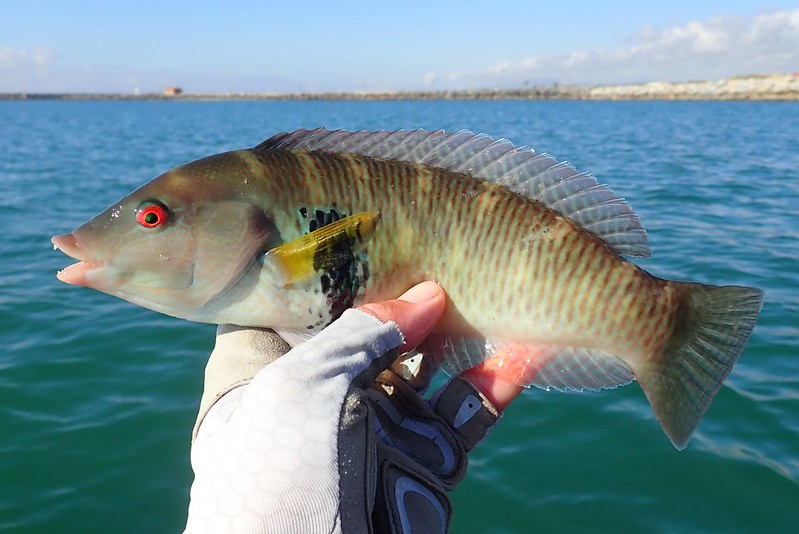
Rock Wrasse (Halichoeres semicinctus)


Topsmelt (Atherinops affinis)


Opaleye (Girella nigricans)


It was a very sunny day, so I'm wondering if the perch bite best in the early morning or when it's overcast. I think next time I try for them I'll show up before sunrise and just fish the harbor pier instead of using the kayak. It's nice to be out on the water, but it's also a lot of work dealing with all of the gear and cleanup.


Here's the Garmin screenshot and stats:


Miles: 6:02
Hours: 6:19

More blog posts to come soon!

Saturday, January 4, 2020

Kayak fishing the HMCS Yukon

Happy New Year! Rumor has it that the wrecks outside Mission Bay have pile perch, and possibly a few rubberlip perch, so I kayaked out there on Saturday to check them out. I launched from Mission Point Park shortly after sunrise.


Once on the water I started recording an activity with my Garmin watch and turned the fish finder on.


My first pin was the NOSC Tower wreck. I had it saved as 32.77191, -117.26868, but when I got to those coordinates, I couldn't find it! I circled the kayak around a few times but didn't see any signs of it on the fish finder, so I gave up and decided to move on in the interest of time. While I was entering the coordinates for the next spot into the fish finder, I let a sabiki drop to the bottom. When I pulled it back up, I found my first fish of 2020 and a new species!

Speckled Sanddab (Citharichthys stigmaeus) - new hook & line species #654


The next spot was the HMCS Yukon, which was pretty much lined up with a white rainbow in the fog. I hoped it would be a good omen.


As it turns out, the GPS coordinates for the Yukon are also off by a bit. Luckily they have red buoys marking the ship, otherwise I probably wouldn't have found it.


First fish off the Yukon was a calico bass.

Kelp / Calico Bass (Paralabrax clathratus)


When I switched to pieces of shrimp on a sabiki the bites really picked up. I was worried about snags so I fished right next to the wreck and picked up 3 ocean whitefish.

Ocean Whitefish (Caulolatilus princeps)


To avoid the whitefish I moved over what I thought was the center. Hopefully my rig wouldn't be near any of the deck railings. I had watched a few dive videos before the trip and knew there would be a lot of blacksmith, and sure enough I ended up catching 8 of them, all decent sized.

Blacksmith (Chromis punctipinnis)


Also caught 3 sheephead, and probably missed a lot more. The sabiki hooks were tiny and not really suited for their mouths.

California Sheephead (Semicossyphus pulcher)


The wind was beginning to pick up and become a problem, but my persistence finally paid off, and I pulled up a new perch species. It wasn't a pile or a rubberlip or even a white. Instead it was a sharpnose, one people occasionally catch in deeper water (200+ ft) while going for rockfish. I was stoked!

Sharpnose Seaperch (Phanerodon atripes) - new hook & line species #655


Before I paddle back I wanted to see if there were any big sheephead hanging around, and I had a couple whole shrimp to use up. I put one on a 2 oz jig and hopped it along the bottom for a bit. A sand bass picked it up, which was good enough for me.

Barred Sand Bass (Paralabrax nebulifer)


I always stay out about an hour longer than I ought to, and the paddle back was a little rough in the wind. The New Seaforth gave me a pretty big wake to punch through before I headed back into the Mission Bay channel.


Miles: 9.44
Hours: 6:23

Hope you enjoyed the report! And by the way, anyone is welcome to join when I go kayaking. Just leave a comment, and we'll make plans.

Saturday, December 28, 2019

Winter road trip to Phoenix

Between Christmas and New Years I had a few extra days, so I drove over to Phoenix to do some winter fishing with my friend Chris and his boys. It had been colder than usual in Arizona, which would likely make the fishing tough, but Chris promised I could at least add longfin dace to my list, and that was good enough for me.

I arrived Saturday afternoon, transferred my microfishing gear to Chris's truck, and we drove over to a nearby stream to fish for dace. It was a 15 minute hike from the parking lot, which was a good thing, because you should have to work a little bit for new species.


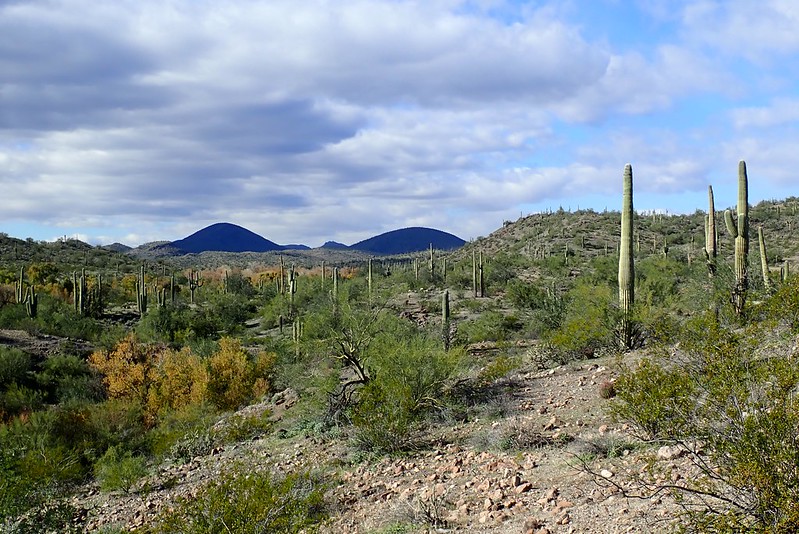
Desert streams always seem to defy their surroundings, and this one was no exception. Once we scrambled down the small canyon to the creek, it was easy to forget that we were in the middle of the desert.


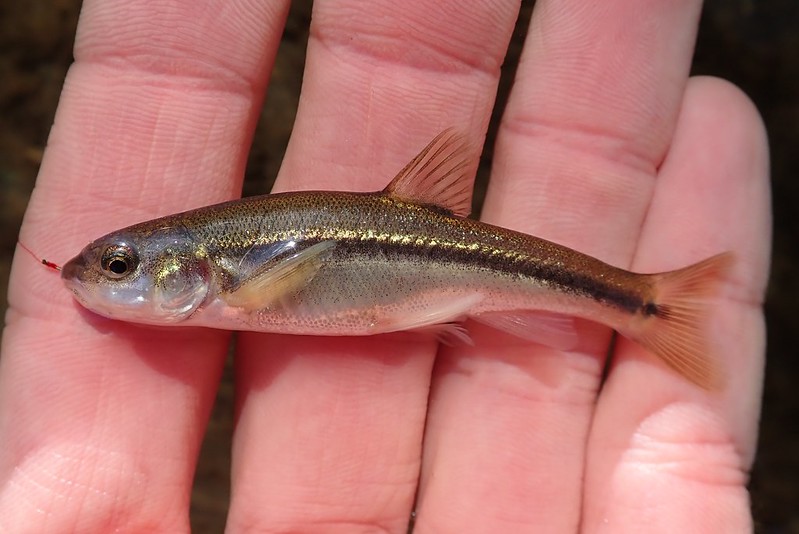
The stream was loaded with dace. They appeared equally at home in the deep slow pools and the swifter runs with undercut banks. I found a group of larger individuals, put a piece of aquatic insect on my hook, and pulled up a good looking male.

Longfin Dace (Agosia chrysogaster) - new hook & line species #652


I caught a few others that were larger, but none had a lateral stripe as distinct as the first one. At the time I assumed some of the chunkier fish were females, but looking through my photos it seems they all have traces of tubercles on their heads, so I guess that makes them all males.


A few of the longfin dace had fully developed tubercles, which meant they would be spawning soon. We also saw juvenile fish from the previous spawn.


The next morning I headed out before sunrise to spend the day on the Salt River. I had caught a Sonora sucker at this spot back in 2014, but I was looking forward to getting an updated photo of one in better light. More importantly, I hoped to have a shot at a desert sucker, which are more difficult to catch than Sonoras because they feed predominantly on algae. When I arrived at the river my car's thermometer said 27 deg. Would the fish be biting?


I spent the first few hours at the same spot I fished back in 2014. The angle of the morning light made it impossible to see into the pool, but I figured there must be suckers hanging out in the deepest part. I swapped out my bait (half a nightcrawler) every 15 minutes or so, but no one was interested.


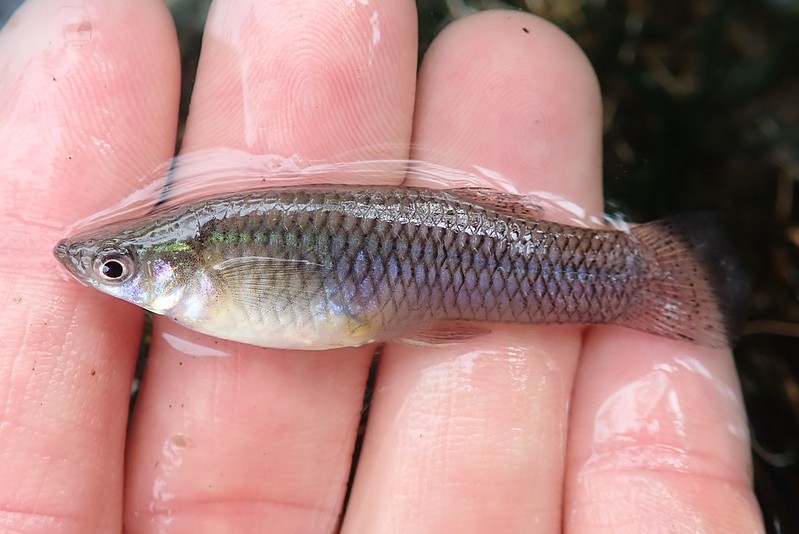
Eventually I gave up and packed up to try somewhere further upstream. As I was crossing the riffle, I spotted a small fish tucked in the strands of algae. It didn't look like something that wanted to eat, so I scooped it up with my hand. It was a sailfin molly, and it looked like it was probably not going to survive the cold.

Sailfin Molly (Poecilia latipinna)


The sun was now higher in the sky, and I was able to see clearly into the pool at the second spot. I wasn't surprised to see dozens of suckers. Most looked to be Sonoras, but a few looked more grey in color and might have been deserts.


Unfortunately, being able to see the fish didn't help me catch one. I was able to cast past a large sucker perched on the slab rock and slowly reeled in until my half a nightcrawler was brushing gently against the front of its lip. Even then, they showed no interest in eating. There were largemouth bass and common carp cruising around as well, and they also showed zero interest.


On the third day we tried to salvage the trip by having me catch a Nile tilapia or a koi. The tilapia, if it looked convincingly like a pure Nile, would be a new species, but the koi would just be a novelty for my list of angling accomplishments, since it's the same species as common carp. We looked for Nile tilapia in a body of water that's fed by a wastewater discharge and empties into the Gila River,.


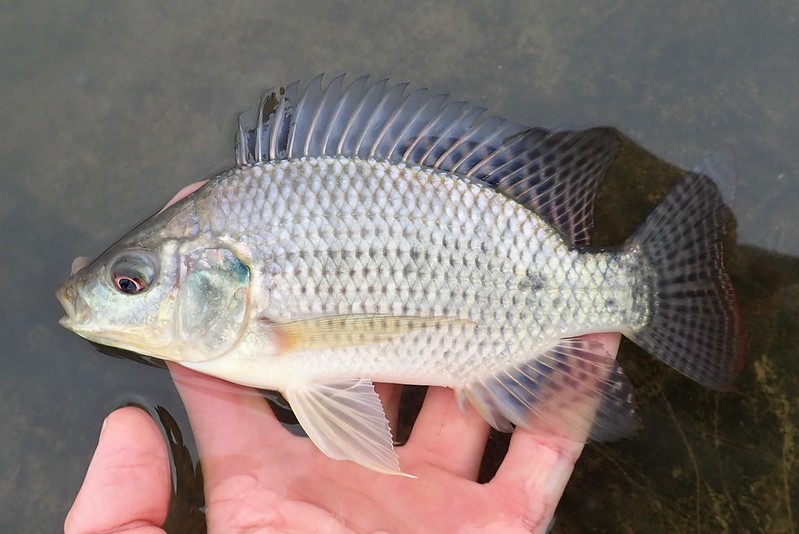
The low temperatures were still affecting the fishing, but eventually we each catch a few tilapia. The dorsal and anal fin shapes (rounded at the back) and tail markings (broken and wavy bars) suggested blue tilapia. They were likely hybrids, but they certainly couldn't be called Niles.

Blue Tilapia (Oreochromis aureus)


We also saw half a dozen large plecos hanging out on the concrete embankment. Plecos are a warm water species, so it wasn't surprising that they showed no interest in eating. Even in the warmer months they're an extremely challenging species to catch, but next time I'm in town I'd like to give it a shot.


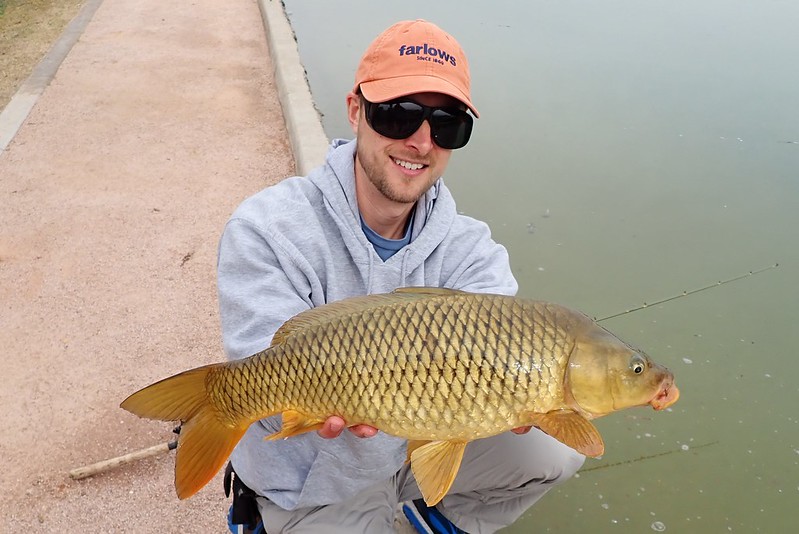
I needed to head back to San Diego soon, but we had time for one more spot, a series of urban ponds stocked with koi and common carp. We walked up to one of the lakes to find a big school of roughly twenty koi swimming about. I tossed a couple of handfuls of canned corn, and within a minute or two they were feeding. I cast a small hook baited with a few kernels of corn into the mix, and within seconds I had a fish on. Was it a bright orange koi? Nope, it was one of the few common carp!

Common Carp (Cyprinus carpio)


The school of koi scattered during the fight with the carp, so we had to move spots and start a new feed going. It took an hour or two, but eventually I had a couple of the bright orange koi feeding again. I cast out, waited a few minutes, and then once again had a nice fish on the end of the line. And it was... drum roll please... another common carp!

I'll admit this road trip wasn't the most productive in terms of new species, but it did get me excited for my next trip to Arizona this spring or summer when it's warmer. I want to try for the two native species of trout - Gila and Apache - and pick up any other natives along the way. Urban fishing in Phoenix should be able to produce a pure Nile tilapia (Chris has good info on them being stocked), plus the abundant inland silversides in Tempe Town Lake. And for good measure I really would like one of those bright orange koi!

Tuesday, December 24, 2019

San Francisco road trip with very little fishing

We decided not to fly anywhere for the holidays this year. Instead, we road tripped up to San Franciso to visit Steve and Marta. Steve has been telling me for years how seriously they take Christmas, and needless to say we weren't disappointed. If you're unfamiliar with Steve Wozniak, be sure to check out his blog: (https://1000fish.wordpress.com/). For some reason, I appear in a lot of his stories holding a cat. You'll have to ask Steve why that is.

On the drive up we stopped in Santa Clarita to check out a spot for convict cichlid I found on iNaturalist. Lifelist fishing will take you to some interesting locations, and this one happened to be a ditch behind a gas station.


The ditch fed into the Santa Clarita River, which is dry most of the year. So where does this water come from you ask? If you guessed sewage effluent from the nearby waste water treatment plant, you are correct.


The research for this spot paid off, because there were hundreds of convict cichlids here! Armed with a gas station turkey sandwich for bait, I got out my Tenkara gear. Catching a cichlid was no problem, but it took a little bit of time to find one with nice markings for a good lifelist photo.

Convict Cichlid (Amatitlania nigrofasciata) - new hook & line species #650


I was hoping to find a few more exotic releases here, but the only other fish I saw were mosquitofish. The iridescent green and purple made me wonder if it might be something else, but the rows of black spots on the tail are characteristic of mosquitofish.

Western Mosquitofish (Gambusia affinis)


Before left I stuck my camera in the sewage effluent to get some underwater photos of the cichlids. This one should give you a sense of just how many there were. (I washed my camera afterward.)


Up in the bay area we split our time between hanging out with Steve and Marta and seeing a few of the sights. Mostly we just looked at this big red bridge.


As we wandered along the coast we found a sign for a local fish, but it was one that could not be caught. No swimming, wading, or microfishing allowed in the lagoon.


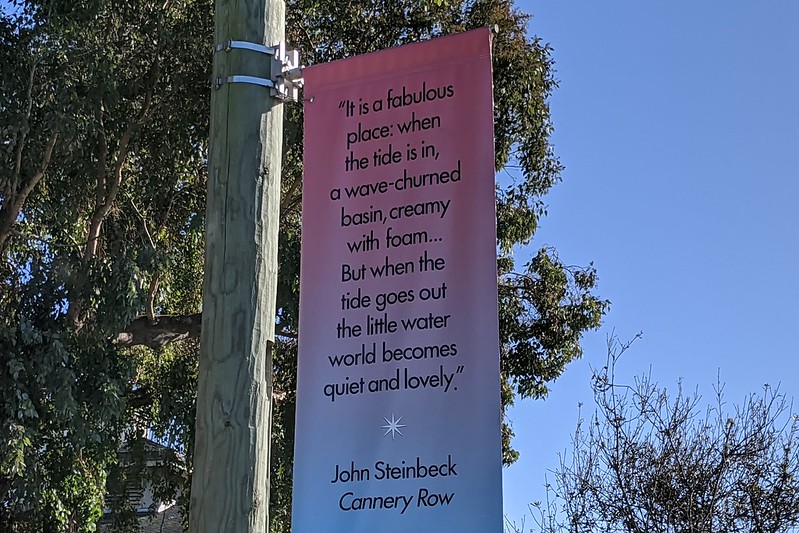
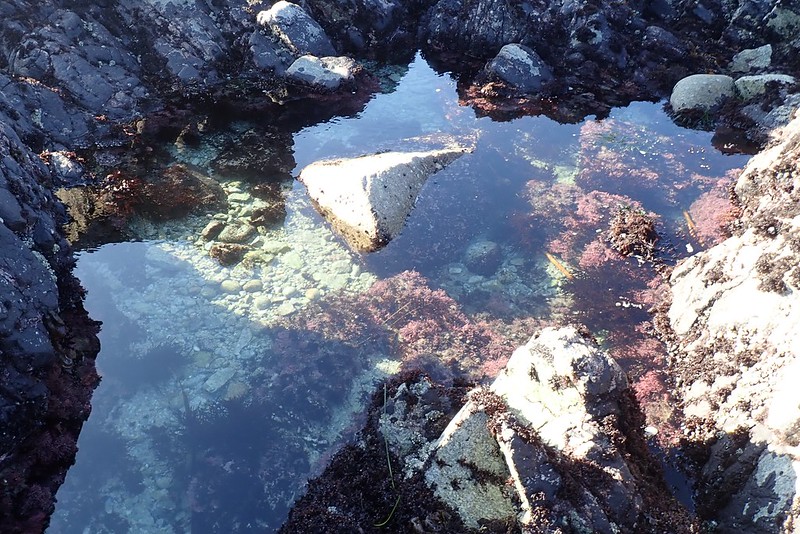
The next day we said our farewells and headed south. We stopped in Monterey and walked around the Cannery Row part of town. John Steinbeck is one of my favorite authors, and this quote seemed fitting for the tidepools we planned to visit in the afternoon.


After lunch we drove through Pebble Beach and stopped at a tidepooling spot right in time for low tide. We couldn't stay long, but it looked promising!


The tidepools here were full of life - snails, crabs, sea stars, octopodes, and of course, fish. The color theme for the vegetation in the pools was dark maroon and light pink.


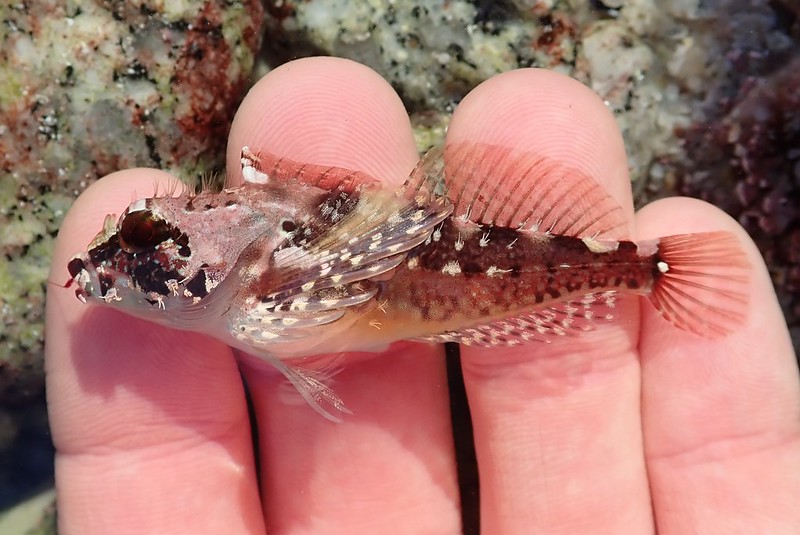
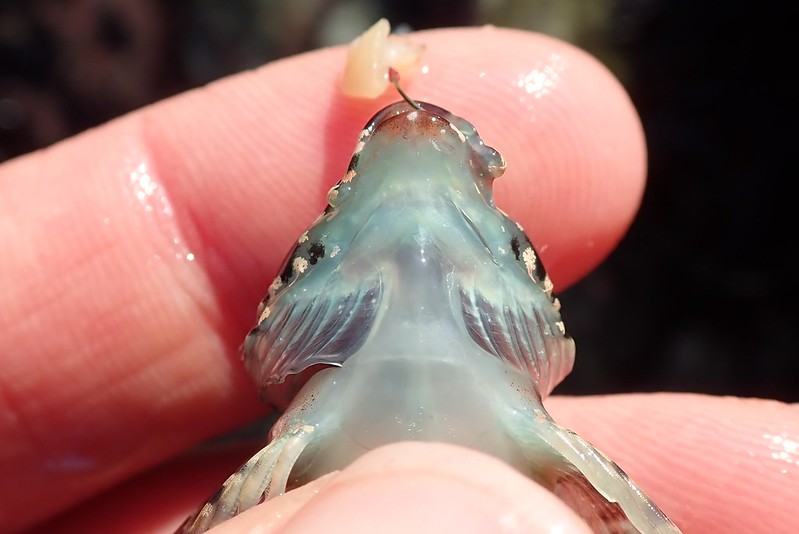
My hope was that I could find something besides woolly and tidepool sculpin. I wasn't sure what species would be most common at this spot, but I had a sinking feeling it would be tidepool sculpin, which is what I caught in northern California a year and a half ago. However, when I keyed them out back at home, I found they were rosy sculpin, a new one!

Rosy Sculpin (Oligocottus rubellio) - new hook & line species #651


View of the rosy sculpin top.


And view of the rosy sculpin bottom.


The sculpins all looked to be the same species, so I focused my last 15 minutes on trying to catch a clingfish or pricleback. Finding them was no problem, but getting them to bite was. Finally, when I ran out of time, I picked up a clingfish so I could at least get a picture.

Northern Clingfish (Gobiesox maeandricus)


I've always thought that line that looks like a big frown was the clingfish's mouth, but I learned something new when I held up this one. The real mouth is actually below it! It's hard to unsee that frowny face though, haha.


We wanted to leave the tidepools in time to see the view at Big Sur, and we made it just in time. We crossed the iconic bridge along California 1 and parked at one of the pull-offs to watch the sunset.


There's a lot of Californian coast between San Diego and San Francisco, and someday I'd really like to explore it more with time to figure out the local fishing along the way. Hopefully I'll be back soon!