Wednesday, December 18, 2019

Deep dropping 1500 feet from the kayak

The surf and wind forecast for Wednesday looked too good to pass up, so I used my last vacation day of the year to go kayaking in La Jolla. Launching on a weekday is great, because you pretty much have the beach and parking spots all to yourself.


The night before I plotted out GPS locations along the center of La Jolla Canyon, with the deepest one at 1500 feet. The wind typically picks up around 11am, so I planned to fish the deepest spot first and then work my way back towards shore. What did I expect to find at 1500 feet? Honestly I wasn't sure, but I hoped to pull up a weird species like hake, eelpout, cusk-eel, or one of the many species of flatfish that prefers deeper water.

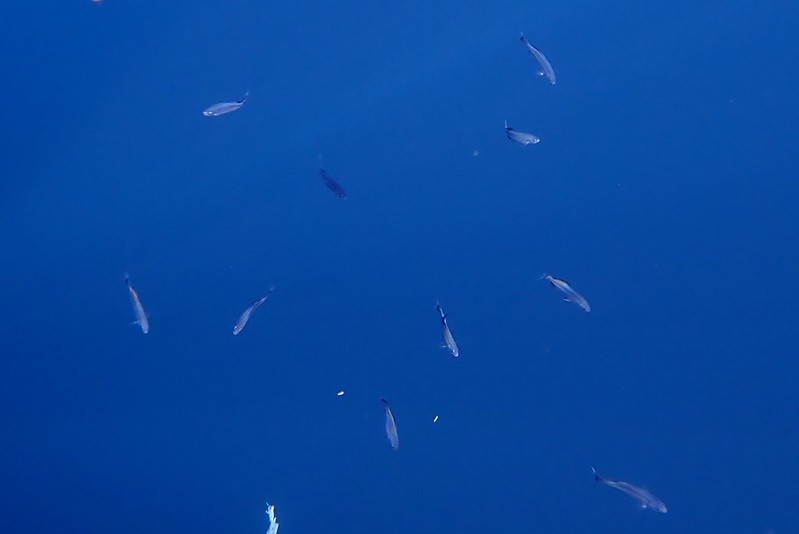
Unsurprisingly, the fish finder had trouble with depths more than about 550 feet. It didn't register the bottom at 1500 feet, but when I moved up the canyon to the next spot it briefly picked up 1325 feet, and I took a quick photo. If you look closely, you can see the bottom on the contour plot, but there was no way to see structure or fish hanging out at the bottom.


Dropping to the bottom in 1500 feet was no problem when there was no wind. I used a 28 oz torpedo sinker, 500 meters (1640 feet) of 65 lb braid main line, and a Penn Fathom 2-speed Lever Drag. My terminal tackle had four #4 circle hooks on 10 lb mono branch lines, so really not much bigger than a sabiki. I couldn't legally fish for rockfish because of the depth (and because of the four hooks), so I had a descending device ready to go in case I caught any off limits groundfish incidentally.


I swapped out fresh squid strips on every drop, but I didn't get a single bite. I also alternated between using and not using a deep drop strobe light. I know lights are important for catching large predators like grouper, but I wasn't sure if they'd attract the smaller less aggressive species that I was going for.

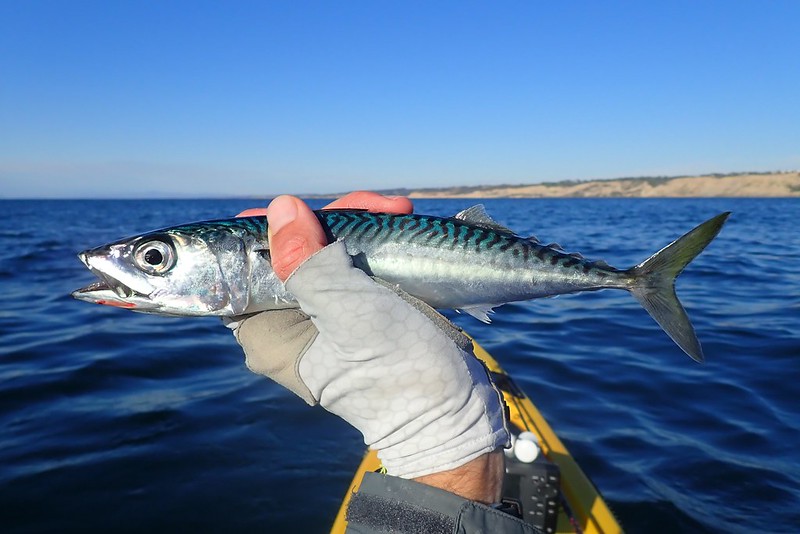
My one fish of the day was a mackerel that grabbed one of the baits in the top 30 feet of water.

Pacific Chub Mackerel (Scomber japonicus)

The wind picked up right on cue and put a stop to the fishing. The paddle back was kind of rough. I was coming back at a 30 degree angle to the waves, and the bigger waves would push my bow to the left, while the wind wanted to push my bow to the right. The wind was more of an issue, and I pretty much paddled the entire way back using only my right side. I think I'll have to invest in a rudder if I'm going to keep doing these long distance paddles. This was my longest paddle to date, and I felt it!


Miles: 12.70
Hours: 7:32

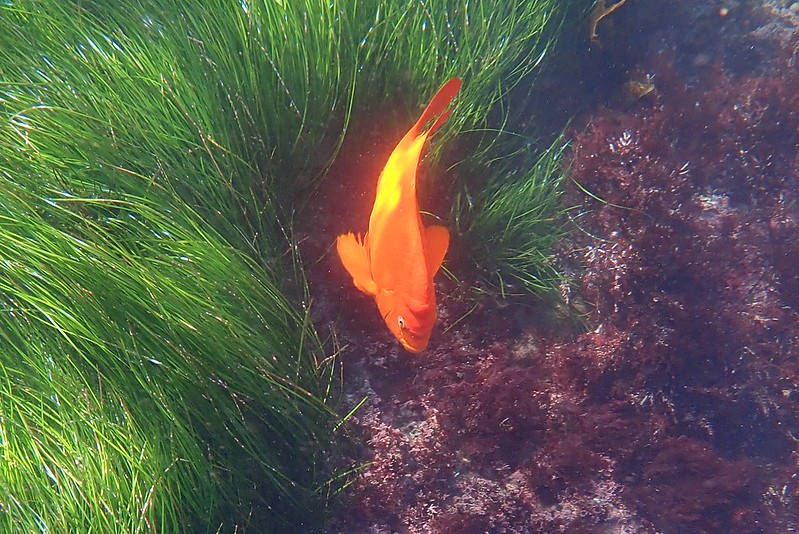
I try to keep my blog posts heavy on the fish content, so to make up for the lack of fish in the actual report, here's a few photos I took underwater with my camera on a non-fishing kayak trip in the La Jolla marine reserve a few weeks ago.

Zebra Chub (Kyphosus azureus)
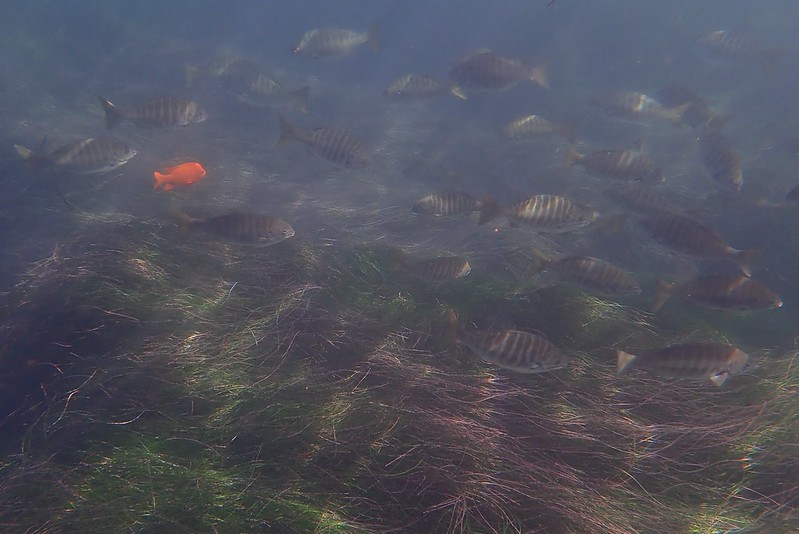


Garibaldi (Hypsypops rubicundus)

Here are the stats for that trip.


Miles: 4.37
Hours: 3:00

And don't worry, I won't give up on deep dropping in La Jolla Canyon! Those weird fish are down there, so it's just a matter of finding them. One of my redeeming qualities is stubbornness, so I'll keep trying until I figure it out.

Safety Extra:


If you kayak in the ocean, make sure to practice capsizing and self rescuing! After paddling in the marine reserve I did three intentional capsizes before coming in to land. The water was surprisingly cold, and by the third re-entry I wanted nothing more than to be on land, dry, and warm. When I got home I ordered a pair of neoprene wetsuit bottoms to wear during the cold months.

Thursday, December 12, 2019

And finally a San Diego horn shark!

Horn sharks are really cool fish, and they have eluded me. They're in San Diego Bay, Mission Bay, tucked in rocks and reefs offshore, and in the surf at night. They're everywhere around San Diego, but I haven't been able to find one to call my own. This year I made catching one a priority.

I started my earnest search for a horn shark in August when Steve was in town for a visit. We had a good location in Mission Bay from my friend Josh. In fact, I had fished with him there on several occasions, and nearly every time someone in the group caught a horn shark.


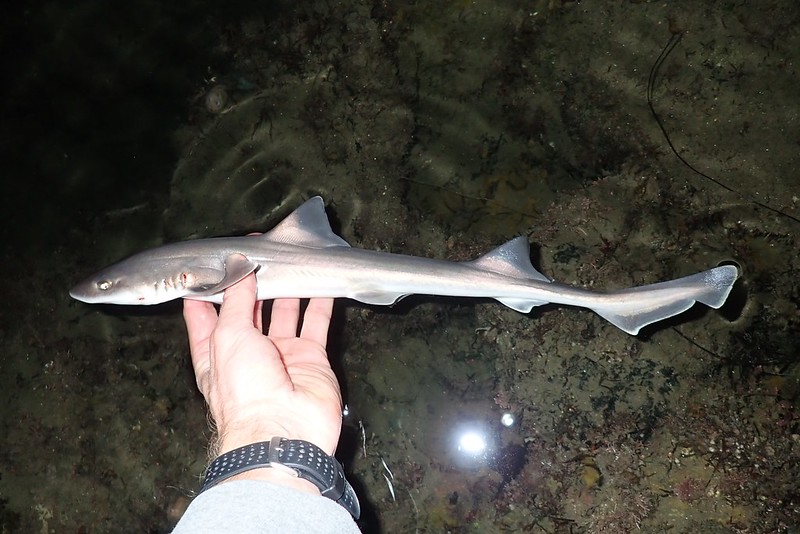
We got our baits out after sunset, casting far enough out to clear the eel grass beds. The rest of the night was a waiting game. I've become used to out-of-town visitors catching species that I still need - while standing right next to me - so I wasn't surprised when Steve pulled in a horn shark in the first 30 mins. I got a hit as well, but it was a small guitarfish.

Shovelnose Guitarfish (Rhinobatos productus)


After that it was bite after bite, but none materialized into a horn shark for me. Mostly it was smoothhounds and round rays, but a decent butterfly helped round out the catch.

Gray Smoothhound (Mustelus californicus)


Haller's Round Ray (Urobatis halleri)


California Butterfly Ray (Gymnura marmorata)


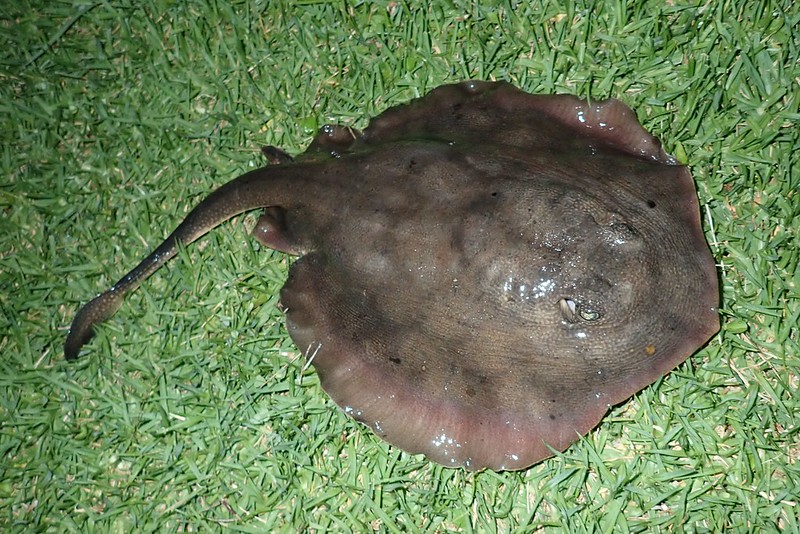
The night was getting late, and we were ready for that one last fish before calling it. Right on cue something bent my rod over hard. We assumed it would be a bat ray, the surf tractor of the sea, but when got it to shore we saw that it was a big diamond ray! I forgot all about horn sharks as we scrambled up the rocks to do a photo shoot. Afterward, Steve and I agreed that the night went well with him getting the shark and me getting the ray, since he already had the ray from a past trip to Mexico.

Diamond Stingray (Dasyatis dipterura) - new hook & line species #644

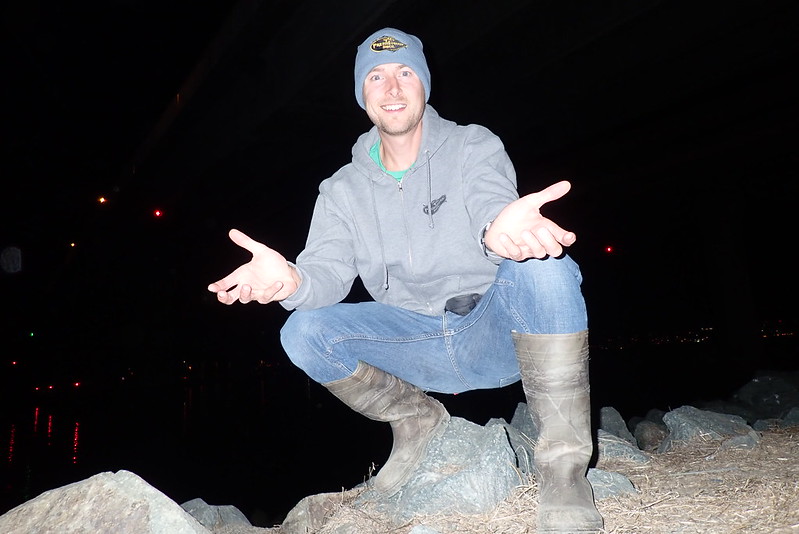
I managed to avoid thinking about horn sharks in September, but in October I was back at it again. The water was still warm from the summer, but it would be dropping soon. I'll admit that I started to become superstitious about the person next to me always catching the horn shark, so I went by myself to eliminate that possibility. It has been a while since I used the auto timer on my camera, so I took some practice shots. Just imagine a beautiful big horn shark in my hands!


It turned out to be an extremely slow night, with the only catches being a couple of smoothhounds and one extremely small guitarfish. It beat wearing the stripe, but it's too bad one of them couldn't have been a little horn shark instead.

Gray Smoothhound (Mustelus californicus)


Shovelnose Guitarfish (Rhinobatos productus)


This was the smallest guitarfish I've seen, and one thing that stuck out to me was the sharp scutes along it's back, similar to the "thorns" on a thornback. It makes sense that the juveniles need a little extra protection, but I wonder why they don't just keep them as adults. Guitarfish really don't have any defense other than their camouflage.

My next horn shark attempt was in November, and this time Josh and my running friend Ryan joined me. It was another slow night. We were definitely into fall, and the water temps were dropping. I caught a couple of round rays, and Josh caught a small diamond ray with two barbs on its tail. Can you guess what Ryan caught? That's right, a great big horn shark. Unfortunately it unhooked itself in the water as I was trying to grab it, so we didn't get a photo. It was a tough way to end the night.

Haller's Round Ray (Urobatis halleri)


Diamond Stingray (Dasyatis dipterura)


Finally it was December, my last chance of catching a horn shark in 2019. I invited two of the researchers I had recently met from Scripps, Jimjohn and Zach, to join me. Zach was interested in having a live horn shark to use in one of his research projects, but I think mostly the two of them came out to enjoy a nice evening outside. After all, my track record of catching horn sharks was pretty dismal.

This was the slowest night yet for this location. Not even the round rays or smoothhounds would show up. The hours ticked by, and I was feeling defeated. But then... my rod tip bounced a little, I felt something small on the other end, and I reeled in the fish I had been looking for, a San Diego horn shark. Mission accomplished.

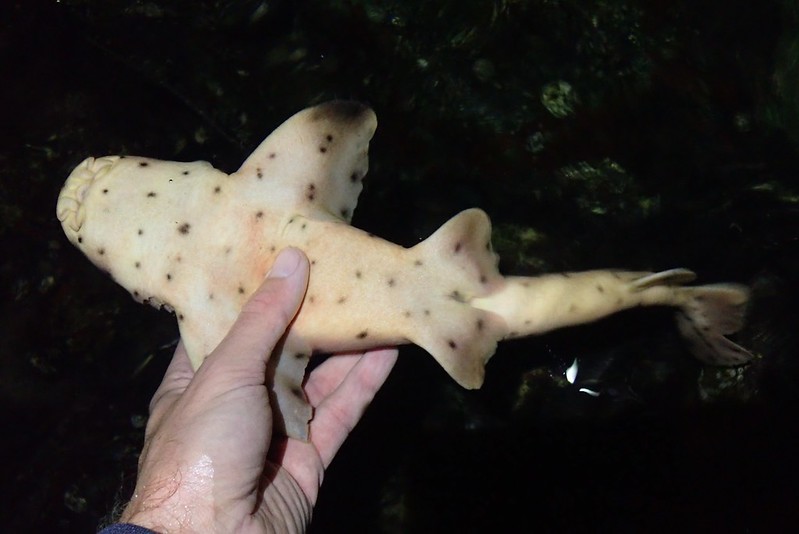
Horn Shark (Heterodontus francisci) - new hook & line species #649


I was so happy about this catch that I took a photo of it from every angle. It was covered in cute little black spots, and you can see the horns at the base of it's two dorsal fins.


It's belly and fins were also covered in the same black spots. Adorable!


From above it's head looks like a little dinosaur. A really cute dinosaur.


But then things get weird when you take a look at it's mouth. It's like a cute little pig somehow crossed with a cute little wood chipper.


I've run out of things to say about this fish, but here's a view of it's mouth from below. Pig crossed with wood chipper crossed with cute alien. It's impossible not to love it.


I held the shark in the water while Zach jogged back to his car to get his bucket and aerator. We were lucky it was such a small specimen, because a larger one probably wouldn't have fit. I packed up my fishing gear, and the little lady (it was a female horn shark) headed off to Scripps.


I've considered horn shark to be my nemesis for so long, now that I've caught one I'm not sure what should take it's place. Midshipman, cabezon, and staghorn sculpin come to mind. I'll have to give it some more thought and officially declare a nemesis for 2020. Stay tuned!

Monday, November 25, 2019

Long paddle for La Jolla rockfish

Yesterday I launched from La Jolla to check out a seamount I found using Google Maps. The surf at La Jolla Shores was low, but I didn't realize how high the tide would be! The water was actually pushing up onto the street. It was chilly too, as you can see from my car dash.


I met up with a guy Esteban who wanted to give deep water rockfishing a try. We were the only two people who launched at sunrise, probably due to the high tide. I had a waypoint marked about 4 miles from shore where it looked like there would be good structure. Along the way we stopped for a break and caught some whitefish.

Ocean Whitefish (Caulolatilus princeps)


It was really cool to see the bottom change from flat and featureless to a rocky seamount when we reached the waypoint. It pays to do your homework! I dropped a 4 oz megabait tipped with squid to the bottom and almost immediately hooked up with my first starry rockfish of the year. Esteban got a starry on his first drop as well.

Starry Rockfish (Sebastes constellatus)


My primary target was a squarespot rockfish for my lifelist, so I switched to dropper loops with smaller sized hooks. Starry rockfish were by far the most common catch of the day, but there was plenty of variety mixed in.

Flag Rockfish (Sebastes rubrivinctus)


Blue Rockfish (Sebastes mystinus)


Rosy Rockfish (Sebastes rosaceus)


California Scorpionfish (Scorpaena guttata)


California Sheephead (Semicossyphus pulcher)


After a few hours Esteban wanted to fish the kelp closer to shore, so he took off while I stuck it out at my spot. I'm sure we'll cross paths again!


The spot I was fishing was between 200 and 250 ft deep, which is the depth that I've always seen other people catch squarespots, so I knew they had to be down there. And sure enough, one eventually turned up.

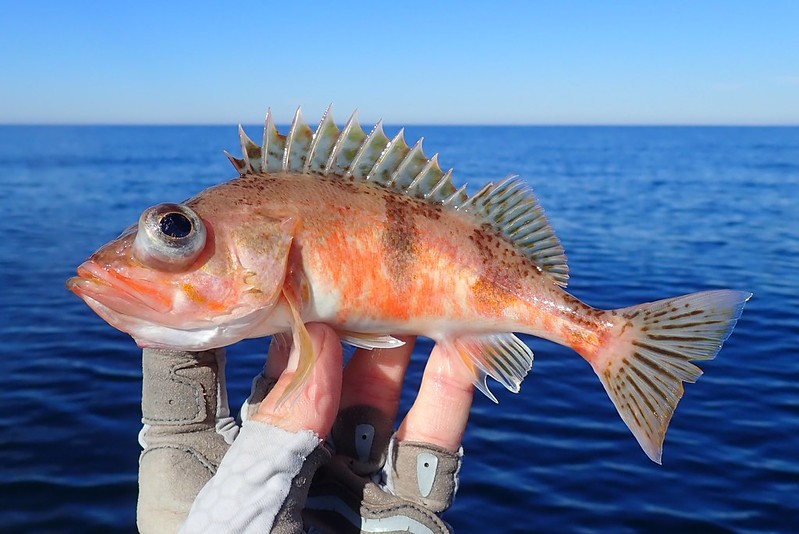
Squarespot Rockfish (Sebastes hopkinsi) - new hook & line species #648


After that a school of halfbanded rockfish and chub mackerel moved in and wouldn't leave my bait alone, so I put away the dropper loops. You can only catch so many of these guys before they drive you crazy.

Halfbanded Rockfish (Sebastes semicinctus)


Pacific Chub Mackerel (Scomber japonicus)


I wanted one more good fish to cap off the day, so I dropped the megabait again. I thought I had drifted off the structure, so I reeled up a couple cranks and stuck the rod in one of the kayak's rod holders. I pulled out my phone to check the location when the kayak suddenly lurched sideways! Fish on! It was a big vermilion, worthy of using the net on. It measured 4.5 lbs on my fish gripper.

Vermilion Rockfish (Sebastes miniatus)
 

A lot of the rockfish were spitting up these strange spongy sacks, and I had no idea what they could be. I posted this photo on Instagram, and someone from Scripps chimed in that they're pyrosomes,, which are "free-floating colonial tunicates". What I do know is rockfish like to eat them!


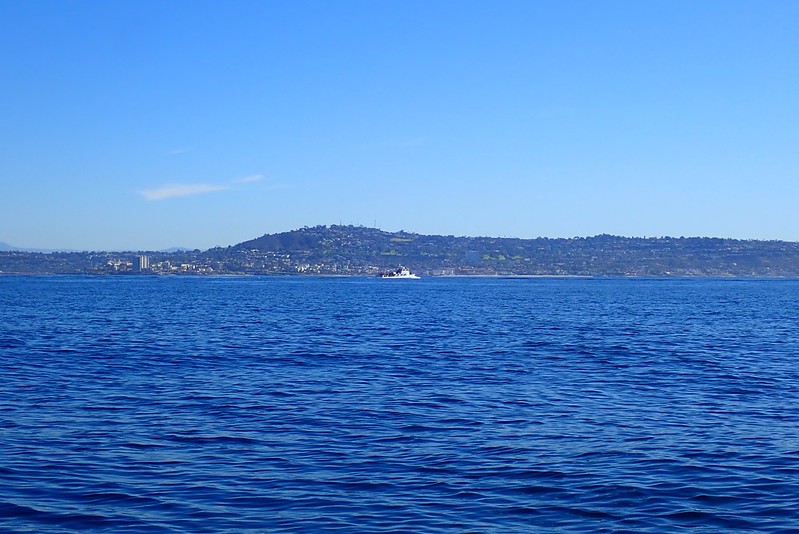
As I paddled back in I saw one of the sport boats heading back towards Mission Bay. I've done a few half day rockfish trips, usually when friends are visiting from out of town, but I'm immensely grateful that I can fish for rockfish now without being crammed on the deck of one of those boats. I won't take what I have for granted.


The screenshot from my Garmin app shows exactly where I was fishing, and I'm fine with that. Next time I head out I'll probably be checking out something new. So if anyone is able to find some fish because of the information I share on this blog, it's perfectly fine with me!


Miles: 11.10
Hours: 7:27

The depth limit for rockfish recently increased from 360 feet to 450 feet, so I think on my next trip I'd like to try the bottom 400+ feet down in La Jolla Canyon. It'll actually be a much shorter paddle from the launch compared to what I've been doing. Hopefully there's some weird stuff down there!

Monday, November 4, 2019

Long paddle for La Jolla sanddabs

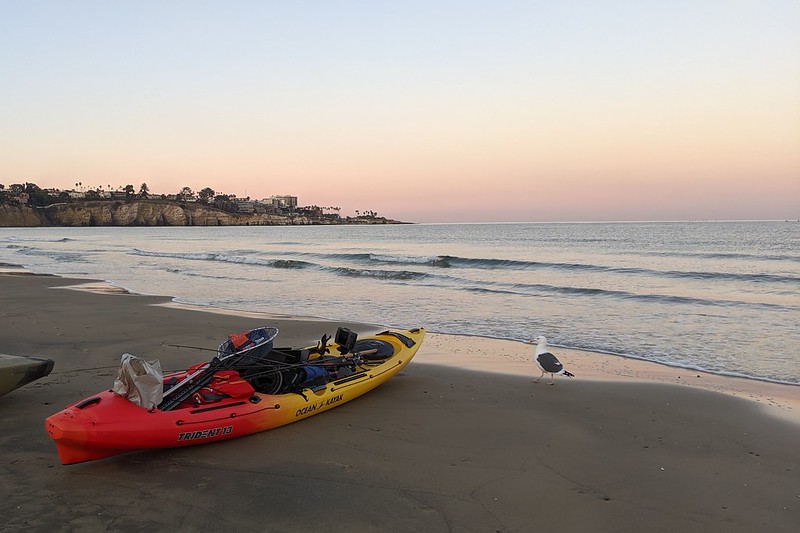
Yesterday I did a solo kayak trip in La Jolla. Parking was tough because I showed up later than most, but unloading gear without a headlamp was nice. The surf was less than a foot, which made for a super easy launch.


I finally figured out how to turn on contour lines on my fish finder, which meant I could actually plan out where I wanted to go. My plan was to bottom fish in 300 ft to try for a squarespot rockfish for my lifelist, so I set a waypoint a few miles out and started paddling.


Unsurprisingly, the bottom there didn't have any structure, but the day was more of a proof of concept than anything, so I dropped pieces of squid down to see if I could pull something up. Right away I had savage little bites, and I started pulling up sanddabs. The first one was a longfin, which is a new species for me! (And yes he was missing an eye.)

Longfin Sanddab (Citharichthys xanthostigma) - new hook & line species #647


The sanddabs were coming up two at a time, and this photo shows my deepest kayak catch at 312 feet.

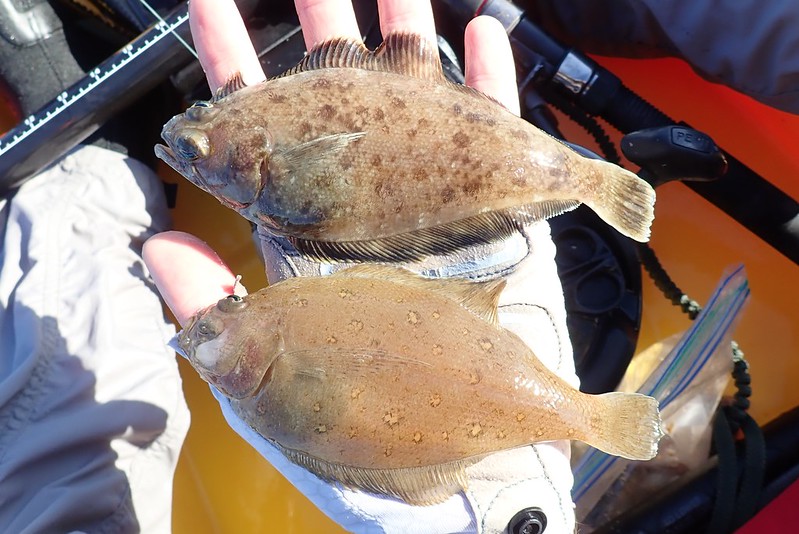
The majority of the sanddabs were Pacifics, but on one of the drops I caught both species, so I was able to do a side-by-side photo. The length of the pectoral fin is the obvious ID characteristic, but there are other differences as well. Sometimes the pectoral fin can be frayed and shorter than it ought to be, so scale size (and therefor lateral line scale count) is another way to quickly tell the two apart.


I caught a few Pacifics that were big enough to keep and stashed them in a walmart bag in the shade. They came home with me and were delicious.

Pacific Sanddab (Citharichthys sordidus)


While I was sanddab fishing I had some juvenile fish use my kayak for shelter. I'm pretty sure they were halfmoons. They ate little bits of squid that I dropped over the side. Perhaps I should bring microfishing gear whenever I kayak in case something weird shows up?


Mixed in with the sanddabs were a few small rockfish, but none of them were squarespots. Here's a halfbanded and a blue.

Halfbanded Rockfish (Sebastes semicinctus)


Blue Rockfish (Sebastes mystinus)


For the remainder of the day I paddled over to the 100 feet deep area near the kelp where other boats typically fish. Along the way I had a genuine shot at a mako that was finning at the surface, but I tangled up my lines and missed my chance. In the shallow(er) water I caught other species including copper rockfish, gopher rockfish, kelp rockfish, California scorpionfish, ocean whitefish, and Pacific chub mackerel.

Copper Rockfish (Sebastes caurinus)


Ocean Whitefish (Caulolatilus princeps)


My last fish of the day was this gopher rockfish that ate both of my baits.

Gopher Rockfish (Sebastes carnatus)


Here's the the route for the day from my Garmin app. The sanddab spot is in the upper left, and the end of the day was below where it says La Jolla Tide Pools.


Miles: 10.09
Hours: 6:51

This trip was more of a skills building session than anything, but I'm quite happy that I picked up a new species! Next time I'd like to focus on finding structure in deeper water so I can catch some decent fish that aren't sanddabs.