Sunday, November 7, 2021

Maryland fall 2021 - part 2

We arrived in Annapolis in the afternoon, driving past the Naval Academy on the way to our fishing spot. I didn't realize how much the people of Maryland love crabs, but now I know.

Photo credit Ally Toth.

We poked around a public dock and a concrete seawall, hoping for blennies or gobies or maybe a spot croaker. Fishing was slow though, and we were ready to give up and move on to another spot. I left my bait sitting on the bottom a few feet out from the seawall, and when I checked my line I discovered a tiny funny-looking fish holding on to my worm! I don't even think the hook point had penetrated his mouth, but that doesn't matter. Skilletfish was my 800th species!

Skilletfish (Gobiesox strumosus) - new hook & line species #800


Thanks Ally for capturing this momentous occasion.


Photo credit Ally Toth.

We had time to try another saltwater spot. We parked a half mile from the water and hiked down to a jetty and small beach that looked promising.


We fished the rock jetty for blennies and other micros, but the only two species we could find were mummichog and Atlantic silverside. Both were very aggressive. I had no problem hooking them with a #14 hook and a large piece of worm.

Mummichog (Fundulus heteroclitus)


Atlantic Silverside (Menidia menidia)


The sun was getting low in the sky, but we kept fishing the jetty because the habitat looked perfect for blennies. I felt a fish bite when I dropped my bait between two boulders, but then I realized my hook was stuck. I pulled up on my rod, and when it came free there was another skilletfish on the end!

Skilletfish (Gobiesox strumosus)


Despite the low light, I was able to get some good photos in a calm pool of water behind the jetty.


One of the coolest things about skilletfish, or any clingfish for that matter, is that their suction cup is composed of several fins that have fused together. Their ability to cling to rocks or your hand is pretty impressive. 


Ally had something take her bait twice, but she was using presnelled tanago hooks, which unfortunately weren't strong enough to pull skilletfish out of the rocks. I gave her my rod that had 4 pound line, but she wasn't able to find another skilletfish before we needed to leave. We'll find them again someday!


The following morning we had time to check out a creek that had sampling data for rosyside dace. It was a small slow-moving stream in an urban park and again was easy to access.


We found fish in a small pool. Most of them were blacknose dace, but Ally was the first to notice that a few of them were rosyside dace. We each caught one, which made for a good end to the trip.

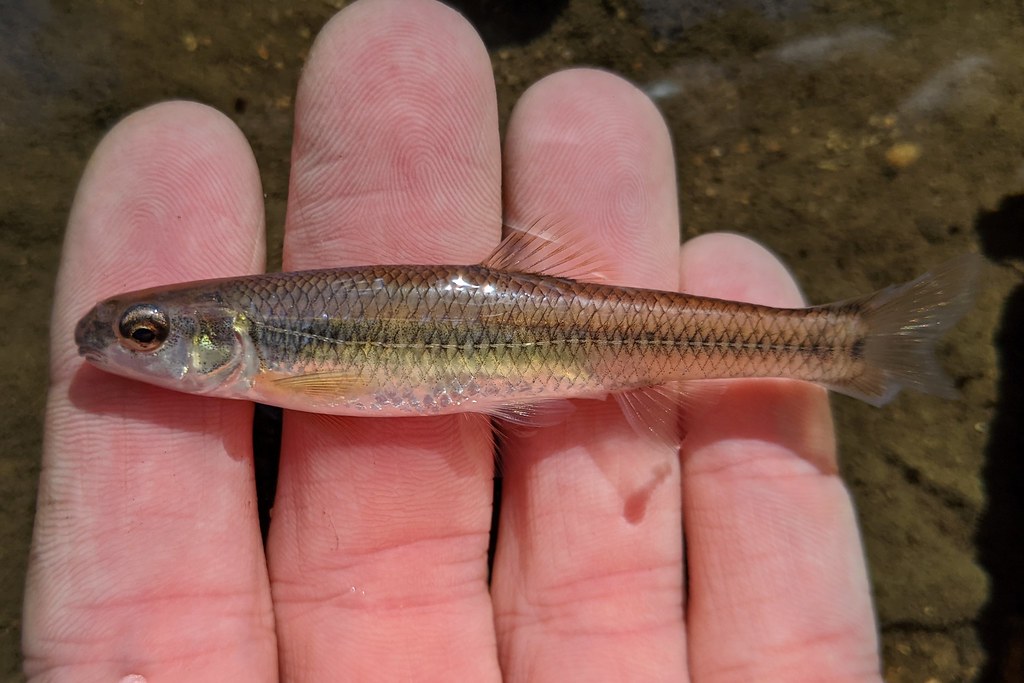
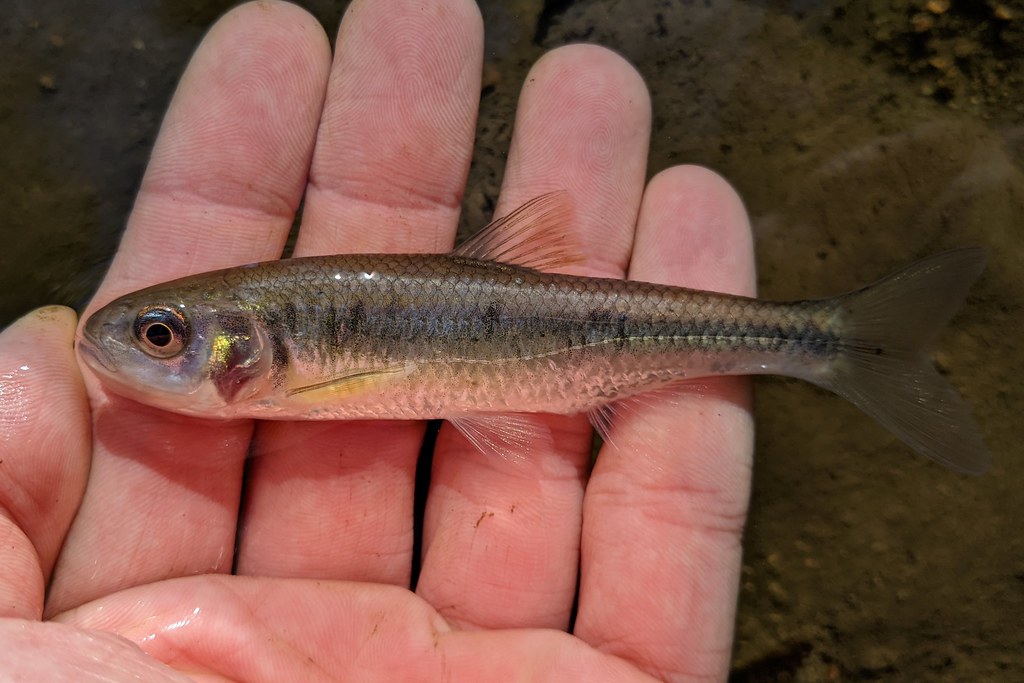
Eastern Blacknose Dace (Rhinichthys atratulus)


Rosyside Dace (Clinostomus funduloides)


Ally caught around six new species, and I caught three. We were both very happy with how we did, especially considering how cold it was. We'd like to go back to that area (not necessarily Marlyand though) to look for saltwater fish like striped blenny, skilletfish for Ally, gobies, and flounders.


Now back to Florida where it's 80 degrees!

Saturday, November 6, 2021

Maryland fall 2021 - part 1

It may be warm and sunny in Florida, but the rest of the country has been cooling off. Ally and I recently traveled up to Maryland for a three day weekend, and before we left we had to dig in our closets to find our winter coats to survive the frigid temps. Seeing the fall colors more than made up for the chilly weather.


We knew fishing would be tough, and most of the species wouldn't be colorful, but we picked out a few targets and made a plan to target them. First up was the Blue Ridge sculpin for both of us and a decent list of minnows for Ally. We fished a medium sized stream in the mountains and quickly caught a few different minnow species.

Bluntnose Minnow (Pimephales notatus)


Common Shiner (Luxilus cornutus)


I switched gears to focus on sculpin, but I wasn't seeing any among the rocks. However, I did find a well camouflaged northern hogsucker tucked under a rock and pointed it out to Ally. She put a piece of worm in front of its mouth, and a few minutes later I saw her dashing up the bank with the fish in hand.


I moved upstream to the next riffle and continued poking around for sculpin. This time I had no trouble finding them. After two failed hooksets I finally got a big sculpin to take my bait and get him to hand. The unnotched caudal peduncle bar confirmed that it was a Blue Ridge!

Blue Ridge Sculpin (Cottus caeruleomentum) - new hook & line species #798


The chin pigmentation and median chin pores also support the ID, but because there is significant variation within the species, I think as a hobbyist you ultimately have to use location as the most important evidence for separating Blue ridge from mottled sculpin.


Ally captured my fish-in-hand-in-water photography technique, which is also the reason why my lower back is sore whenever we go microfishing.


Photo credit Ally Toth.

We promised ourselves we wouldn't spend all our free time in Maryland fishing, so after we caught all the easy species in the creek we went for a trail run in the mountains. The views from the overlooks were pretty good.


The next morning we fished an urban stream that had fallfish for me and tessellated darter and another handful of minnows for Ally. It was an easy stream to access, and right away we saw fish.


We started off catching small minnows. Ally caught a satinfin shiner, and I caught a few creek chubs. We didn't see any fallfish or tessellated darters though.

Creek Chub (Semotilus atromaculatus)


We worked our way upstream until we found a run with good flow and more rocks. We spotted a few darters and got to work fishing for them.


It didn't take long for each of us to catch a tessellated darter, and we also picked up swallowtail shiner. Neither was a new species for me, but both were much needed photo upgrades for my lifelist album.

Tesselated Darter (Etheostoma olmstedi)


Swallowtail Shiner (Notropis procne)


I scouted further upstream and found a deep pool with a fallen tree providing cover at one end. It had a few big chubs in it, so I tied on a larger #14 hook and put on half a worm. I dropped it in the shadow of the fallen tree, and a bigger chub dashed out and grabbed it. My first fallfish!

Fallfish (Semotilus corporalis) - new hook & line species #799


With one more species to go to reach 800, we headed towards the coast to fish saltwater...

Saturday, October 30, 2021

North Florida road trip 2021 - part 2

On the third day of our North Florida road trip we ventured into the Osceola National Forest. This area is primarily pine forests with an abundance of tannic water ditches. Our targets were mud sunfish and banded sunfish, for both of us, and bluespotted sunfish for Ally.


I had some new hooks from TenkaraBum called Akita Kitsune that I wanted to try out, and they ended up being perfect for small sunfish. Their shape is similar to New Half Moon tanago hooks, but they're larger and have stronger snelled line. It was a cold morning, but as the sun came up the fish slowly started biting. My first two catches were bluespotted sunfish, and after that I caught several mud sunfish, a flier, and a nice warmouth. Ally caught the same except for the bluespotted sunfish. We were very excited to finally add mud sunfish to our lists! They're a cool fish.

Bluespotted Sunfish (Enneacanthus gloriosus)


Mud Sunfish (Acantharchus pomotis) - new hook & line species #794


Flier (Centrarchus macropterus)


Warmouth (Lepomis gulosus)


We had another spot marked for banded sunfish, so after a few hours we drove further into the forest to give it a try. I honestly enjoyed the fact that we lost our phone signals. It feels good to get off the beaten path from time to time! Several of the locals stopped to see what we were doing. An older gentleman in a beat-up pickup truck was excited to show us the spot on his chest where he recently had a catheter removed after he beat cancer. We were happy for him.


This spot had plenty of flier, but we explored a little further down the road and found a small pocket of open water surrounded by vegetation. It looked promising, and much to our delight we each caught a banded sunfish there. Now all we're missing from the Enneacanthus genus is blackbanded sunfish!

Banded Sunfish (Enneacanthus obesus) - new hook & line species #795


We spent more time than we planned fishing the first two spots, so we had to skip a couple of boat ramps to the west and head straight to our last stop of the day, St. Mark's Lighthouse. It's a very fishy looking area with easy access to saltwater, freshwater, and everything in between.


We started off fishing the lagoon next to the parking lot, which had nice clear water. It was full of sheepshead minnows and gulf killifish. The male pupfish had bright iridescent blue marking on their heads, which I was able to just barely capture in the photo below. The gulf killifish were the largest we've ever seen. The one I caught was easily half a pound!

Sheepshead Minnow (Cyprinodon variegatus)


Gulf Killifish (Fundulus grandis)

Photo credit Ally Toth.

I saw one longnose killifish mixed in with the other fish, but I lost track of it before I could get a bait in the water. Striped killifish, their close relative, like being in pure saltwater, so I suggested that we walk over to the Gulf and try the shallow sand flats. The wind was pretty strong.


Small schools of killifish were swimming around in a few inches of water. They were indeed our target, longnose killifish, and we each caught a few of them.

Longnose Killifish (Fundulus similis) - new hook & line species #796


I like to use a plastic tub to put our catches in when it would be difficult to photograph them in their natural habitat. We learned a hard lesson while we were catching the sheepshead minnows and gulf killifish - the local birds like to eat them! We made sure to keep the lid on the tub when we caught the longnose killifish. No more free snacks!


We spent the night in Perry and then drove home on the fourth day. We had a few extra hours to fish, so we stopped at the boat ramp on the Santa Fe River to try again for madtoms. We had seen a few of them on the second day, but we didn't give them our full attention. This time we didn't bother trying for Suwannee bass or spotted bullhead and focused exclusively on madtoms.


Photo credit Ally Toth.

Madtoms can be very frustrating. I found a few of them, but they usually swam off until I couldn't keep track of them. Finally I found one that stayed in its hiding spot and immediately grabbed a bait when I put it in front of it. The two possibilities were tadpole madtom and speckled madtom, and I was very glad to see that it was the latter. My sixth new species of the trip!

Speckled Madtom (Noturus leptacanthus) - new hook & line species #797


Ally was able to hook a couple of madtoms, but both of them fell off before she could get them to hand. It was a painful way to end the trip, but sometimes that's how fishing goes. We'll be back in the spring when its warmer and the water is still low. The Santa Fe still has a half dozen or more species for us to work on. We can't wait to go back!

Friday, October 29, 2021

North Florida road trip 2021 - part 1

At the end of October Ally and I got around to doing a proper Florida road trip. We planned to drive to Gainesville, fish the Santa Fe River, continue on to the Osceola National Forest, and then finish up by heading west to the Gulf of Mexico. We left on a Thursday afternoon, and unfortunately we only made it a few hours before getting a flat tire that required a patch.

Photo credit Ally Toth.

The next day we fished several spots along the Santa Fe River, starting at a public boat ramp that several other species anglers have visited. It was cool and cloudy, and we hoped that the cold front that arrived the day before hadn't turned off the fishing.


Microfishing produced two species, ironcolor shiner and Westfalls darter. I looked for ironcolor shiner many years ago in Illinois, where they are quite rare, so it was nice to finally catch one. The Westfalls darter was the last species on my list that I've caught but still needed a photo of.

Ironcolor Shiner (Notropis chalybaeus) - new hook & line species #792


Westfalls Darter (Percina westfalli)


We saw a few madtoms, but weren't able to catch them. Likewise we didn't have any luck with Suwannee bass or spotted bullhead. Our next spot was supposed to be good for the latter two species, so we moved there and fished some larger baits.


Again we didn't have any luck with Suwanee bass or spotted bullhead, but I was able to get some nice photo upgrades for a couple other species. The size of the Seminole killifish really blew me away!

Redbreast Sunfish (Lepomis auritus)


Spotted Sunfish (Lepomis punctatus)


Seminole Killifish (Fundulus seminolis)


Ally did some more microfishing, and she excitedly showed me a darter she caught. It was certainly not a Westfalls; it was a brown darter! She gave me a few pointers on how to find them (hidden in the green vegetation), and a few minutes later I caught one as well.

Brown Darter (Etheostoma edwini) - new hook & line species #793


We had hoped to snorkel a spring for hogchokers, inspired by a video made by our friend Hunter, but it was closed due to damages from flooding earlier in the summer. We didn't have much daylight left, so we picked the next closest access to the river to fish for an hour. After throwing a few lures for bass, I got out my snorkeling gear so I could see what we were missing.


Photo credit Ally Toth.

I saw a lot of largemouth bass and miscellaneous sunfish, but there was still no sign of Suwannee bass. What I did find were a ton of juvenile hogchokers. Adult hogchokers have tiny mouths, and these juveniles had mouths so small that even a tanago hook looked too big for them.

Hogchoker (Trinectes maculatus)


I tried bopping the hogchokers on their faces with a tiny bit of worm on a tanago hook, but eventually I gave up and caught a few by hand. Next year we'll have to come back in the spring and look for adults when they come up the river to spawn. I don't think these tiny juveniles are catchable by hook & line.


Photo credit Ally Toth.

There were a lot of shiners at this spot, but they looked the same as the ironcolors from the first spot. However, after studying my photos more closely, I'm pretty sure the ones from this spot were coastal shiners. Their dorsal and pelvic fins are positioned differently, and their black stripes are not as black as ironcolors.

Coastal Shiner (Notropis petersoni)


We wrapped up the day by driving up to Lake City to get dinner and spend the night.