Happy fourth of July! Ally and I spent the weekend checking out new spots and trying out different ways of fishing. On Saturday we drove down to Stuart to try out the snorkel gear we picked up at a local dive shop. It was a hot day, and the water looked good.

Photo credit Ally Toth.
It felt good to get in the water, but the visibility ended up being pretty poor. There was some sort of brown algae making it difficult to see more than a few feet. Every now and then we found a patch of clear water, but within a few minutes the brown algae would move in. We swam out a ways looking for fish, but we didn't find any until we came back towards shore. Everything was in 2 feet of water or less! We saw assorted damselfish, including a possible new one, juvenile grunts, slippery dicks, silver porgies, hairy blennies, and molly millers. Most exciting of all was a big school of sand drum, which look almost identical to yellowfin croakers in the Pacific.
Sand Drum (Umbrina coroides)
We tried snorkel fishing with tanago hooks for a while, but the silver porgies and sand drum were too tempting, so we switched to regular spinning gear. I pointed out the school of drum to Ally, she flipped a bait out to them, and almost instantly she had one on and caught her lifer.

I expected to get one just as easily, but I shouldn't have been so confident! Despite having the school just 5 feet in front of me, I couldn't get a sand drum to find my bait. I did catch some nice silver porgies though. This species is similar to spottail pinfish, and I've held off on adding it to my list in the past, but I'm feeling confident with this one. I looked back at my old photos, and I think I probably caught silver porgy all the way back in 2013. Ah well.
Silver Porgy (Diplodus argenteus) - new hook & line species #746

It might not be a 100% foolproof ID trait, but in general the spot on silver porgies is a nice round circle and does not form a saddle. Spottail pinfishes have more variation, but instead of a spot they have a blotch that forms a saddle over the caudal peduncle.

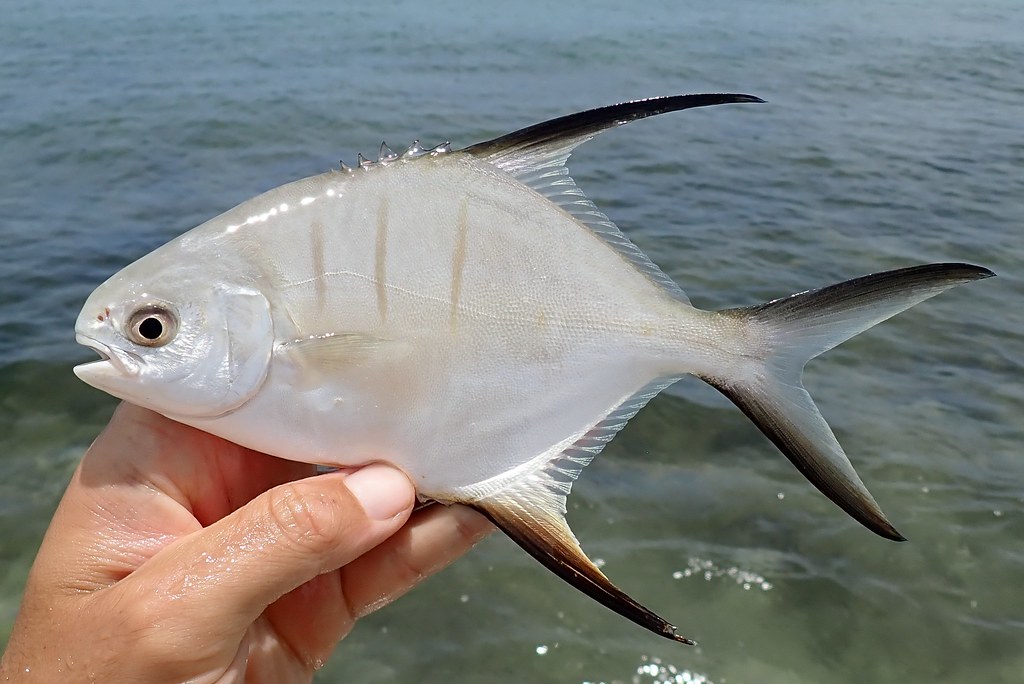
My next not-a-sand-drum was even more exciting. I flipped my bait out, something grabbed it, and whatever it was actually ran fairly hard. I saw black and silver and was excited to see that it was my lifer palometa!
Palometa (Trachinotus goodei) - new hook & line species #747
The tide was coming in, the school of drum scattered, and some dark clouds appeared to the north. It was last call, so I decided to get back in the water before we had to pack up. We had seen several nurse sharks when we were fishing, and it didn't take long for me to find one tucked in the rocks. I also saw a green tail which had to belong to a moray. We'll definitely be back to see what else is there.
Nurse Shark (Ginglymostoma cirratum)

On Sunday we celebrated Independence Day by getting out on the water. We wanted to try a new kayak spot, so we drove down to Fort Pierce to check out some artificial reefs with publicly available GPS pins. We'd finally get more than a mile from shore, but it wouldn't get deeper than 35 feet.

Photo credit Ally Toth.
Getting down to the beach was easier than up near Sebastian. We picked a launch that we thought would be quiet, and it was, but we should have expected that it would be packed with people when we came back to land in the afternoon. The swells were less than a foot.

We paddled out to where the 15 foot reef drops off to a sandy 20 foot bottom and stopped to fish for live bait. I had rigged my kayak anchor with a bright red float, and this was a good opportunity to try it out. It worked great... until it was time to pull it up. The anchor got stuck between some rocks, and I had to abandon it. We paddled out to the first pin, which was an artificial reef made up of concrete culverts. We quickly caught some Atlantic bumpers and sent them back down as live bait. They didn't get any interest though, so when I caught a pinfish I swapped it in.
Pinfish (Lagodon rhomboides)

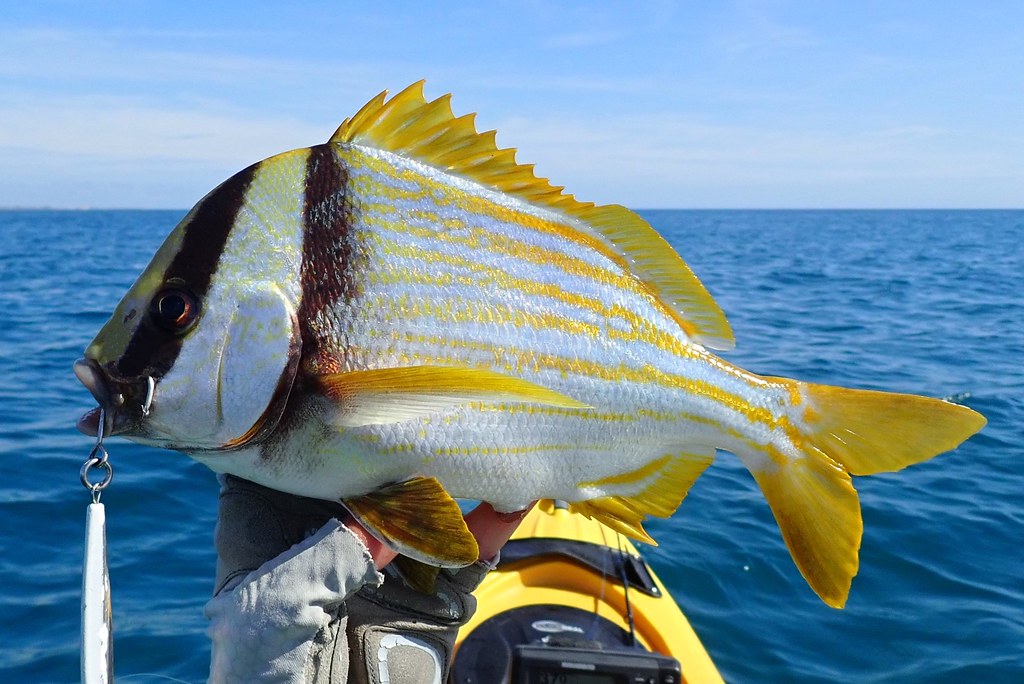
The pinfish didn't attract attention either, so I started bottom fishing with a 2 oz jig tipped with shrimp. It got a little more action. First up was the biggest porkfish I've ever seen, then a white grunt that came home for dinner, and finally a surprisingly strong smooth puffer. The puffer actually pulled drag on my spinning reel.
Porkfish (Anisotremus virginicus)
Smooth Puffer (Lagocephalus laevigatus)

We paddled to the next pin, but I couldn't find the reef on my fish finder. I paddled around the mark in circles looking for structure on the bottom, but it looked like bare sand down there. That was disappointing, but it only got worse when we couldn't find the next two reefs. The numbers must be off, because I don't think a bunch of concrete rubble up and moved. I caught a blue runner to troll as live bait, and we headed back towards the shallow reef.
I ended up trolling or drifting with the blue runner for at least two hours, and nothing went for it. Either the predators weren't around, or they weren't biting. We were getting tired, so we finished the day by sabiki-ing the reef. I caught a southern puffer, slippery dicks, blackear wrasse, a sand perch, and two damselfish that I identified as cocoa damselfish. They're a pain to ID, but at least I feel confident that it's one I haven't caught before.
Sand Perch (Diplectrum formosum)

Cocoa Damselfish (Stegastes variabilis) - new hook & line species #748

The wind picked up as it always does in the afternoon, so we packed away our gear and looked for a place to land. Before we did that though, I wanted to try to get my anchor one more time. I paddled back to where I left it, pulled with all my might, was ready to cut the rope, but then it was magically unstuck. I'm glad it came home with me.

Miles: 8.4
Hours: 5:26
Water Temp: 82 F
Landing was easy, but we had to do it about a 100 yards north of the trail to the parking lot. Ally and I agreed that we had a good time, but we weren't really successful in what we set out to do. We fished live bait almost the entire day, didn't have any bites, and we only found one of the four reefs we planned to fish. Next time we'll do better!