Monday, January 27, 2020

Gerry visits San Diego - January 2020 edition

My friend Gerry was in town for a visit this past weekend, and we did a tour of San Diego to add a few species to his list. On Friday we went to the Ocean Beach tidepools to collect mussels for bait and look for rockpool blennies. Gerry already had the other usual suspects (opaleye, zebra chub, woolly sculpin, and spotted kelpfish). I knew of one small pool in particular that was likely to have blennies, and sure enough Gerry caught one out of it almost immediately.

Photo courtesy of Gerry Hansell.

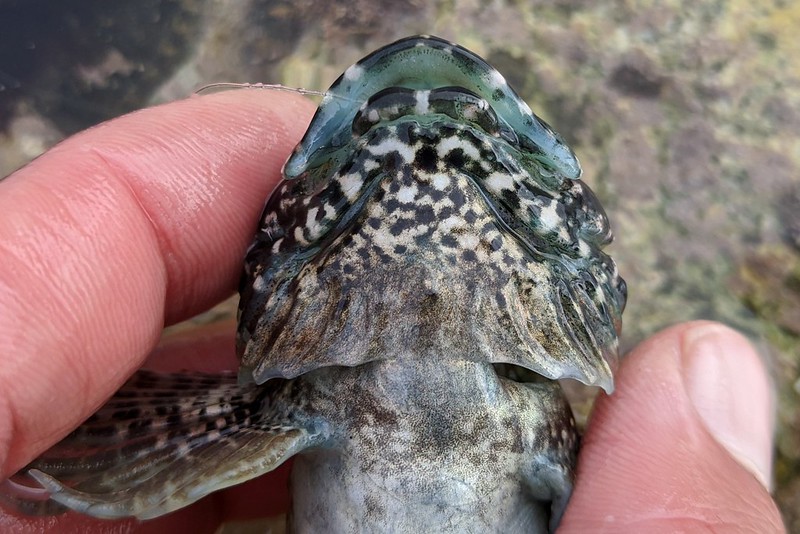
I fished a few of the pools as well and caught woolly sculpin and rockpool blenny. One of the sculpin was especially large with nice spawning colors.

Woolly Sculpin (Clinocottus analis)


The mouth and throat of these big spawning sculpin are pretty cool. Big turquoise mouths must be sexy in the sculpin world.


We moved over to Mission Bay to pump ghost shrimp and look for cheekspot gobies with the hour or two of remaining daylight. One of the local fishing legends from the sdfish message board, Coach (Werfless), happened to be there as well. We swapped fishing stories for a bit before he headed over to the Mission Bay jetty to fish.

Gerry was the first to find a few gobies out in the open, and despite their small size they were savage biters. Gerry caught one first and then left me some room to find one for myself. At first I tried dropping my bait down into ghost shrimp burrows, and I actually did have success pulling a small goby out of one of them, but he wasn't actually hooked. When I switched to the gobies out in the open I was able to get one right away. We assumed they were cheekspot gobies, but back at home we checked my fish books and came up with shadow goby instead. Either way it was a new species!

American Shadow Goby (Quietula y-cauda) - new hook & line species #656


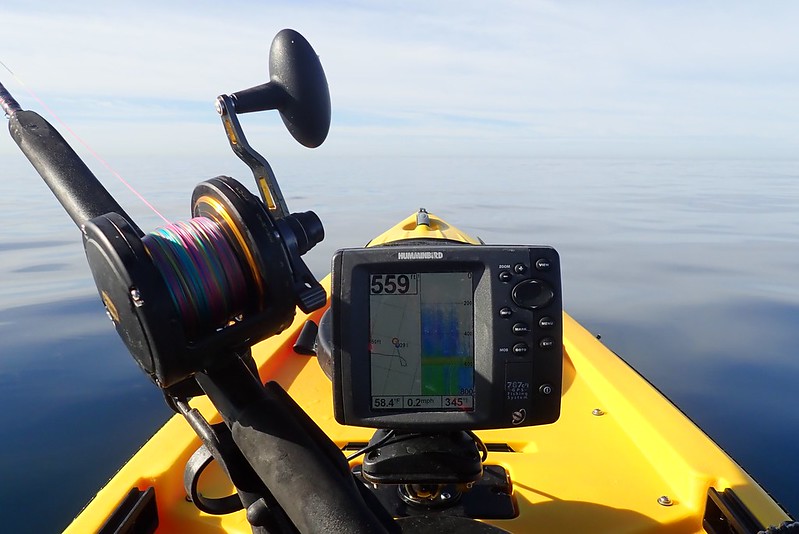
On Saturday we headed back down to Mission Bay, this time with kayaks. My friend Kam lent us his old Ocean Kayak Scupper Pro, and I put Gerry in my Ocean Kayak Trident 13. Gerry gifted me his old fish finder a few years ago, so I was happy to give him a chance to use it again.


Our plan was to duplicate my success fishing the wreck of the HMCS Yukon, so we made the long haul out to its GPS pin. It was an odd day with high swell but not too much wind, and despite being a little unnerved by the swell we made it out without issue. The bites came right away, and Gerry added ocean whitefish to his list, and I caught a few as well.

Ocean Whitefish (Caulolatilus princeps)


Unfortunately, from then on it was blacksmith, blacksmith, and more blacksmith. I was really hoping we'd find some perch - sharpnose seaperch for Gerry and pile or rubberlip perch for either of us. However, there was an army of blacksmith ready to intercept our offerings.

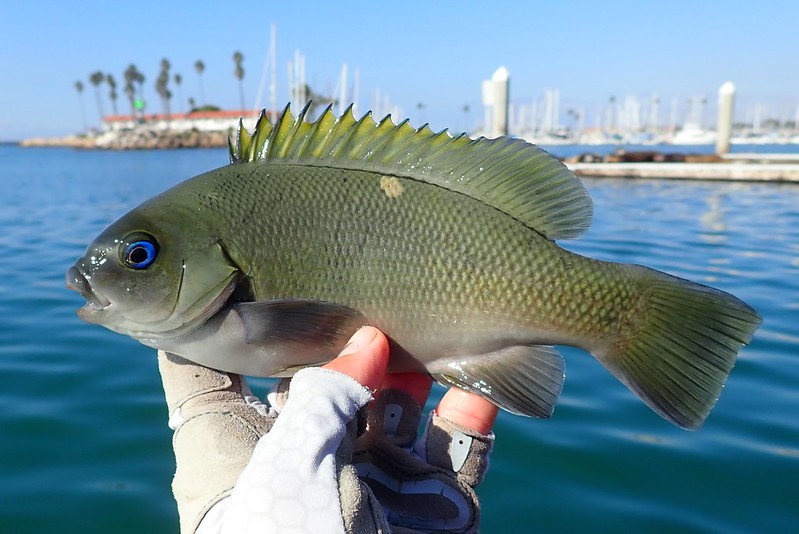
Blacksmith (Chromis punctipinnis)
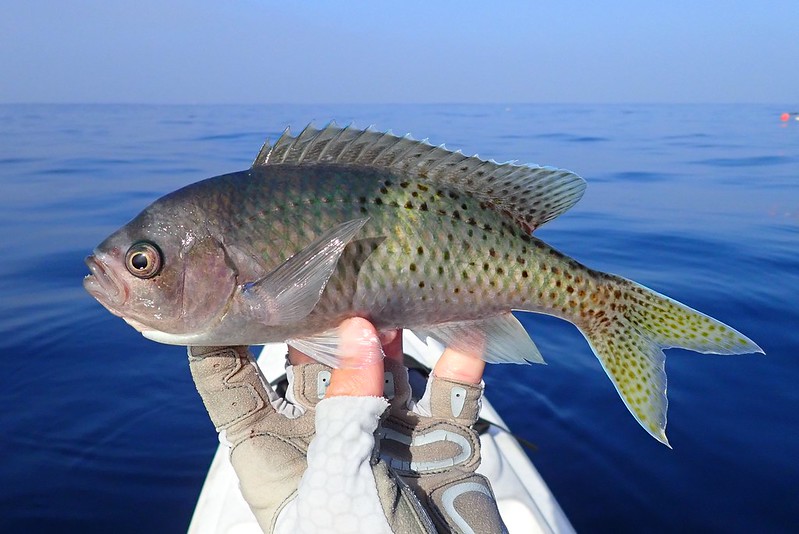

At one point I thought I had a nice fish on, but it turned out to be six blacksmith on the six hooks of my sabiki, most of which had been unbaited. I found it funny that I had to work pretty hard to catch my first blacksmith two years ago, and now they were lining up to jump on my hook.


The paddle back got a little scary as we entered the Mission Bay channel. The swell had picked up, with some of the waves going straight down the channel and others reflecting off the jetty walls at various angles. We gritted our teeth and kept paddling with short fast strokes to prevent any of the waves from turning or rolling us. To make the situation more bizarre, there was an outrigger race going on at the same time. Once we were finally in the clear I hung back to get a photo of Gerry surrounded by the racers (they were significantly faster than us).


Our route looked pretty similar to my previous trip to the Yukon.


Miles: 8.83
Hours: 5:08

On Sunday we took the kayaks down to Mission Bay again, but this time we stayed inside the bay. We had plenty of good bait - ghost shrimp and live mussels - and we hoped to find a mixed bag of species like croakers, wrasse, and maybe those elusive perch. Unsurprisingly we caught mostly juvenile sand bass, but Gerry was able to add a couple new ones including rock wrasse and garibaldi.

Kelp Bass (Paralabrax clathratus)


Barred Sand Bass (Paralabrax nebulifer)


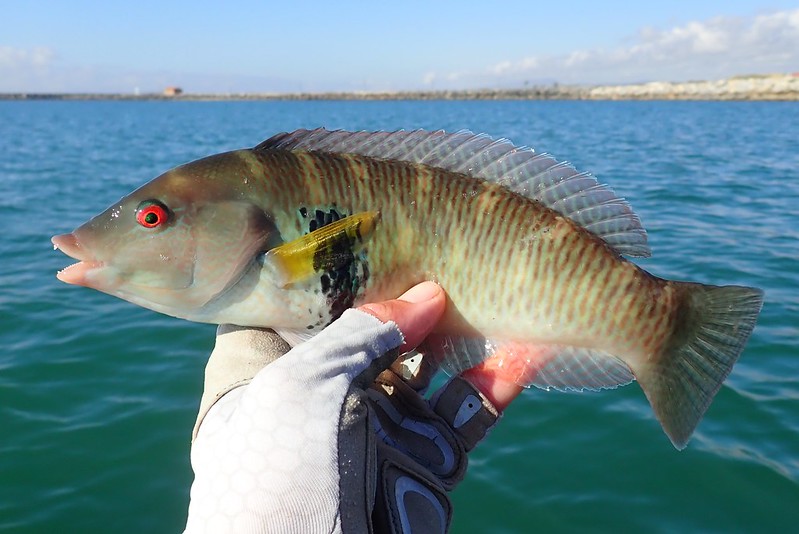
Rock Wrasse (Halichoeres semicinctus)


We also paddled over to check out the bait barge to see if there were any predators hanging around, but there was nothing going on. The sea lions were majestic as usual, surrounded by their court of birds.


Overall, kayaking didn't end up being as productive as we had hoped, but we had to remind ourselves that it was January, and fishing does tend to slow down in winter.


Miles: 3.04
Hours: 3:06

I'd heard a few rumors that there might be midshipman and staghorn sculpin in the San Diego River channel, so we headed over to check it out once the kayak gear was stowed. We ran into another sdfish member, Brandon (Cyborgstarfish), who was there looking for bass. He said the midshipmans might be there, but we'd have to go through a lot of bass to find one.

We got our baits in the water right around high tide. We did catch a few bass, but the most common fish ended up being diamond turbot, and all of them were good sized. We caught four of them in about an hour of fishing.

Diamond Turbot (Hypsopsetta guttulata)


Flatfish are bizarre. I usually forget to get a photo of the blind side of sanddabs, but for some reason with turbots I always remember.


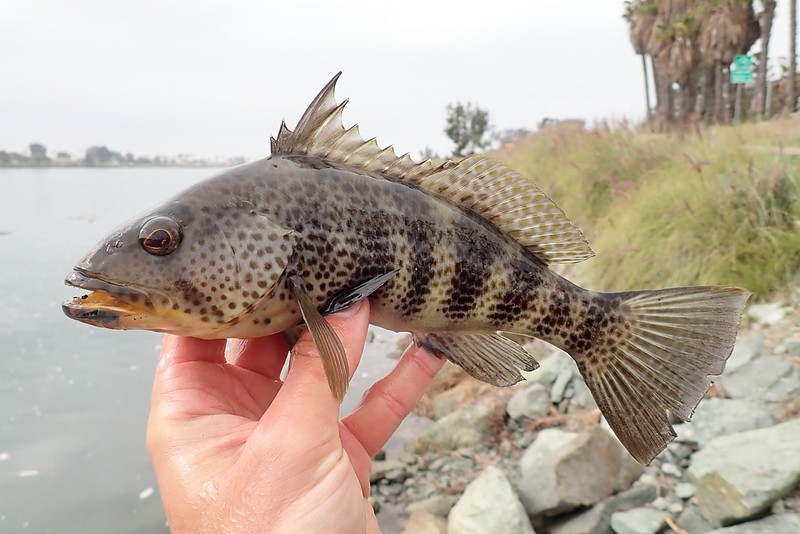
Spotted Sand Bass (Paralabrax maculatofasciatus)

We had hoped to fish one more spot for longjaw mudsucker, yellowfin goby, California killifish, and diamond stringray, but by the time we got there the tide had already dropped too far. Feeding really only goes on there when the estuary is connected to the bay, and we arrived too late.

Despite quite a few missed targets, Gerry was still able to add ten new species to his list, which is pretty darn good by any species fisherman's standards.

  1. Pacific sardine
  2. chameleon goby
  3. bay blenny
  4. rockpool blenny
  5. American shadow goby
  6. ocean whitefish
  7. blacksmith
  8. garibaldi (incidental catch)
  9. rock wrasse
  10. diamond turbot

Thanks again Kam for loaning us your kayak, thanks Gerry for treating us to dinners, and it was good to meet both of you, Coach and Brandon! I'm looking forward to what February has in store for us!

Sunday, January 19, 2020

Kayak deep dropping for sanddabs

On Sunday I gave deep dropping in La Jolla Canyon another try. My primary goal was to catch something new and interesting from the deep, and my secondary goal was to break my record for deepest fish caught from the kayak. My official targets were sanddabs, which are always in-season at any depth, and I had a descending device ready in case I caught any incidental rockfish, which are closed in January and February. As an extra precaution I tried my best to avoid any spots that looked rocky on the bottom.

There was a descent sized pod of dolphins moving through as I paddled out.


My deepest kayak fish (a sanddab) was from 315 ft, so I started out in 400+ ft near the head of the canyon (making sure I was outside the marine reserve). I upped my PR to 410 ft with this little guy.

Pacific Sanddab (Citharichthys sordidus)


I moved deeper to 500+ ft. The fish finder was having trouble deciding on the depth because of how much the signal cone spreads out before returning to the transducer. It bounced around erratically from the low 500's to the high 500's.


The screen said 540 ft when I hooked into this guy, so that's going to be my new PR. I think for anything deeper I'll have to use charts to come up with an estimate.


It wasn't the weird fish of the deep I was looking for, but it was still pretty weird.


After that I tried dropping at 600+ ft, 800+ ft, 900+ ft, and 1000+ ft, going off GPS pins that I had pulled from a depth chart ahead of time. The wind was almost nonexistent, so I only needed 16 oz to hold bottom in 1000 ft. Most days aren't like that. Eventually I gave up with the super deep and came back up to the edge of the canyon to catch a few more sanddabs and call it a day. Between 350 ft and 400 ft I got into a few out-of-season rockfish. The vermilions I sent down immediately without a photo, but this one I took a quick picture of because I wasn't sure of the species. I looked it up when I got home and determined that it's a greenspotted rockfish. It was also sent back to the bottom with the descending device.

Greenspotted Rockfish (Sebastes chlorostictus)

I moved spots to avoid the rockfish and succeeded in getting some more sanddabs. My record was three on one drop. After a few more I called it a day and paddled back in.


Here's the Garmin screenshot for the day and the distance and time stats:


Miles: 6.45
Hours: 6:58

As I've mentioned in other posts, anyone is welcome to join when I go kayaking. Just leave a comment, and we'll make plans.

Saturday, January 11, 2020

Tidepools, mussels, and searching for perch

On Friday I stopped by a much frequented tidepool spot to get some mussels for perch bait. I've heard that white seaperch are starting to show up in Oceanside Harbor, and I wanted to try for them on Saturday with the best possible bait.


With bait secured I spent the remaining daylight microfishing the tidepools. I caught the three most commons species from this spot.

Opaleye (Girella nigricans)


Rockpool / Notchbrow Blenny (Hypsoblennius gilberti)


Woolly Sculpin (Clinocottus analis)


I also saw lots of medium sized zebra chub, but they were too busy freaking out to be interested in eating anything. Usually I encounter largemouth blenny and spotted kelpfish in this area, but I didn't see either of them this time.

On Saturday my friend Emerson met me at Oceanside Harbor to look for white seaperch. We launched our kayaks from a public dock. There were some fish in the mid water column on the fish finder that turned out to be topsmelt, but I didn't see any schools of fish near the bottom. We fished pieces of mussel on small hooks, and within the first 30 minutes Emerson caught a white seaperch in about 12 ft of water near the rocky shoreline.

White Seaperch (Phanerodon furcatus)
Photo courtesy of Emerson Sims.

Sadly though I spent the next 6 hours trying to duplicate his success, but I couldn't get a perch of my own, and he didn't catch any others. Bycatch included garibaldi, rock wrasse, topsmelt, and opaleye.

Garibaldi (Hypsypops rubicundus) - caught incidentally and quickly released


Rock Wrasse (Halichoeres semicinctus)


Topsmelt (Atherinops affinis)


Opaleye (Girella nigricans)


It was a very sunny day, so I'm wondering if the perch bite best in the early morning or when it's overcast. I think next time I try for them I'll show up before sunrise and just fish the harbor pier instead of using the kayak. It's nice to be out on the water, but it's also a lot of work dealing with all of the gear and cleanup.


Here's the Garmin screenshot and stats:


Miles: 6:02
Hours: 6:19

More blog posts to come soon!

Saturday, January 4, 2020

Kayak fishing the HMCS Yukon

Happy New Year! Rumor has it that the wrecks outside Mission Bay have pile perch, and possibly a few rubberlip perch, so I kayaked out there on Saturday to check them out. I launched from Mission Point Park shortly after sunrise.


Once on the water I started recording an activity with my Garmin watch and turned the fish finder on.


My first pin was the NOSC Tower wreck. I had it saved as 32.77191, -117.26868, but when I got to those coordinates, I couldn't find it! I circled the kayak around a few times but didn't see any signs of it on the fish finder, so I gave up and decided to move on in the interest of time. While I was entering the coordinates for the next spot into the fish finder, I let a sabiki drop to the bottom. When I pulled it back up, I found my first fish of 2020 and a new species!

Speckled Sanddab (Citharichthys stigmaeus) - new hook & line species #654


The next spot was the HMCS Yukon, which was pretty much lined up with a white rainbow in the fog. I hoped it would be a good omen.


As it turns out, the GPS coordinates for the Yukon are also off by a bit. Luckily they have red buoys marking the ship, otherwise I probably wouldn't have found it.


First fish off the Yukon was a calico bass.

Kelp / Calico Bass (Paralabrax clathratus)


When I switched to pieces of shrimp on a sabiki the bites really picked up. I was worried about snags so I fished right next to the wreck and picked up 3 ocean whitefish.

Ocean Whitefish (Caulolatilus princeps)


To avoid the whitefish I moved over what I thought was the center. Hopefully my rig wouldn't be near any of the deck railings. I had watched a few dive videos before the trip and knew there would be a lot of blacksmith, and sure enough I ended up catching 8 of them, all decent sized.

Blacksmith (Chromis punctipinnis)


Also caught 3 sheephead, and probably missed a lot more. The sabiki hooks were tiny and not really suited for their mouths.

California Sheephead (Semicossyphus pulcher)


The wind was beginning to pick up and become a problem, but my persistence finally paid off, and I pulled up a new perch species. It wasn't a pile or a rubberlip or even a white. Instead it was a sharpnose, one people occasionally catch in deeper water (200+ ft) while going for rockfish. I was stoked!

Sharpnose Seaperch (Phanerodon atripes) - new hook & line species #655


Before I paddle back I wanted to see if there were any big sheephead hanging around, and I had a couple whole shrimp to use up. I put one on a 2 oz jig and hopped it along the bottom for a bit. A sand bass picked it up, which was good enough for me.

Barred Sand Bass (Paralabrax nebulifer)


I always stay out about an hour longer than I ought to, and the paddle back was a little rough in the wind. The New Seaforth gave me a pretty big wake to punch through before I headed back into the Mission Bay channel.


Miles: 9.44
Hours: 6:23

Hope you enjoyed the report! And by the way, anyone is welcome to join when I go kayaking. Just leave a comment, and we'll make plans.

Saturday, December 28, 2019

Winter road trip to Phoenix

Between Christmas and New Years I had a few extra days, so I drove over to Phoenix to do some winter fishing with my friend Chris and his boys. It had been colder than usual in Arizona, which would likely make the fishing tough, but Chris promised I could at least add longfin dace to my list, and that was good enough for me.

I arrived Saturday afternoon, transferred my microfishing gear to Chris's truck, and we drove over to a nearby stream to fish for dace. It was a 15 minute hike from the parking lot, which was a good thing, because you should have to work a little bit for new species.


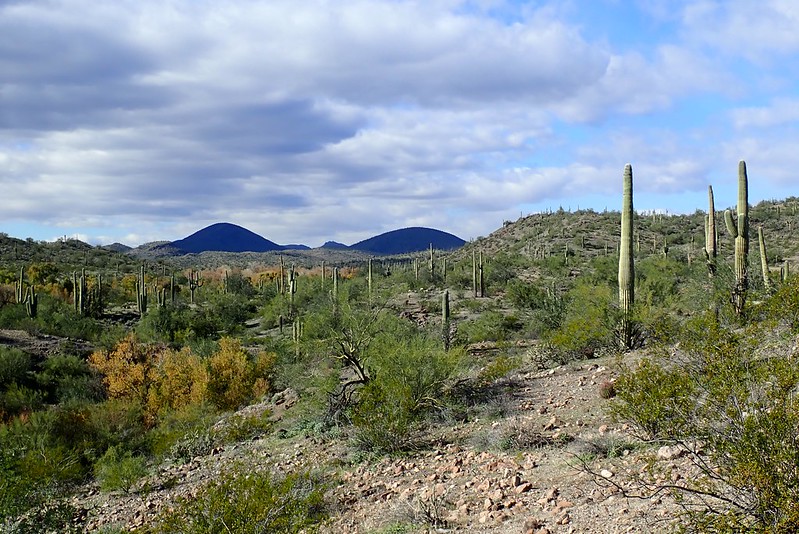
Desert streams always seem to defy their surroundings, and this one was no exception. Once we scrambled down the small canyon to the creek, it was easy to forget that we were in the middle of the desert.


The stream was loaded with dace. They appeared equally at home in the deep slow pools and the swifter runs with undercut banks. I found a group of larger individuals, put a piece of aquatic insect on my hook, and pulled up a good looking male.

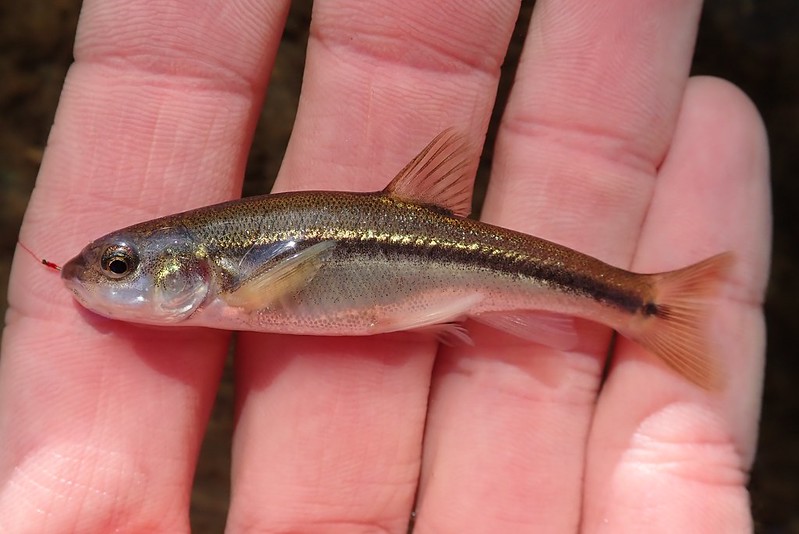
Longfin Dace (Agosia chrysogaster) - new hook & line species #652


I caught a few others that were larger, but none had a lateral stripe as distinct as the first one. At the time I assumed some of the chunkier fish were females, but looking through my photos it seems they all have traces of tubercles on their heads, so I guess that makes them all males.


A few of the longfin dace had fully developed tubercles, which meant they would be spawning soon. We also saw juvenile fish from the previous spawn.


The next morning I headed out before sunrise to spend the day on the Salt River. I had caught a Sonora sucker at this spot back in 2014, but I was looking forward to getting an updated photo of one in better light. More importantly, I hoped to have a shot at a desert sucker, which are more difficult to catch than Sonoras because they feed predominantly on algae. When I arrived at the river my car's thermometer said 27 deg. Would the fish be biting?


I spent the first few hours at the same spot I fished back in 2014. The angle of the morning light made it impossible to see into the pool, but I figured there must be suckers hanging out in the deepest part. I swapped out my bait (half a nightcrawler) every 15 minutes or so, but no one was interested.


Eventually I gave up and packed up to try somewhere further upstream. As I was crossing the riffle, I spotted a small fish tucked in the strands of algae. It didn't look like something that wanted to eat, so I scooped it up with my hand. It was a sailfin molly, and it looked like it was probably not going to survive the cold.

Sailfin Molly (Poecilia latipinna)


The sun was now higher in the sky, and I was able to see clearly into the pool at the second spot. I wasn't surprised to see dozens of suckers. Most looked to be Sonoras, but a few looked more grey in color and might have been deserts.


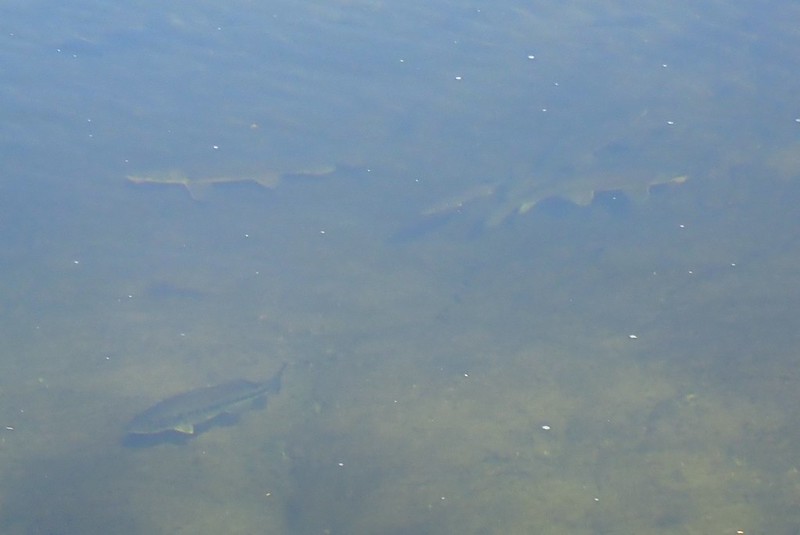
Unfortunately, being able to see the fish didn't help me catch one. I was able to cast past a large sucker perched on the slab rock and slowly reeled in until my half a nightcrawler was brushing gently against the front of its lip. Even then, they showed no interest in eating. There were largemouth bass and common carp cruising around as well, and they also showed zero interest.


On the third day we tried to salvage the trip by having me catch a Nile tilapia or a koi. The tilapia, if it looked convincingly like a pure Nile, would be a new species, but the koi would just be a novelty for my list of angling accomplishments, since it's the same species as common carp. We looked for Nile tilapia in a body of water that's fed by a wastewater discharge and empties into the Gila River,.


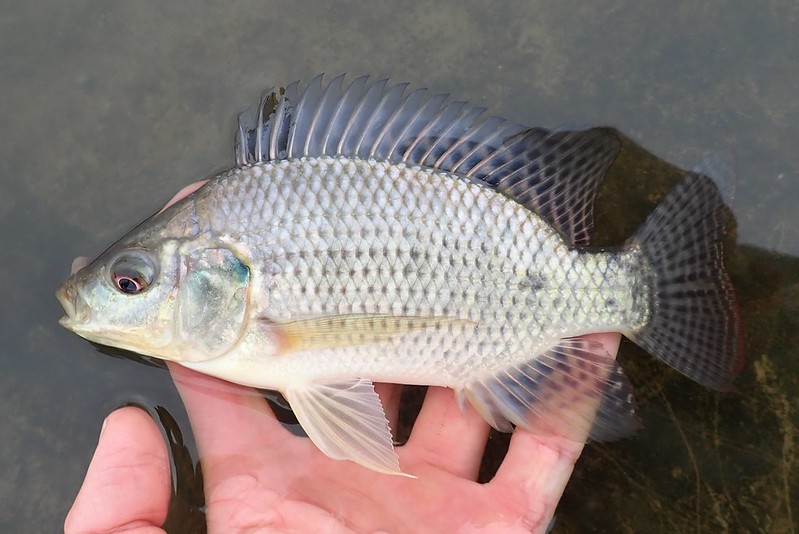
The low temperatures were still affecting the fishing, but eventually we each catch a few tilapia. The dorsal and anal fin shapes (rounded at the back) and tail markings (broken and wavy bars) suggested blue tilapia. They were likely hybrids, but they certainly couldn't be called Niles.

Blue Tilapia (Oreochromis aureus)


We also saw half a dozen large plecos hanging out on the concrete embankment. Plecos are a warm water species, so it wasn't surprising that they showed no interest in eating. Even in the warmer months they're an extremely challenging species to catch, but next time I'm in town I'd like to give it a shot.


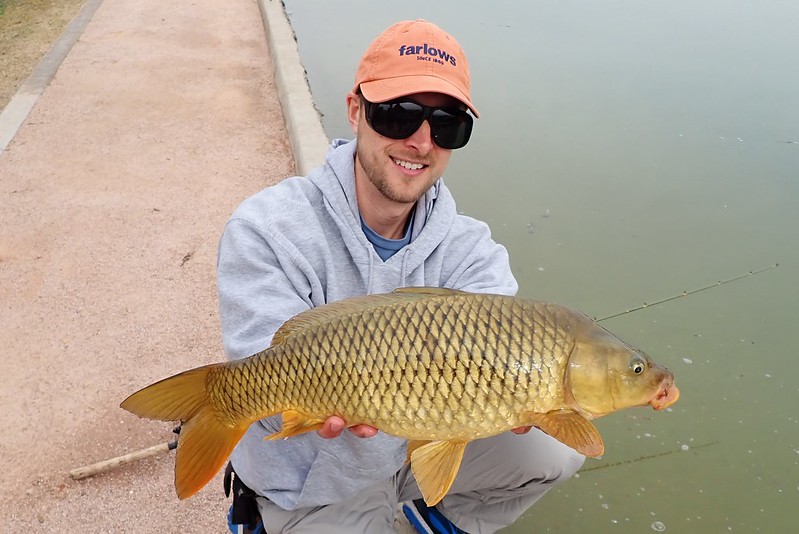
I needed to head back to San Diego soon, but we had time for one more spot, a series of urban ponds stocked with koi and common carp. We walked up to one of the lakes to find a big school of roughly twenty koi swimming about. I tossed a couple of handfuls of canned corn, and within a minute or two they were feeding. I cast a small hook baited with a few kernels of corn into the mix, and within seconds I had a fish on. Was it a bright orange koi? Nope, it was one of the few common carp!

Common Carp (Cyprinus carpio)


The school of koi scattered during the fight with the carp, so we had to move spots and start a new feed going. It took an hour or two, but eventually I had a couple of the bright orange koi feeding again. I cast out, waited a few minutes, and then once again had a nice fish on the end of the line. And it was... drum roll please... another common carp!

I'll admit this road trip wasn't the most productive in terms of new species, but it did get me excited for my next trip to Arizona this spring or summer when it's warmer. I want to try for the two native species of trout - Gila and Apache - and pick up any other natives along the way. Urban fishing in Phoenix should be able to produce a pure Nile tilapia (Chris has good info on them being stocked), plus the abundant inland silversides in Tempe Town Lake. And for good measure I really would like one of those bright orange koi!