Monday, November 25, 2019

Long paddle for La Jolla rockfish

Yesterday I launched from La Jolla to check out a seamount I found using Google Maps. The surf at La Jolla Shores was low, but I didn't realize how high the tide would be! The water was actually pushing up onto the street. It was chilly too, as you can see from my car dash.


I met up with a guy Esteban who wanted to give deep water rockfishing a try. We were the only two people who launched at sunrise, probably due to the high tide. I had a waypoint marked about 4 miles from shore where it looked like there would be good structure. Along the way we stopped for a break and caught some whitefish.

Ocean Whitefish (Caulolatilus princeps)


It was really cool to see the bottom change from flat and featureless to a rocky seamount when we reached the waypoint. It pays to do your homework! I dropped a 4 oz megabait tipped with squid to the bottom and almost immediately hooked up with my first starry rockfish of the year. Esteban got a starry on his first drop as well.

Starry Rockfish (Sebastes constellatus)


My primary target was a squarespot rockfish for my lifelist, so I switched to dropper loops with smaller sized hooks. Starry rockfish were by far the most common catch of the day, but there was plenty of variety mixed in.

Flag Rockfish (Sebastes rubrivinctus)


Blue Rockfish (Sebastes mystinus)


Rosy Rockfish (Sebastes rosaceus)


California Scorpionfish (Scorpaena guttata)


California Sheephead (Semicossyphus pulcher)


After a few hours Esteban wanted to fish the kelp closer to shore, so he took off while I stuck it out at my spot. I'm sure we'll cross paths again!


The spot I was fishing was between 200 and 250 ft deep, which is the depth that I've always seen other people catch squarespots, so I knew they had to be down there. And sure enough, one eventually turned up.

Squarespot Rockfish (Sebastes hopkinsi) - new hook & line species #648


After that a school of halfbanded rockfish and chub mackerel moved in and wouldn't leave my bait alone, so I put away the dropper loops. You can only catch so many of these guys before they drive you crazy.

Halfbanded Rockfish (Sebastes semicinctus)
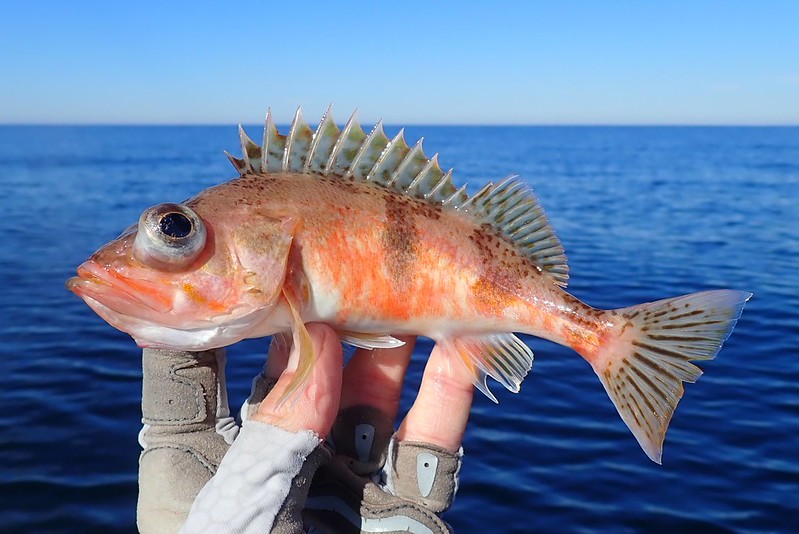

Pacific Chub Mackerel (Scomber japonicus)


I wanted one more good fish to cap off the day, so I dropped the megabait again. I thought I had drifted off the structure, so I reeled up a couple cranks and stuck the rod in one of the kayak's rod holders. I pulled out my phone to check the location when the kayak suddenly lurched sideways! Fish on! It was a big vermilion, worthy of using the net on. It measured 4.5 lbs on my fish gripper.

Vermilion Rockfish (Sebastes miniatus)
 

A lot of the rockfish were spitting up these strange spongy sacks, and I had no idea what they could be. I posted this photo on Instagram, and someone from Scripps chimed in that they're pyrosomes,, which are "free-floating colonial tunicates". What I do know is rockfish like to eat them!


As I paddled back in I saw one of the sport boats heading back towards Mission Bay. I've done a few half day rockfish trips, usually when friends are visiting from out of town, but I'm immensely grateful that I can fish for rockfish now without being crammed on the deck of one of those boats. I won't take what I have for granted.
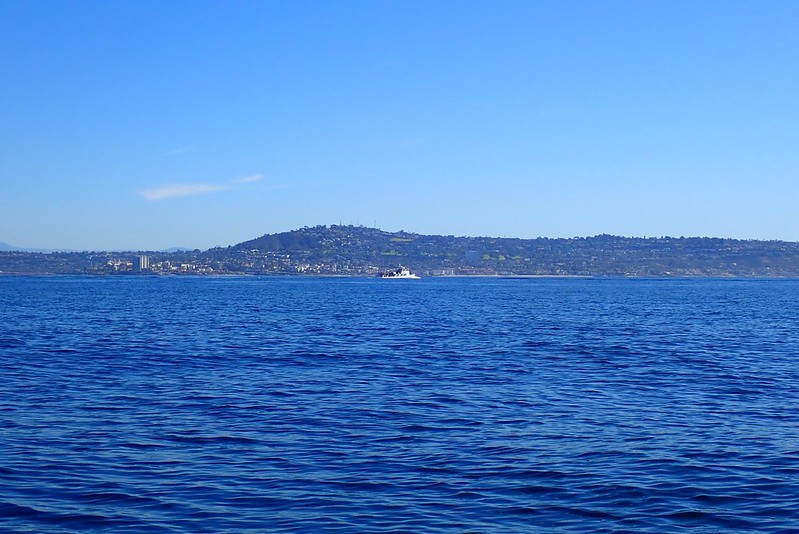


The screenshot from my Garmin app shows exactly where I was fishing, and I'm fine with that. Next time I head out I'll probably be checking out something new. So if anyone is able to find some fish because of the information I share on this blog, it's perfectly fine with me!


Miles: 11.10
Hours: 7:27

The depth limit for rockfish recently increased from 360 feet to 450 feet, so I think on my next trip I'd like to try the bottom 400+ feet down in La Jolla Canyon. It'll actually be a much shorter paddle from the launch compared to what I've been doing. Hopefully there's some weird stuff down there!

Monday, November 4, 2019

Long paddle for La Jolla sanddabs

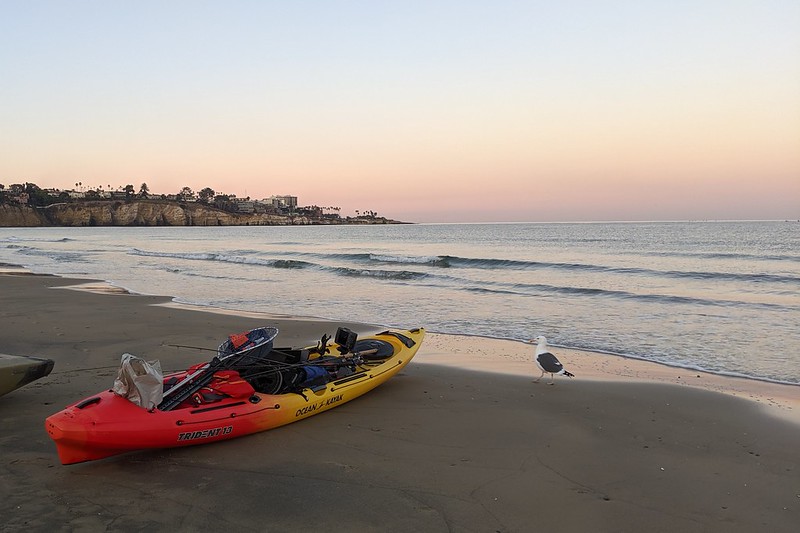
Yesterday I did a solo kayak trip in La Jolla. Parking was tough because I showed up later than most, but unloading gear without a headlamp was nice. The surf was less than a foot, which made for a super easy launch.


I finally figured out how to turn on contour lines on my fish finder, which meant I could actually plan out where I wanted to go. My plan was to bottom fish in 300 ft to try for a squarespot rockfish for my lifelist, so I set a waypoint a few miles out and started paddling.


Unsurprisingly, the bottom there didn't have any structure, but the day was more of a proof of concept than anything, so I dropped pieces of squid down to see if I could pull something up. Right away I had savage little bites, and I started pulling up sanddabs. The first one was a longfin, which is a new species for me! (And yes he was missing an eye.)

Longfin Sanddab (Citharichthys xanthostigma) - new hook & line species #647


The sanddabs were coming up two at a time, and this photo shows my deepest kayak catch at 312 feet.

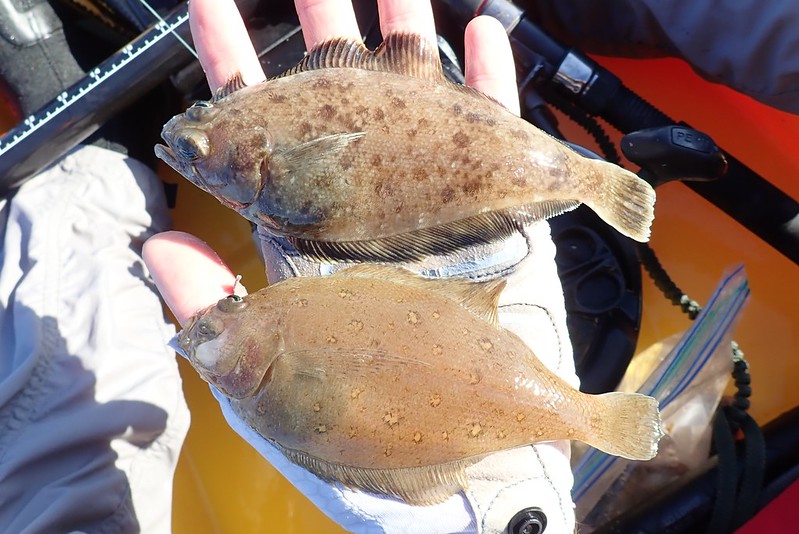
The majority of the sanddabs were Pacifics, but on one of the drops I caught both species, so I was able to do a side-by-side photo. The length of the pectoral fin is the obvious ID characteristic, but there are other differences as well. Sometimes the pectoral fin can be frayed and shorter than it ought to be, so scale size (and therefor lateral line scale count) is another way to quickly tell the two apart.


I caught a few Pacifics that were big enough to keep and stashed them in a walmart bag in the shade. They came home with me and were delicious.

Pacific Sanddab (Citharichthys sordidus)


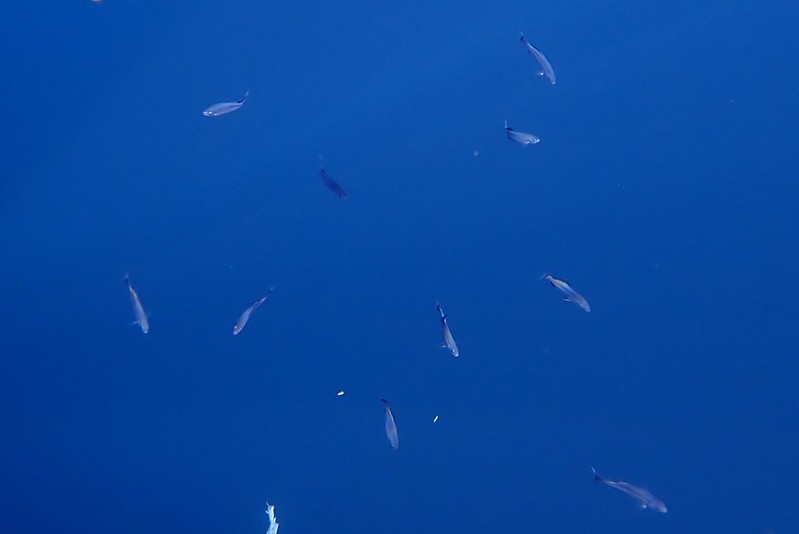
While I was sanddab fishing I had some juvenile fish use my kayak for shelter. I'm pretty sure they were halfmoons. They ate little bits of squid that I dropped over the side. Perhaps I should bring microfishing gear whenever I kayak in case something weird shows up?


Mixed in with the sanddabs were a few small rockfish, but none of them were squarespots. Here's a halfbanded and a blue.

Halfbanded Rockfish (Sebastes semicinctus)


Blue Rockfish (Sebastes mystinus)


For the remainder of the day I paddled over to the 100 feet deep area near the kelp where other boats typically fish. Along the way I had a genuine shot at a mako that was finning at the surface, but I tangled up my lines and missed my chance. In the shallow(er) water I caught other species including copper rockfish, gopher rockfish, kelp rockfish, California scorpionfish, ocean whitefish, and Pacific chub mackerel.

Copper Rockfish (Sebastes caurinus)


Ocean Whitefish (Caulolatilus princeps)


My last fish of the day was this gopher rockfish that ate both of my baits.

Gopher Rockfish (Sebastes carnatus)


Here's the the route for the day from my Garmin app. The sanddab spot is in the upper left, and the end of the day was below where it says La Jolla Tide Pools.


Miles: 10.09
Hours: 6:51

This trip was more of a skills building session than anything, but I'm quite happy that I picked up a new species! Next time I'd like to focus on finding structure in deeper water so I can catch some decent fish that aren't sanddabs.

Monday, October 14, 2019

Catching longjaw mudsuckers for science

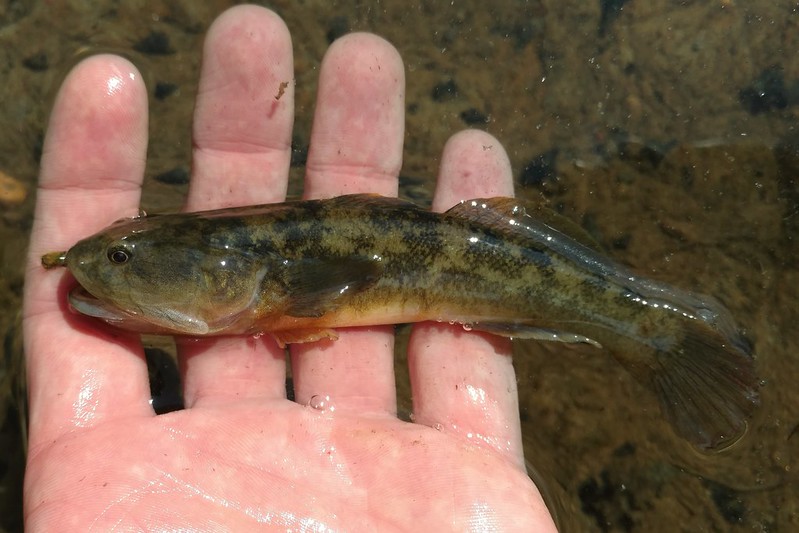
Earlier this year one of my contacts at Scripps asked if I could help one of his graduate students collect longjaw mudsuckers for a research project. It just so happens I have a spot where I can reliably catch them, so I quickly agreed to help. If you're not familiar with longjaw mudsuckers, they're a goby species native to California, and they have a noticeably long jaw. They may or may not suck mud. In my opinion they should have just been named longjaw goby.

Longjaw Mudsucker (Gillichthys mirabilis)


I agreed to meet a couple people from Scripps after sundown, but there was a good low tide in the afternoon, so I drove down to Mission Bay a few hours early to pump ghost shrimp for bait. Big gobies usually aren't hard to catch, but I was feeling the pressure, so I wanted to have the best bait possible. While I was pumping shrimp I noticed a few extremely small gobies on the sand flats hanging around the ghost shrimp burrows.


Later that night I showed the photos to one of the Scripps researchers, and he identified the fish as a cheekspot goby. The dark spot on the operculum makes the ID pretty easy, but he did mention that there are multiple goby species that cohabitate with ghost shrimp. I'll have to try to catch one on hook & line at some point!

Cheekspot Goby (Ilypnus gilberti)


Around sunset I met Jimjohn, the grad student working on the project, at the mudsucker spot. We rigged up and began fishing. I told him the mudsuckers would be easy to find, but for the first hour or two all we could catch were the other species common at that location. My mudsucker catching reputation was in jeopardy!

Yellowfin Goby (Acanthogobius flavimanus)

California Killifish (Fundulus parvipinnis)


Once it was completely dark our luck improved. With headlamps on we were able to find mudsuckers sitting on the bottom near shore. Several more researchers from Scripps arrived, and everyone got to work looking for fish for us to catch.


Before long we had collected about a dozen mudsuckers as well as a few nonnative yellowfin gobies and native California killifish. Everything we caught went into a cooler with an aerator that would go back to Scripps.


What I originally thought would be a 2 or 3 person gathering ended up being 8 people, which certainly helped make the search for mudsuckers easier. In the photo below, from left to right, are Zach Skelton, H.J. Walker, Phil Hastings, Tor Mowatt-Larssen, Jimjohn Milan, Alma Javier, and Ben Frable.


Update:

In February 2020 I asked Jimjohn for an update on how his project is going. He sent some photos of the mudsuckers in their holding tanks and said they would be beginning the behavior study soon.


Here's two of the gobies being roommates. They don't seem to be on speaking terms with each other unfortunately. I hope they can work things out.


Here's a really big fella that is probably eating more than his fair share of the food (squid, according to Jimjohn). They certainly seem to be doing well in captivity.


The same big fella is in the photo below, and it's a good example of how well mudsuckers, and most benthic fish, can change their appearance to match their surroundings. Deactivate sand mode, activate gravel mode!


The behavior study Jimjohn will be doing has to do with whether or not adult mudsuckers use their modified jaws to gape at each other the way some other fish like fringeheads and rockskippers do. Hopefully he's able to get some good photos and videos of them showing the behavior!

Monday, September 30, 2019

Pier fishing in Louisiana and Mississippi

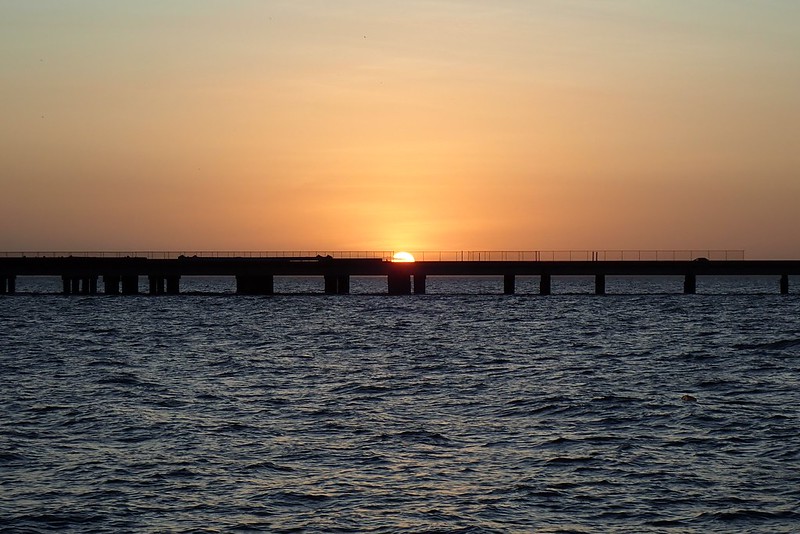
Back in September I was in Louisiana for a conference, and I was able to fit in a little fishing on the side while I was there. The first night I drove across the Lake Pontchartrain Causeway to check out Sunset Point Fishing Pier in Mandeville, LA. It was hot and humid, and coming from San Diego the humidity was really a shock. There was a nice breeze though, and while it was probably a little windy for fishing, it made the humidity more bearable.


Lake Pontchartrain is a brackish estuary with salinity about half of pure seawater. I did my homework before the trip, and it looked like hardhead catfish and gafftopsail catfish are common catches. The latter would be a new species for me, so that was my primary target. I also needed some common fish like red drum, black drum, and a couple other croaker and shark and ray species so I was hopeful that I could add a few new ones to the list. I fished shrimp on two rods, one with a fish finder rig and the other with a high low rig. Hours went by, and I was only able to catch two fish, both of which were blue catfish. It was supposed to be mostly saltwater species at this pier, so what was going on?

Blue Catfish (Ictalurus furcatus)


I chatted with a few locals, and apparently the Army Corps of Engineers was releasing freshwater from the reservoir upstream to prevent flooding. It had rained a lot a week or two before I arrived, but I didn't realize it would still be having an affect on the fishing. I enjoyed the sunset and then packed up my gear to head back to the hotel. Originally I planned to fish a few hours into the night, but there was no point if it was only going to be freshwater species I'd already caught.


Fast forward to the end of the conference, and I had one last opportunity to catch some fish before I flew back to San Diego. I figured Lake Pontchartrain again would be wasting time, so I headed east to find pure saltwater. A quick Google search turned up the Garfield Ladner Pier in Waveland, MS, which was a pretty short drive despite being across the state line.


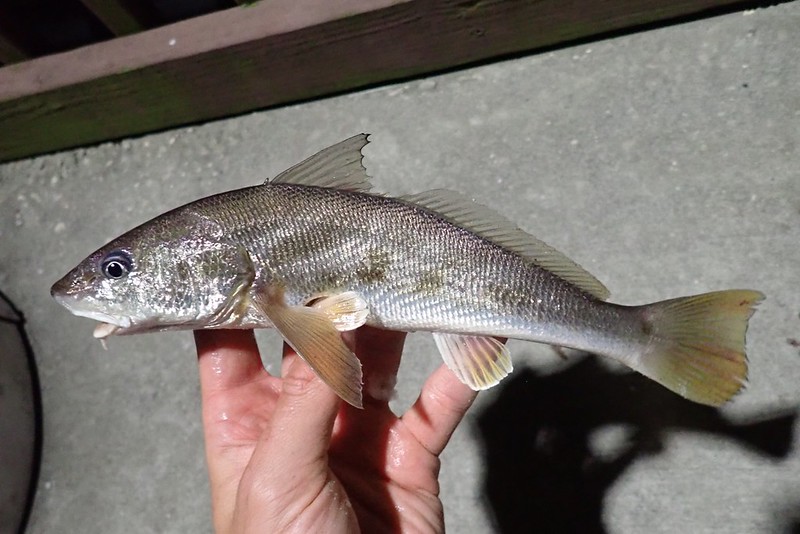
I've fished quite a few piers over the last decade, and surprisingly this was one of the best I've experienced. It had good lighting, benches, and roofed sections. I set up about half way to the end with the plan of fishing for a couple of hours and then moving down to the end to see if the species lineup changed. Switching to pure saltwater made a world of difference. The water around the pier was swarming with small sand seatrout. If you didn't get your bait down to the bottom quickly you'd hook one almost immediately.

Sand Seatrout (Cynoscion arenarius)


Bait on the bottom would sit for a little while longer, but before long a catfish would pick it up. Most of them were hardheads, a species I picked up last year in Tampa, but twice I hooked nice sized gafftopsail catfish only to have them shake off the hook as I was lifting them up to the pier. I didn't let it bother me too much, because I had all night and wouldn't leave until I caught one, but it still hurt seeing a new lifer fall back to the water before I could get it to hand.

Hardhead Catfish (Ariopsis felis)


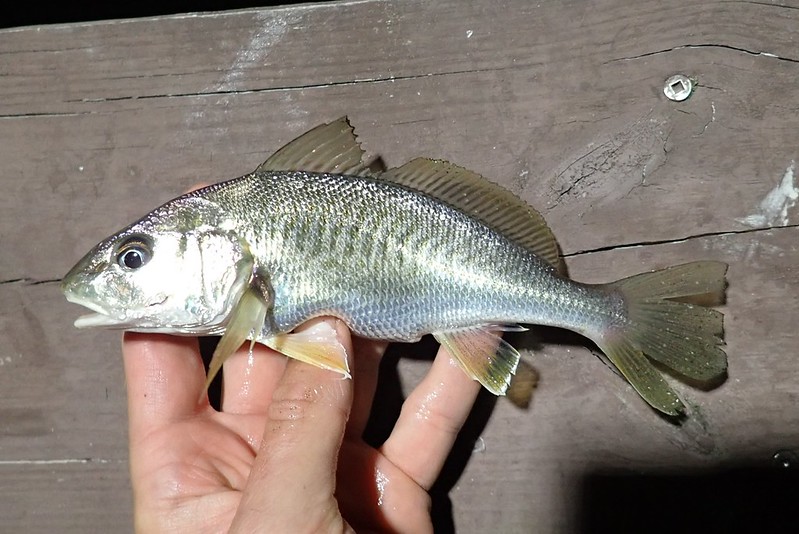
Much less common than the seatrout and catfish were the croakers. I caught two species - southern kingcroaker and Atlantic croaker - and while neither was a new species, I was happy to finally have a photo of Atlantic croaker. I caught one back in 2012 from the Skyway Pier in Tampa, but it slipped out of my hand and went straight down a PVC drain hole to the water below before I could take a photo. It's not something I've been proud of. Now if I can just find a gulf kingcroaker, I'll have photos of all the fish on my lifelist!

Southern Kingcroaker (Menticirrhus americanus)


Atlantic Croaker (Micropogonias undulatus)


The night was getting late, so I moved down to the end of the pier. I figured my odds of getting a gafftopsail would be the same, and if it got really late I could always come back to where I hooked the two earlier. I set up one of the rods with shrimp for smaller fish and the other with cut bait on a large circle hook for small sharks, rays, or even a big drum.


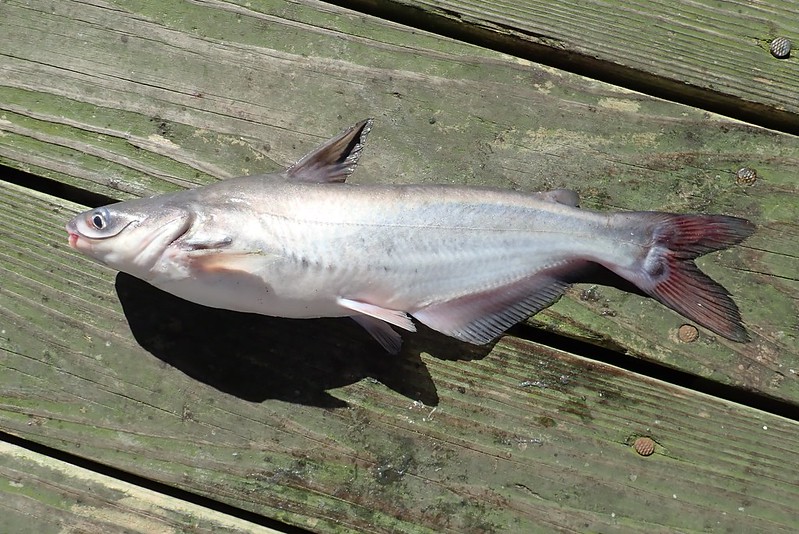
Moving was a good choice, because it only took a few minutes to catch a gafftopsail. It was much smaller than the two earlier ones, but as they say, a fish in hand is worth a lot more than one kerplunking back into the water after shaking off your hook.

Gafftopsail Catfish (Bagre marinus) - new hook & line species #646


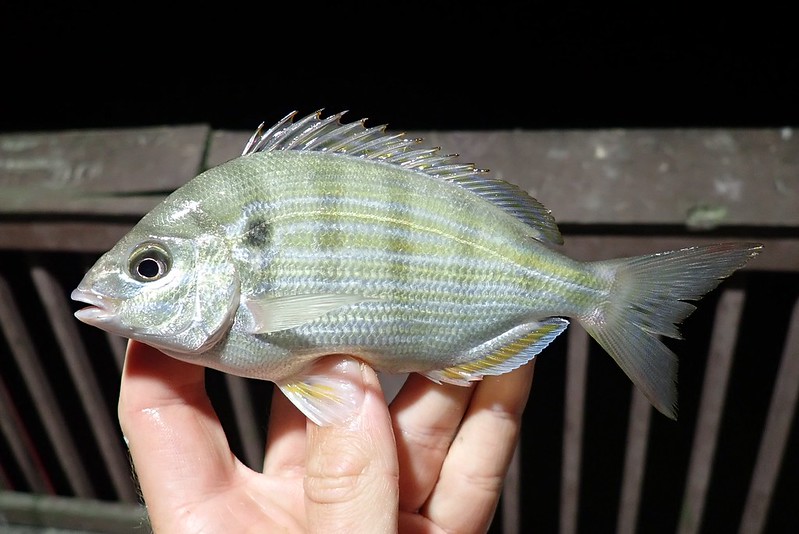
The cut bait had a few taps, probably from small catfish, but nothing big picked it up. I caught more of each of the species above, and the only addition was a pinfish. I won't ever say no to a species because I like having the content for blog posts, but I'm glad there weren't more pinfish out that night. Anyone who's fished a pier in Florida knows what I'm talking about!

Pinfish (Lagodon rhomboides)


I called it a night around midnight so I could get back to the hotel and catch some sleep before flying out in the morning. It took a lot of effort to catch one new species, but I was glad to get out of the city and see a part of the country that I wouldn't otherwise get to see. Hope you enjoyed the read!