Monday, March 18, 2019

South Africa part 7 - St Lucia, Mission Rocks, Cape Vidal

On Monday, March 18th Josh, Eli, and I left Shayamoya and drove to St. Lucia, a town on the coast a few hours to the southeast of Lake Jozini. We rented an apartment for two nights and planned to do a mix of surf and tidepool fishing along the coast. After stopping by a tackle shop and chatting with the owner, we had a few hours to head down to the beach and fish. Eli was the only one to catch fish with a few nice pompano.


The next morning we got up early and drove to Mission Rocks, which was about 30 minutes to the north in the iSimangaliso Wetland Park. The tidepools looked great on Google Maps, and we timed our visit during a really good low tide. I don't know about the other guys, but I've never been so excited to go tidepool fishing. We expected a good mix of tropical species with how far north of Durban we were.
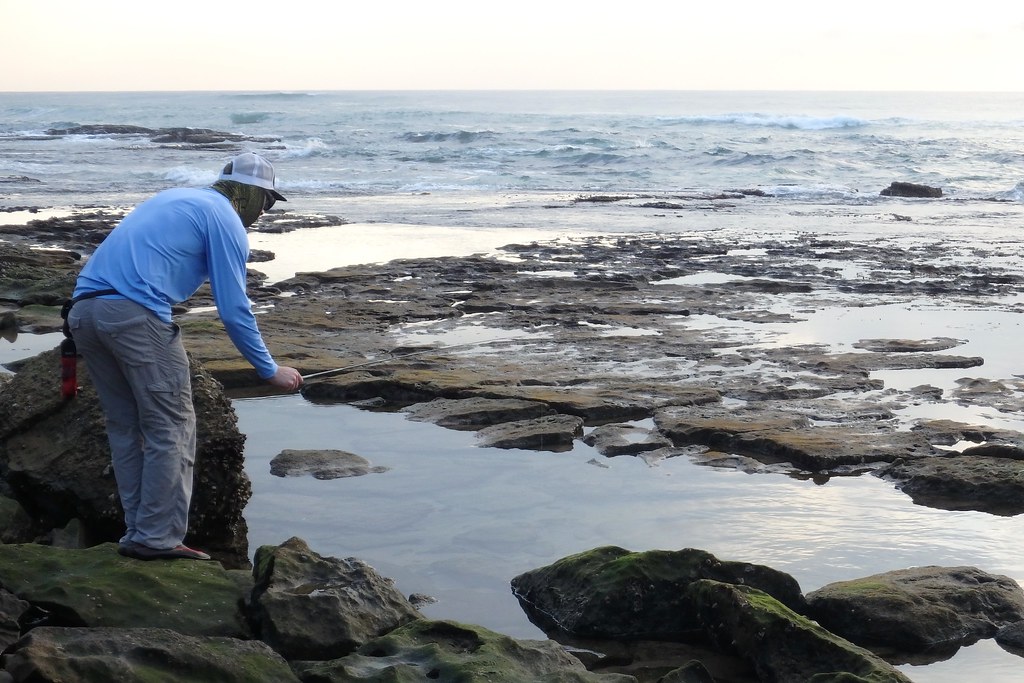

Photo courtesy of Josh Leisen.

I started off fishing a big shallow pool far from the surf. The first fish I caught was the damselfish that I had dropped without a photo at Tinley Manor, so it was nice to officially add it to the list. After that I spent quite a while convincing one of rockskippers that my bait was ok to eat, and I caught another frill-goby in case it was a new species.

Blackspot Sergeant (Abudefduf sordidus) - new hook & line species #613

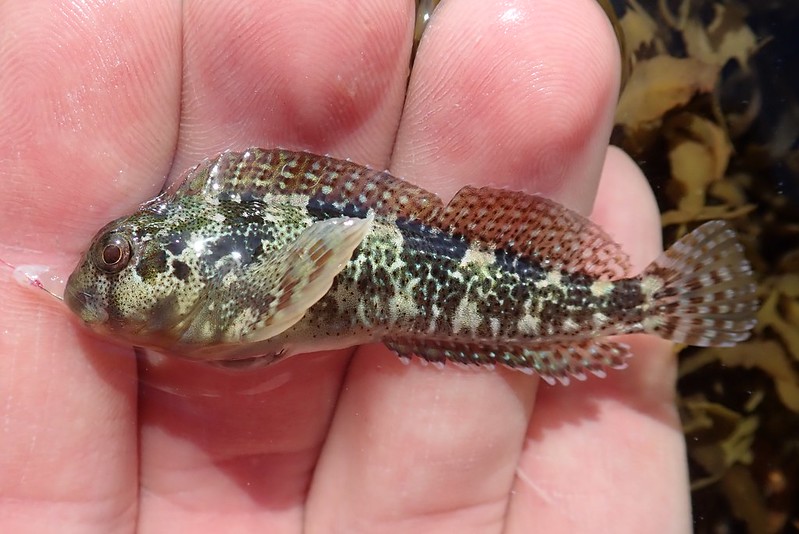
Rippled Rockskipper (Istiblennius edentulus) - new hook & line species #614
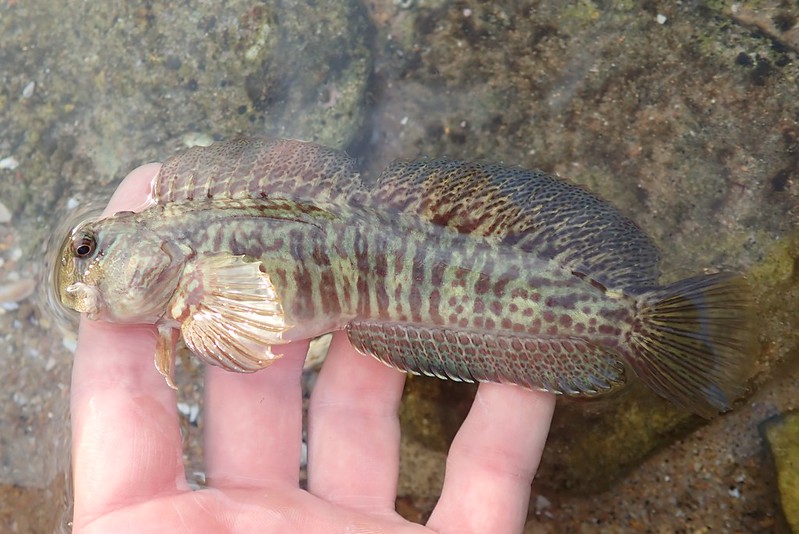
Cocos Frill-Goby (Bathygobius cocosensis)

Josh and Eli had been fishing off the rock ledge into open water, so I gave that a try next. I didn't catch any new species, but I got nice photo upgrades for Cape white seabream and the blackspot sergeant that I had just caught.

Cape White Seabream (Diplodus capensis)

Blackspot Sergeant (Abudefduf sordidus)

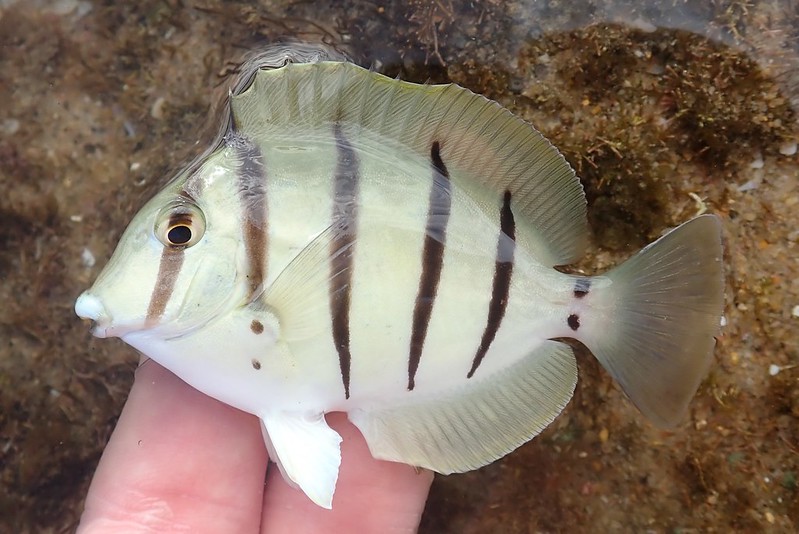
After that I found a tidepool that had the occasional wave washing into it. Back in San Diego I've found tidepools like that to be especially productive because the fish are expect food to wash in with the waves. That was the case here as well, and once I got the timing down (drop your bait in right towards the tail end of the wave washing in), I was able to catch three more small species. The convict surgeonfish is one I'm particularly proud of.

Convict Surgeonfish (Acanthurus triostegus) - new hook & line species #615
Singlebar Devil (Plectroglyphidodon leucozonus) - new hook & line species #616

Barred Flagtail (Kuhlia mugil) - new hook & line species #617

I tried blind fishing in deeper pools with a lot of cover, and in one of them a klipfish dashed out and grabbed my bait. Klipfish are the local name for kelpfish, and they behave pretty much the same as the ones in California. They really don't like lying flat for a photo.

Grass Klipfish (Pavoclinus graminis) - new hook & line species #618

In the afternoon the tide was coming in, and pretty soon the waves were washing over the big rock slab with all the tidepools. It was last call for catching new species out of the pools, so I walked around looking for something different to catch my eye. What caught my eye was a small moray! The first one I hooked broke my line, but I retied and quickly found another. Catching it was easy, now how on earth would I get a decent photo?


The solution I came up with was to clamp his lip with my forcep pliers. I don't think it did any damage to him, and it allowed me to straighten him out for a quick photo before I released him. He definitely didn't enjoy the ordeal, swimming away in a hurry when I put him back in the water. Before we retreated from the rocks I found one more new damselfish species.

Snowflake Moray (Echidna nebulosa) - new hook & line species #619

Yellowtail Sergeant (Abudefduf notatus) - new hook & line species #620

Eli was fishing to the south, but Josh and I had our eyes on the beach to the north. We had an agreed upon time to meet back at the car, so we worked our way over the rocks to the beach to try surf fishing for different species than we found in the tidepools.


When I flipped my bait out into the water I felt little bites, which was a good sign. When I felt bites and pulled in my line with the hook bit off, I knew we had a puffer to catch. After retying twice I had the little culprit in my hand. His eyes were filled with pure evil.

Evil-Eye Puffer (Amblyrhynchotes honckenii) - new hook & line species #621

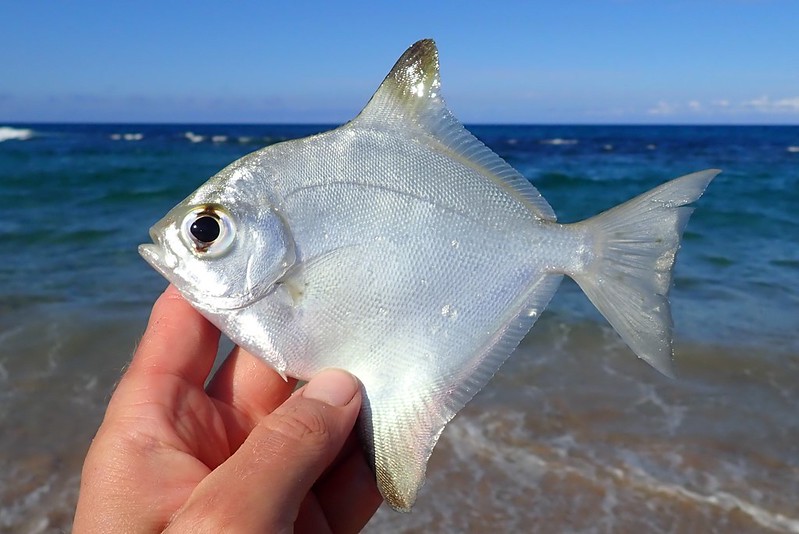
We spent the rest of the afternoon further to the north at Cape Vidal, which is a world famous fishing spot. There's a nice rock jetty there that's exposed at low tide, but unfortunately it was submerged by the time we got there. We fished for a while, but there wasn't much action close to shore. We caught a few small fish though, and I was happy to finally pick up the pompano that Eli had caught the day before.

Largespotted Dart (Trachinotus botla) - new hook & line species #622

Silver Moony (Monodactylus argenteus)
It was a long and productive day, and we ended it by lying out on the beach and enjoying the breeze and the sounds of the ocean. It felt good to lie flat on our backs instead of hunched over tidepools trying to catch tiny fish.

Sunday, March 17, 2019

South Africa part 6 - Lake Jozini tigerfish and safari

We arrived at Shayamoya Lodge late in the evening on March 15th, checked in, and then joined the rest of the guests for a Friday barbecue. A few of the dishes included wild game, but I honestly can't remember what the cooks said they were. Everything tasted great after such a long day of driving, not to mention the running and fishing. We settled into our chalets (small cabins) and fell asleep quickly. The next morning we woke up early and met Lucky, our fishing and safari guide for the next three days. He drove us down to Lake Jozini in one of the safari trucks. A pair of wild zebras was waiting for us by the docks.


Breakfast was packed in a picnic basket, and we ate while we motored across the lake to the fishing spot. We asked Lucky a lot of questions about tigerfish, and he was happy to answer all of them. Lucky is Zulu and grew up in the area, so he knew his stuff. We were glad to have him as a guide.


We hoped to do a mix of lure and bait fishing, but the water was too murky to fish with lures. We had dead sardines for bait, and one thing we learned about South African fishermen is they love bait thread. Lucky would slice open a headless and tailless sardine, slide the hook in between the two halves, and then wrap it a hundred times with bait thread. Delicious!


Bait fishing for tigerfish is the ultimate combination of boring and exciting. We freelined our baits out, kept the slack out of our lines, and waited. The bites were infrequent. When you did get a bite, you usually reeled in an empty hook or a bait too mangled to reuse. On the rare occasion you hooked a fish, the fight was exiting and usually ended with the fish spitting the hook.


Three out of the four of us caught tigerfish during the morning session, but I was not one of the three. We tried several spots, and I got bites at each of them, but I wasn't able to connect with the fish. We did see our first wild African elephant though, and that was pretty darn cool.


After lunch we went out again for the afternoon session. The wind had picked up, and Lucky wanted to try a different part of the lake, starting off close to the submerged grass near shore and then drifting with the wind into deeper water. Whatever I did to displease the fish gods in the morning was forgiven, because I hooked up with a decent fish and guided it into the net. My first tigerfish!

Tigerfish (Hydrocynus vittatus) - new hook & line species #612


This was the fish we planned the entire trip around. It was perfect.


The windy conditions really turned on the bite, and I ended up landing four tigerfish by the time we finished. It seemed like each one was bigger than the one before, which makes for an exciting session. No they weren't River Monsters sized fish, but they weren't small either.


Here's the last tigerfish of the day. Those teeth and scales and stripes were awesome!


This is a good time to say thanks to Ken, Josh, and Eli for being such awesome travel companions. Thanks for all the planning, brainstorming, researching, and working together as a team!


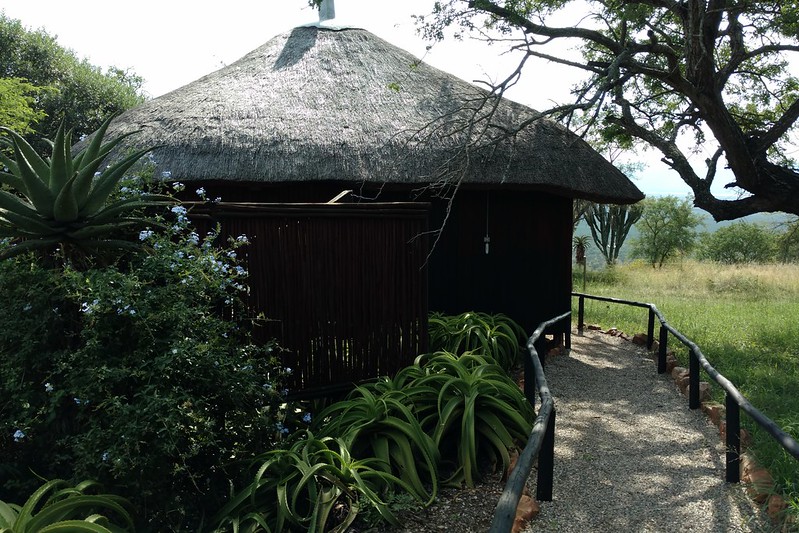
We enjoyed a hearty (and very dimly lit) dinner back at the lodge. Our chalets had a nice view of Lake Jozini with the mountains behind them.


I had been fighting the beginning of a cold for the past day or two (thanks Josh), and the next morning it finally caught up with me. Since we had one more morning of tigerfishing scheduled, I decided to sleep in and focus on getting better. The rest of the guys went fishing again, and Eli caught a sharptooth catfish.


By the afternoon I was feeling better, so I rejoined the group for a short safari in the Pongola Game Reserve. Lucky was once again our guide, and we took the same truck that we took the docks to go fishing. The reserve borders Lake Jozini and Eswatini (Swaziland).


The safari was cool, definitely something everyone should do if they visit Sub-Saharan Africa. Mostly it was nice to see the animals have all the open space. I really don't enjoy going to zoos, so it was good to see the animals and not feel bad for them.


The most entertaining animal on the safari was the baby rhino. Pre-teen rhino is probably more accurate, since he definitely wasn't a little guy. He thought it was funny to ram his mom in the stomach, and she just ignored him.


We also saw hippos and crocodiles in the lake. The crocodiles (at least the ones we saw) didn't look particularly large, but the hippos did, and they looked like they meant business. We were thankful they didn't approach the boat while we were fishing!


The next morning was our last session of fishing for tigerfish. Ken had to head back to Canada early to start a new job, so he headed out in one of the rental cars for Durban. Josh, Eli, and I were satisfied with the fish we had already caught, but Josh and I really hoped to catch a sharptooth catfish. I left my rod in one of the rod holders, since I wasn't as concerned with timing the hook set.


We didn't come across any catfish, but I did pick up one more tigerfish, the smallest one of the trip. It was a handsome specimen though with the red on its tail more vibrant than the larger individuals.


Tigerfish were the reason we traveled to Africa, and we were really happy that all four of us were able to catch them. Lake Jozini is the only place in South Africa to fish for them, so if you ever visit the country and want to repeat what we did, we highly recommend staying at Shayamoya. The cost was reasonable, and the lodging, meals, and guides (thanks Lucky!) were all great.

http://www.shayamoya.co.za/

After we were done fishing we packed up, bought some souvenirs from the gift shop, and headed towards the coast for our next leg of the journey.

Friday, March 15, 2019

South Africa part 5 - Tinley Manor, there and back again

On Friday, March 15th our group of four split up for the day. Ken and Eli wanted to fish with TK again and target some deeper reefs. Josh and I were ready to take a break from fishing, so we slept in and went for a run along the Durban boardwalk instead. Both of us have really been getting into running this year, and we needed to put some kilometers on our feet!


Running north along the coast gave us a chance to see Durban from a new perspective. There were a lot of other people out walking and jogging. It was relatively early in the morning, but the humidity took us by surprise. We had to check our egos and run a lot slower than we were used to back home, but it was a refreshing run nontheless.


After our run we enjoyed a big breakfast, stopped by a tackle shop to buy a cooler and rod holders for the surf, and spent an absurd amount of time at the rental car place dealing with some Grade A bullshit. I rented three vehicles through Thrifty while I was in South Africa, and with two out of the three they tried to scam me for significant amounts of money. Do not rent vehicles from them! Finally we were back on the road, headed north towards Lake Jozini where we would be fishing for tigerfish for three days. Before the trip I looked up a tidepool spot in the small town of Tinley Manor, and our timing worked out perfectly with the low tide.


We didn't know what species we would find, but we knew that tidepools always have good diversity. I started off with micro gear and fished the higher pools that weren't getting hit by the crashing surf. There's always one species that's the easiest to catch, and here it was the highbrow rockskipper, a very small member of the blenny family.

Highbrow Rockskipper (Hirculops cornifer) - new hook & line species #607


Josh was having good luck fishing a large lower pool that the waves crashed into. I knew I had more micro targets to go for, but I couldn't resist switching to light spinning gear to try for slightly bigger fish. We used small pieces of the yellowfin tuna that Josh caught the day before, and I added surge wrasse and stone bream to my list. The upper tidepools were convenient spots to take photographs without worrying about losing the fish.

Surge Wrasse (Thalassoma purpureum) - new hook & line species #608


Stone Bream (Neoscorpis lithophilus) - new hook & line species #609


I switched back to microfishing and focused on the mid-level tidepools, the ones that waves occasionally surged into but mostly stayed calm. Josh got a photo of me doing the classic microfishing hunch.

Photo courtesy of Josh Leisen.

I was able to find two more species willing to bite, the maned blenny and Cocos frill-goby. A couple of other species eluded me, in particular a damselfish and a big rockskipper that spent most of its time out of the water on a vertical rock face. I felt pretty absurd trying to present my bait to a fish not in the water! I got him to show interest a few times, but whenever I got my hopes up a big wave would crash over the rock, and I'd have to start all over again.

Maned Blenny (Scartella emarginata) - new hook & line species #610


Cocos Frill-Goby (Bathygobius cocosensis) - new hook & line species #611


We had to pack up and get back on the road after only two hours at Tinley Manor. It was tough leaving new species on the table, but we needed to make it to our tigerfish lodge before they closed for the evening. We made good time driving north, only making one stop for fast food burgers at a rest stop, which were surprisingly good.

Photo courtesy of Josh Leisen.

Fast forward to Wednesday, March 20th. Josh, Eli and I drove back to Durban to stay one more night in Durban before catching a flight to Cape Town. (Ken had to head home early due to a new job start date that couldn't be moved.) We had time to stop at the Tinley Manor tidepools again, so that's what we did. The tide wasn't as low as our previous session, but it didn't deter us.


The highest tidepools only had highbrow rockskippers and Cocos frill-gobies, and the deeper pools had stone bream, surge wrasse, and Blackspot sergeants. I figured the mid-level tidepools would give me the best shot at new species, so that's where I focused. I was able to sight fish two different species of rockskipper, with the second one being the individual that I saw out of the water the first time we were at this spot. I caught him while he was briefly underwater after a big wave washed into his pool.

Kosi Rockskipper (Pereulixia kosiensis) - new hook & line species #623


Fringelip Rockskipper (Entomacrodus epalzeocheilos) - new hook & line species #624


I'm pretty certain the individual above is a male due to his dark colors, and the one below is a gravid female (or maybe just a well fed female, but that's a risky question to ask).


I have to include this shot of the lady fringelip rockskipper. So pretty!


Josh and Eli each caught a few lifers here as well, and by the time the incoming tide pushed us off the tidepools we were ready to pack up and be on the way. I spent a little time casting out to where the rocks transitioned to sand, but I didn't get any bites. Eli is doing the same thing in the photo below.


We made it back to Durban and spent the night in the same hotel as earlier. We felt satisfied with our time fishing the Indian Ocean along the Natal coast, and we were ready to head to Cape Town to fish the Atlantic Ocean!