Monday, May 9, 2016

D.C. and Virginia part 3 - more Potomac River

My third D.C. post combines the evening of the second day with the third and final day, because both took place back in the Potomac River drainage.  American eel was high on my "want" list, so after dark we went back to the spot where we caught white catfish the night before.  I didn't bother with lures this time.  Instead, I used two bait rods - one with a piece of nightcrawler and the other with a piece of cut sunfish.

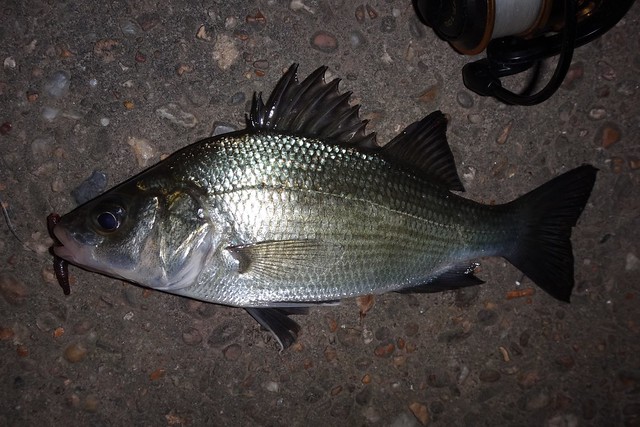
White Perch (Morone americana)
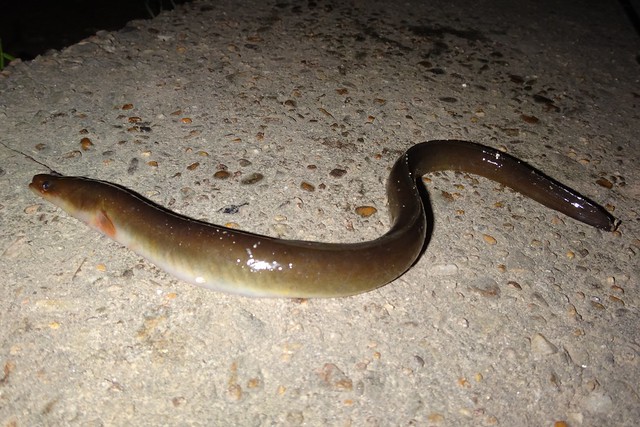
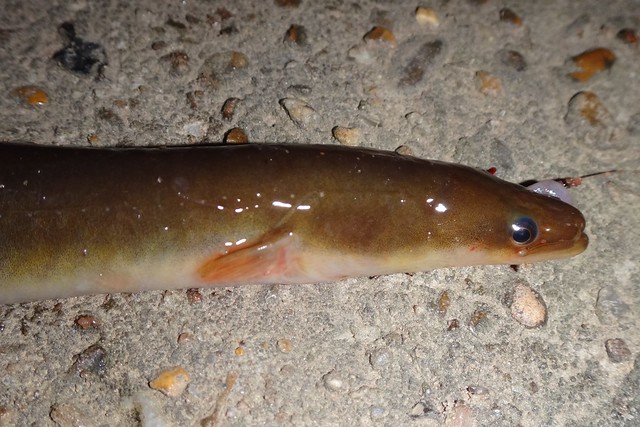
I was hoping for a big eel to hit the cut bait, but to my surprise I caught one on the tiny piece of nightcrawler I was dangling right next to shore.  That was easy!

American Eel (Anguilla rostrata) - new hook & line species #332

This was my first eel of any kind.  What a cool fish!

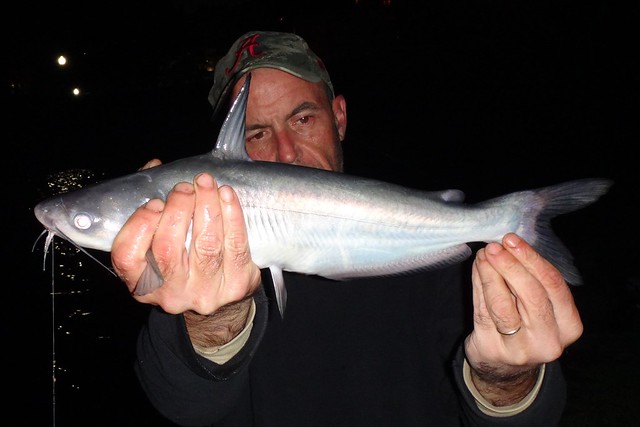
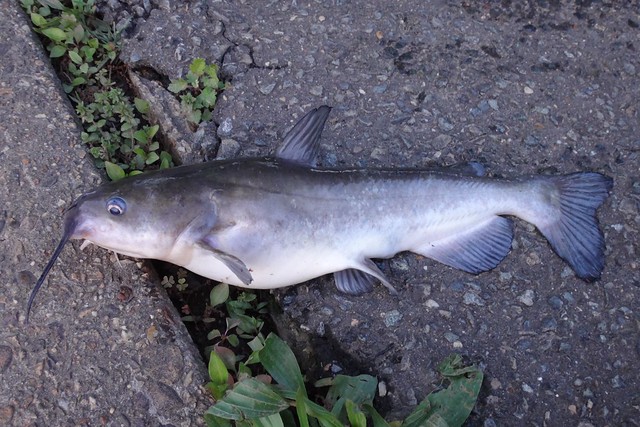
The cut bait attracted catfish, and lots of them.  We had a steady bite from channel cats, white cats, and Pat caught one blue catfish.

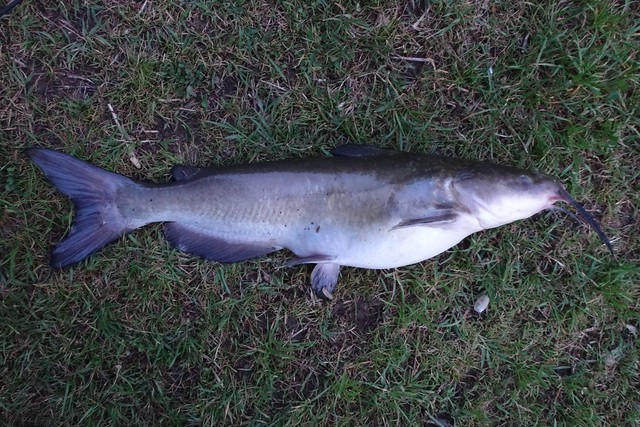
White Catfish (Ictalurus catus)


Blue Catfish (Ictalurus furcatus)


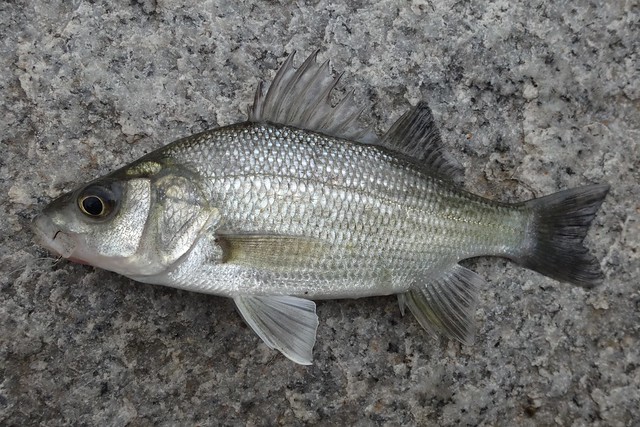
In  the morning we were on a mission to catch herring and shad.  Michael and George had caught them in the tidal basin a few days earlier, so we headed there and walked along the walls looking for schools of fish.  Michael suggested a plain hook, so I tied a rig with two #14 bronze hooks, one twelve inches above the other and a small weight 12 inches below the bottom hook.  To my surprise, it quickly attracted the attention of small white perch.

White Perch (Morone americana)
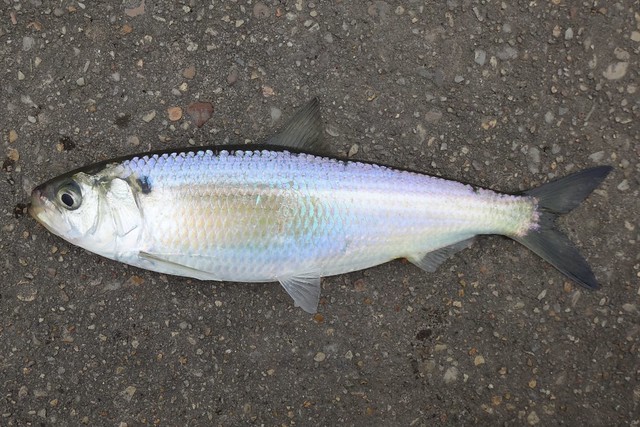
The herring were hard to find, but eventually we found small schools of about 10 individuals moving quickly along the wall.  An actively jigged plain bronze hook turned out to be irresistable to them.  All of the fish we caught were fair hooked inside the mouth!

Blueback Herring (Alosa aestivalis) - new hook & line species #333
I never thought a rig like this would be so productive.  The plain hook must look like a small aquatic insect desperately trying to swim away in the water.


The only potential lifers left to go after were American shad, hickory shad, and gizzard shad.  We knew the Potomac River near the fall line would be blown out from the recent rains, but we decided to check out anyway.  Perhaps we could find a side pool full of fish trying to avoid the main current.

After a difficult hike through the woods and scrambling over boulders, Pat and I made it to the river.  We did in fact see big schools of gizzard shad in the side pools, but we could not get them to bite.  Snags were frustrating.  On top of that it began to rain.  The difficult situation got the best of us and we gave up.

Pat had one more spot to try for American and hickory shad, so we gave it a try before I had to head out to the airport.  Several other fishermen were trying this spot, but the bite was slow.  My shad jig got one hit from a tiny striped bass, but that was it.

Striped Bass (Morone saxatilis)
With very little time left, I hoofed it to the nearest train station to head back to the airport.  I made it to my gate 5 minutes before boarding started - a little too close for comfort!  However, the rest of my travels went smoothly, and I made it back to Peoria late that night.  I had a wonderful three day trip thanks to Pat and his wife Lia.  Thanks to both of you for the hospitality, home cooked food, and great company!

Sunday, May 8, 2016

D.C. and Virginia part 2 - tannin ponds

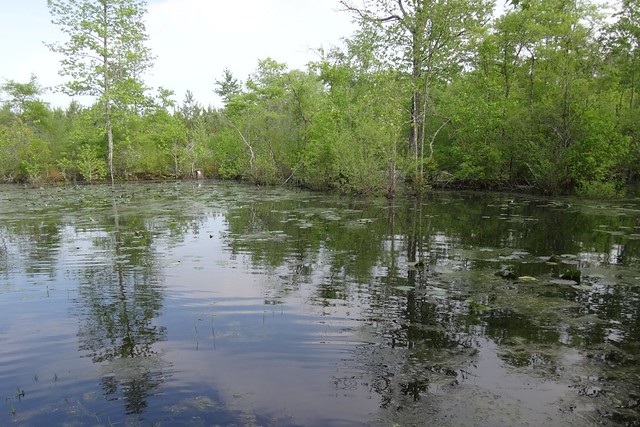
On day two, Pat took me on a mini road trip to some tannin ponds a few hours south of D.C.  We knew it would be tough for new lifers, but there was a chance for mud sunfish, so we were going to give it a shot.  Even if we didn't find them, the other lowland species that live in these ponds would be cool to see.  We started off at a creek near the ponds in hopes that I could get a fallfish.  The only bite I got was a redbreast sunfish, so we moved on.

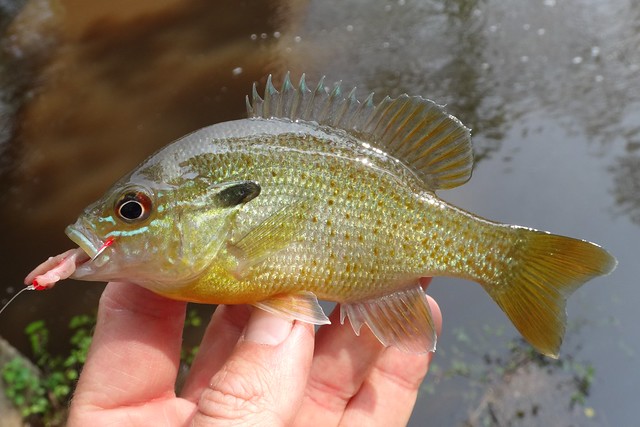
Redbreast Sunfish (Lepomis auritus)
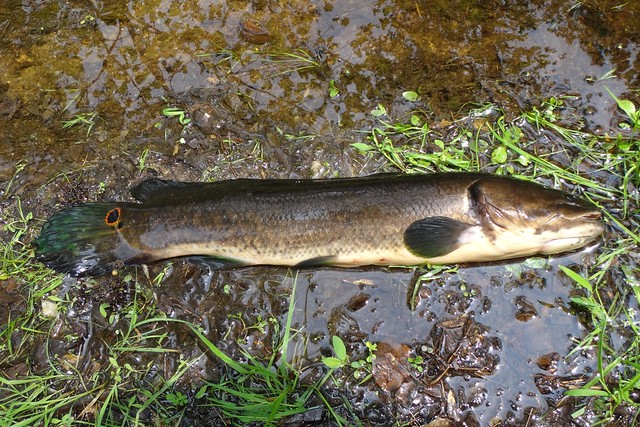
Pat took me to the spot where he had netted mud sunfish in the past.  We poked around the edge of the pond, dropping tiny baits where we thought small fish might be hiding waiting to ambush tiny baits.  I don't think we got a single bite.  While Pat was exploring down a small creek I found an injured bowfin in the shallows.  I'm not sure what was wrong with it, but unfortunately it didn't look like it would make it.

Bowfin (Amia calva)
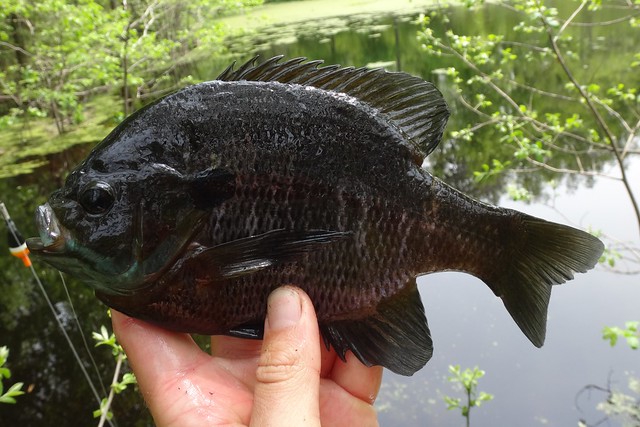
We  hiked to the next pond, which was a little bigger and deeper.  Again, we didn't get any bites next to shore, so we added bobbers and cast to the center of the pond.  We started catching sunfish right away.  The cool thing about the fish in this pond is that they were waaaay darker than their counterparts living in clearer water.

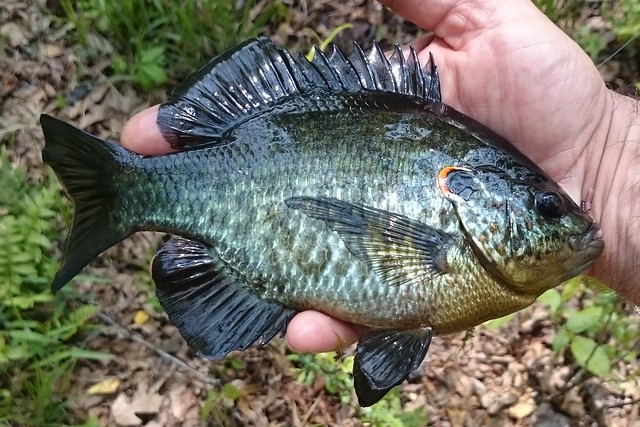
Bluegill (Lepomis macrochirus)


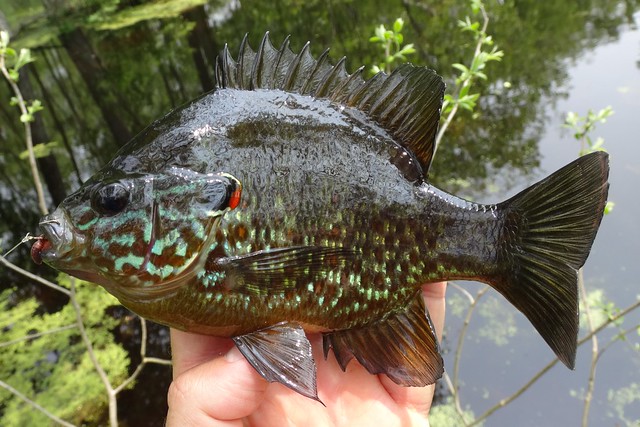
Pumpkinseed (Lepomis gibbosus)
Pat caught the one redear sunfish of the day.

Redear Sunfish (Lepomis microlophus)


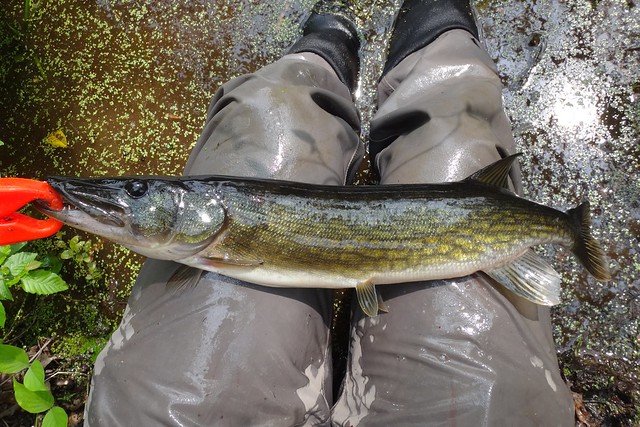
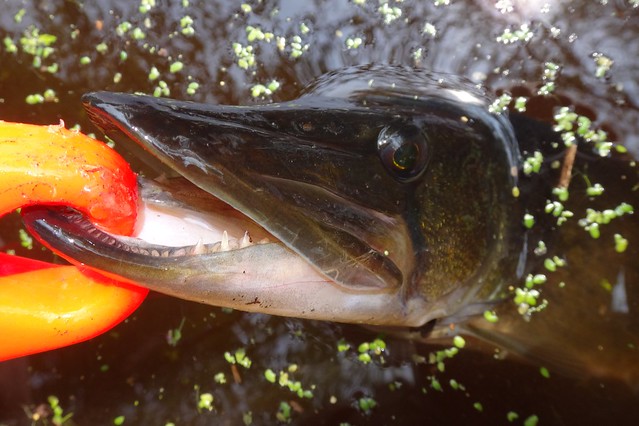
On  one of my casts, something viciously attacked my bobber.  I had a suspicion what the culprit was, so I tied on a large spinner and cast to the same spot.  As soon as my lure hit the water, I got a hit and pulled in this big chain pickerel.  It was my first time catching one from the east coast.

Chain Pickerel (Esox niger)
I'm glad Pat had his fish grippers, because pickerel are hard to hold on to!

Pat had a similar encounter with a predatory fish, but his turned out to be a very dark bowfin.  It was cool to see so much diversity from one little pond.

Bowfin (Amia calva)
Pat knew there were flier in this pond, so he set to work figuring out where they were.  Eventually he found a school of them hanging out underneath the branches of a tree.  He told me to cast my bait there, and I immediately caught one as well.

Flier (Centrarchus macropterus)
We  had one more pond to try, and this one was small and very shallow.  We switched to our smallest hooks and hopped in with our waders.

Fish weren't out in the open, so we fished our baits close to vegetation and submerged wood.  The easiest fish to find were juvenile warmouth with their proportionally large mouths.

Warmouth (Lepomis gulosus)
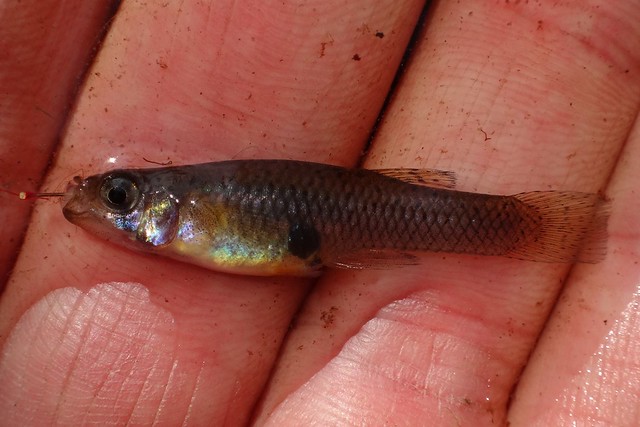
Mosquitofish were in the dense mats of vegetation and could be caught by dragging your bait along the surface of the water.

Eastern Mosquitofish (Gambusia holbrooki)
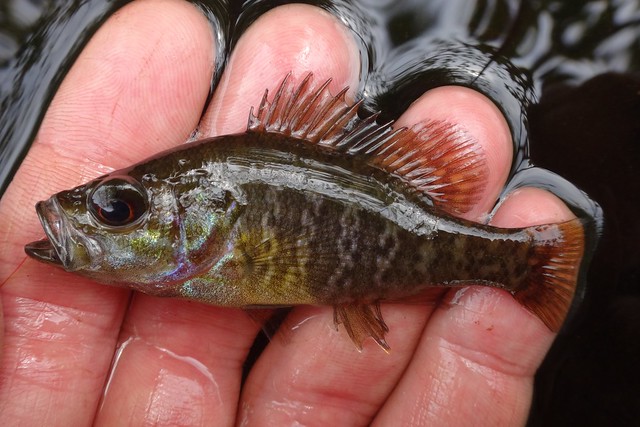
The coolest fish in this pond were the tiny bluespotted sunfish.  They were harder to find, but if you fished your bait right up against submerged wood you could usually get one to come out and grab it.  They were beautiful.

Bluespotted Sunfish (Enneacanthus gloriosus)


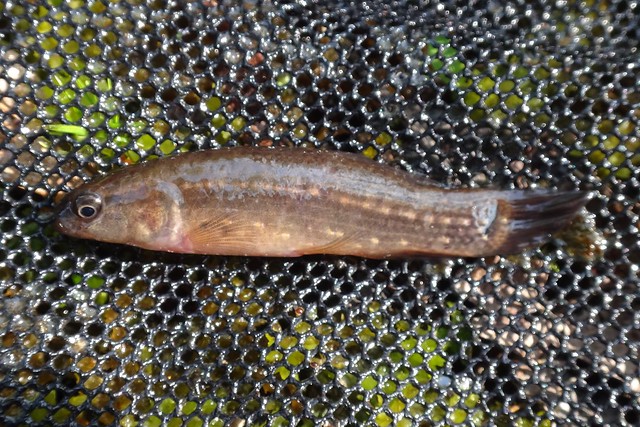
Daylight was running out, so I grabbed Pat's dip net to see what we missed out on.  Lots of the three species above, a few salamanders or newts (sorry I'm not an amphibian guy), and this one lone mudminnow.  I don't have one on my lifelist, but my hopes of catching one on hook & line were slim to none at this spot.  Perhaps during a different time of year they would be more common and larger.

Eastern Mudminnow (Umbra pygmaea)
Thanks Pat for taking me to more of your secret spots!  I hope I can try for mud sunfish and eastern mudminnow again someday.
Saturday, May 7, 2016

D.C. and Virginia part 1 - Potomac River

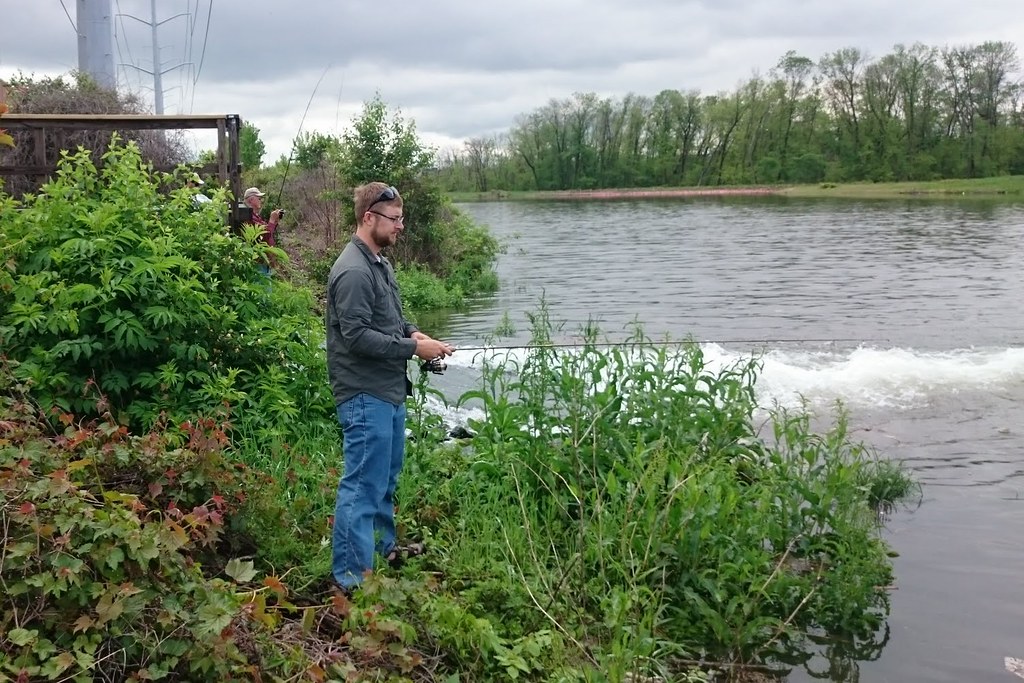
In the second week of May I traveled to D.C. to visit my friend Pat Kerwin.  It was the first time I took a flight for the sole purpose of a fishing trip!  We had been talking about a snakehead and shad trip for quite a while, and I was excited that the time had finally arrived.  My flight landed late Friday night - well after midnight - but I felt well rested the next morning and ready to fish.  We started off at a small discharge to see if I could get my lifer striped bass out of the way.

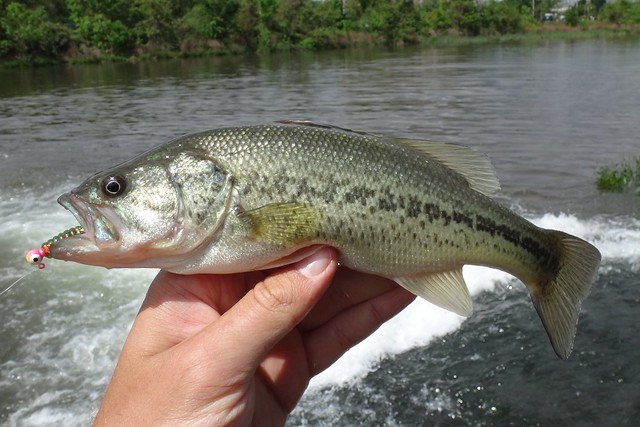
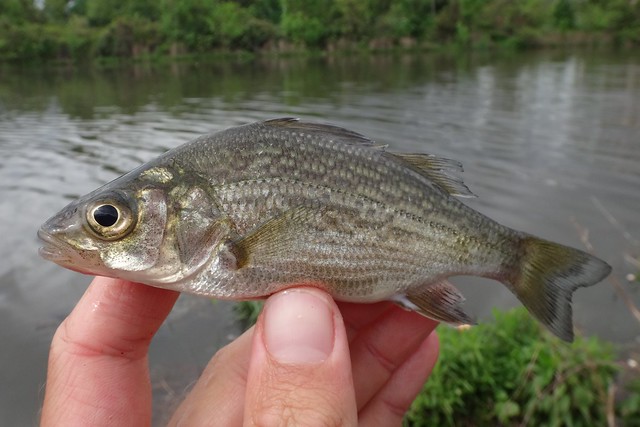
We  were surprised to find our friends Michael and George already at the discharge when we arrived!  Pat and I knew they would be in town, but we hadn't made any plans to meet them that morning.  It was good to finally meet George in person, because he would be joining our group to Peru later in the summer.  Fishing was slow, and I wasn't able to catch my striper.  I did catch a few bass and white perch.

Largemouth Bass (Micropterus salmoides)


White Perch (Morone americana)


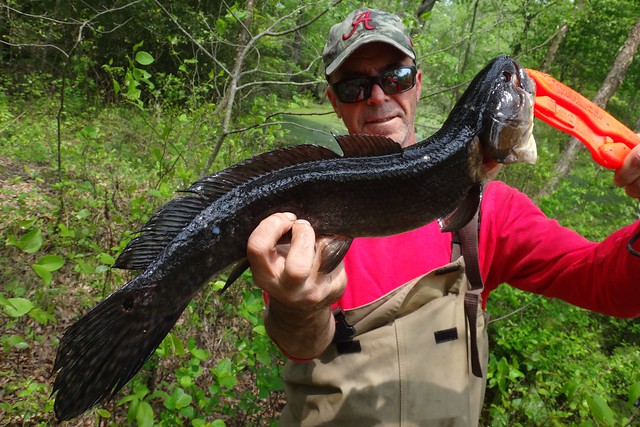
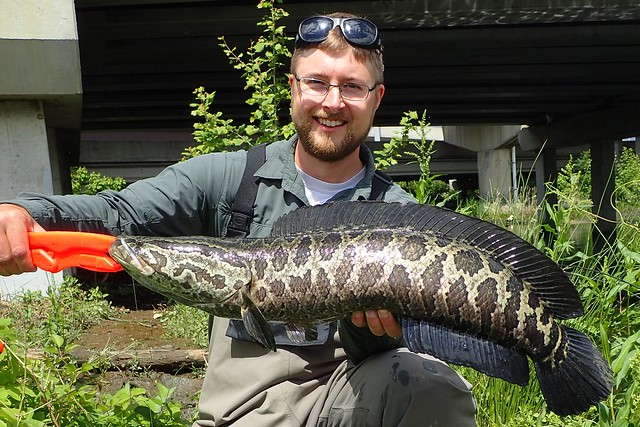
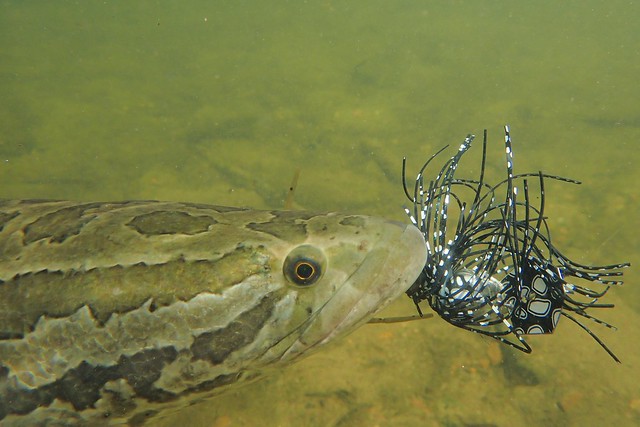
After lunch Pat and I headed to his top secret snakehead spot.  It was a huge privilege to be taken there.  On the way we tossed chatterbaits at a couple of spots where Pat has caught snakehead before, but we didn't get any hits.  The water was muddy, so all we could do was fish close to structure where we thought fish might be hanging out.  The water at Pat's good spot is clear, and when we arrived we could see nearly a dozen snakeheads hugging the bottom.  On my first cast I hooked up, but the fish came off.  Second cast hooked up again, and this time the fish was on!  Snakehead can swim backwards by undulating their long dorsal fin, which makes for a very unusual fight.  It's kind of like playing tug of war with a small bulldog.  It didn't take too long to bring it in though, and man was I stoked when I saw the size of it.  30 inches and beautiful fins and markings.  Thanks so much Pat!

Northern Snakehead (Channa argus) - new hook & line species #329
I made quite the ruckus bringing my fish in, but Pat was able to hook into one as well before the rest of the fish spooked and took off.  He played around with under water photographs while I was trying to recover my chatterbait, and some of the photos turned out really well.

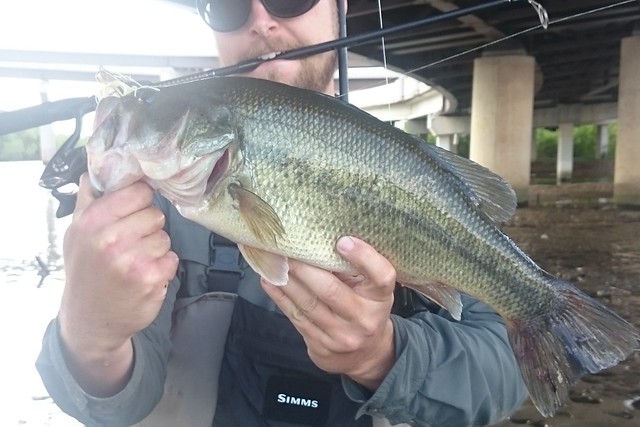
It  really was a bummer that I spooked the rest of the fish.  We tried the current seam where the clear water met the muddy water, had a few follows, but did not get hit.  Our only option was to continue on and see if we could find more fish elsewhere.  I saw a few snakeheads as I was wading in shallow water, but they always saw me as well and refused to bite.  My last fish from this spot was a nice largemouth bass that hit right next to one of the bridge pilings.

Largemouth Bass (Micropterus salmoides)


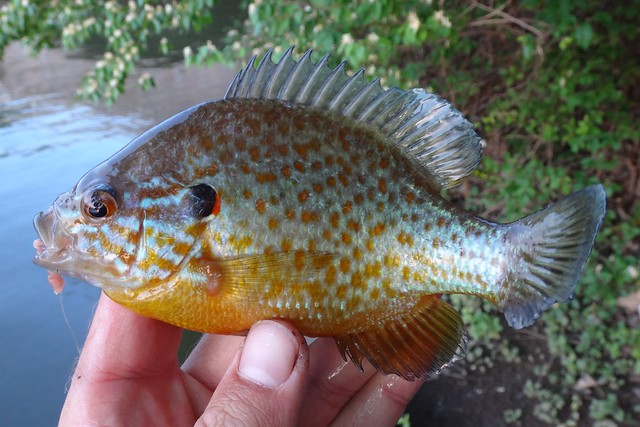
In  the evening Pat's wife Lia joined us, and we headed down to the Potomac River's tidal basin near the Washington monument.  We saw a few snakehead here as well, but they refused to bite.  After a while we put away our lures and switched to worms and cut bait.  We caught a variety of sunfish, white catfish, channel catfish, and striped bass.

Redbreast Sunfish (Lepomis auritus)


Pumpkinseed (Lepomis gibbosus)


White Catfish (Ictalurus catus) - new hook & line species #330


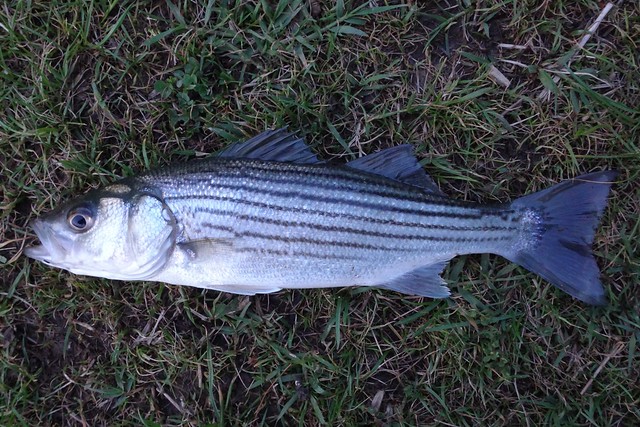
My  lifer striped bass hit a small pearl colored curly tail jig.

Striped Bass (Morone saxatilis) - new hook & line species #331


Lia wandered off in search of her lifer striped bass as well.  She came back successful, and of course hers was bigger than mine.


Several of the white and channel catfish were missing one or both of their eyes.  I have not seen this in the midwest.  I'm curious if they're being born this way in the Potomac or if something is attacking their eyes when they're young.  The catfish seemed to be in good health regardless of how many eyes they had.

Channel Catfish (Ictalurus punctatus)
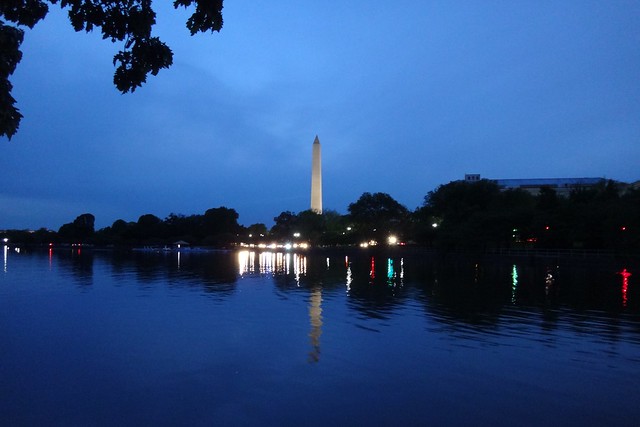
It's hard to keep your fishing spot a secret when one of our most famous national monuments is in the background, haha.  Thank you Pat and Lia for a fantastic first day of my trip.

Thursday, May 5, 2016

Shorthead redhorse in the rain

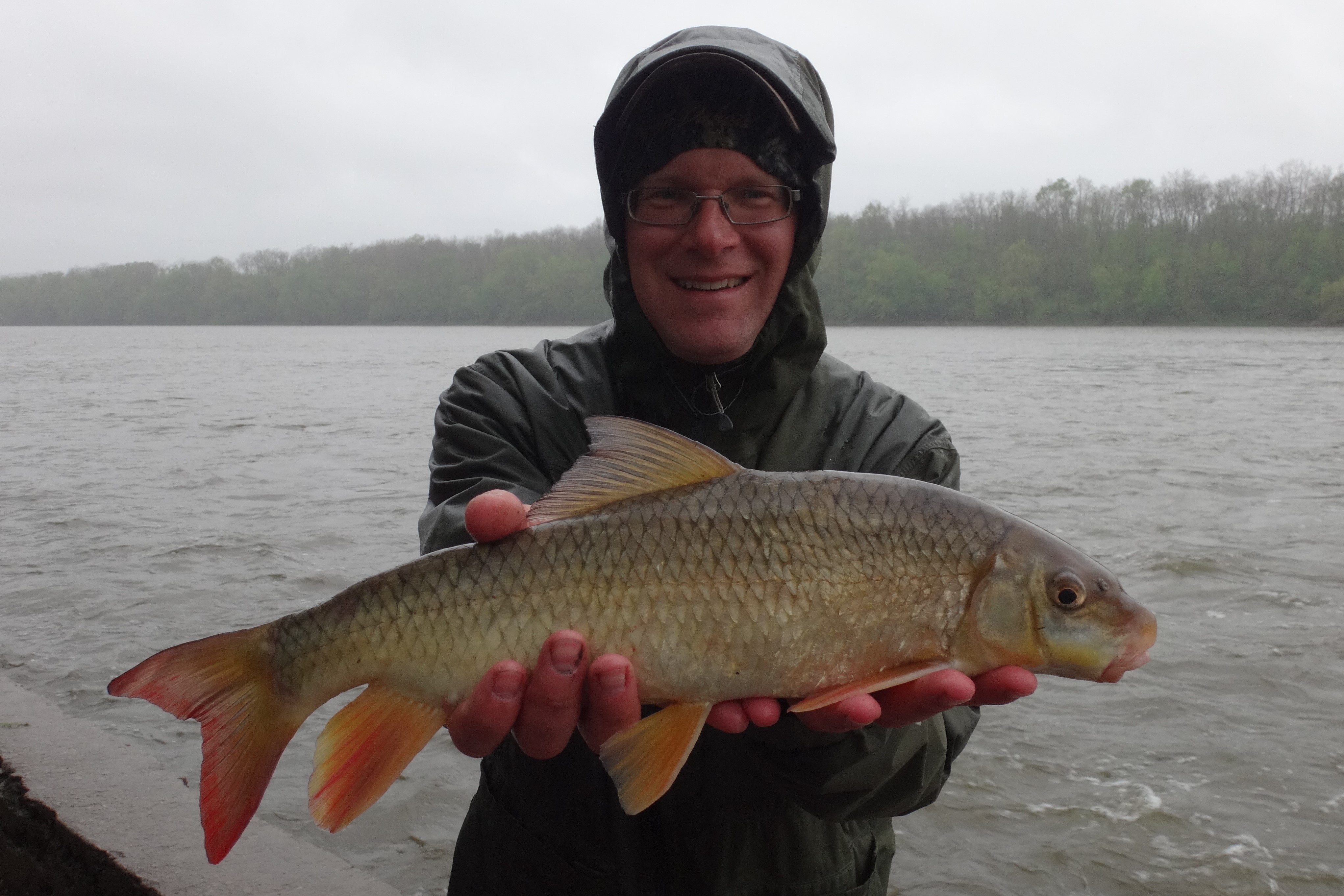
Last weekend my friend Matt Miller was in Iowa visiting family, so I met up him at the Rock River near Moline to do a little fishing.  It was cold and rainy.  I caught one smallmouth bass before he arrived, and then we each caught one shorthead redhorse.

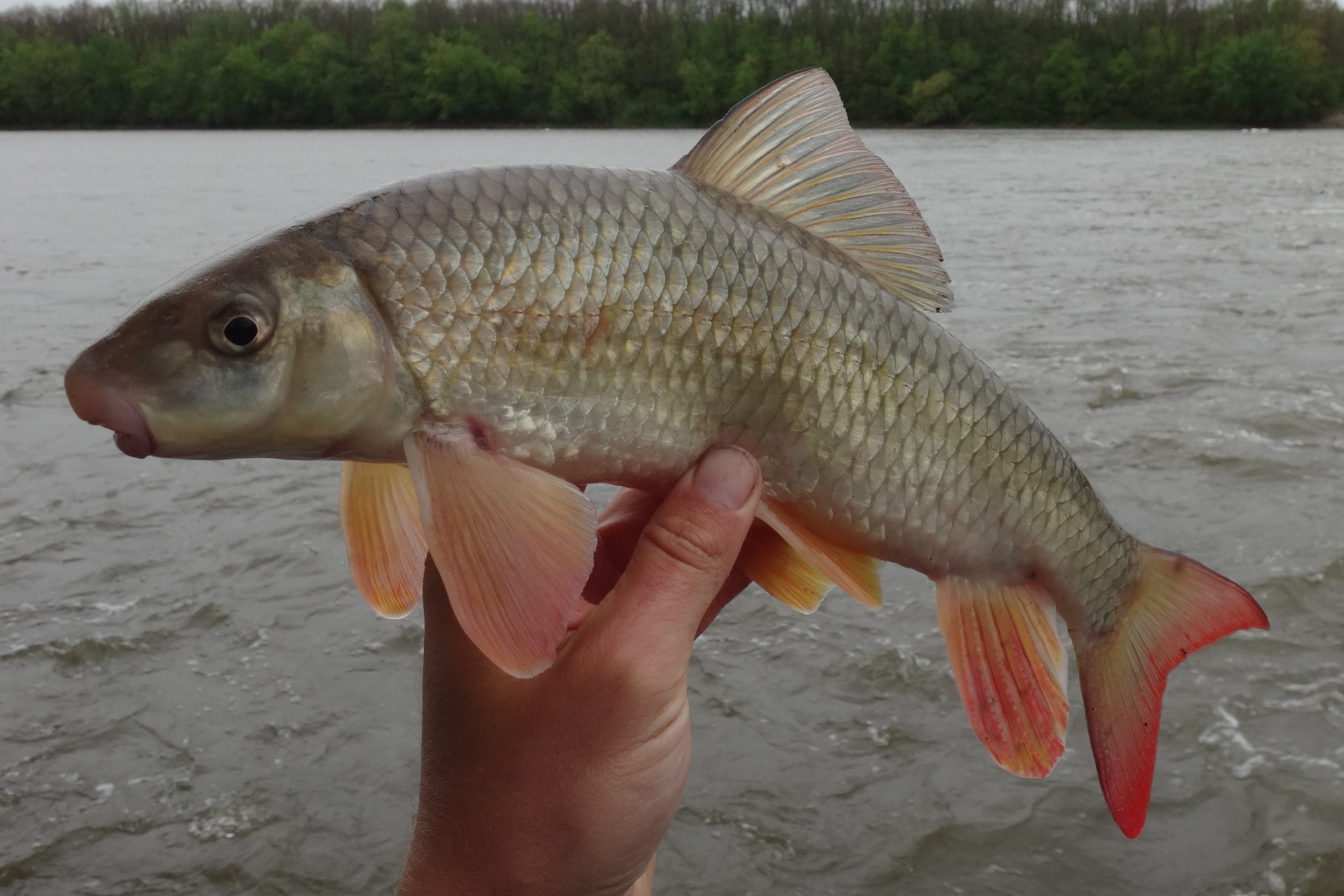
Shorthead Redhorse (Moxostoma macrolepidotum)

Mine was clearly a male.


And I'm guessing Matt's was a female.


It was really cold and really wet, but at least we caught some fish.  It was good seeing you again Matt!

Saturday, April 23, 2016

Illinois River carp

I've been on the road a lot this spring, so it was nice to check out some spots close to home for a change.  A biologist with the DNR gave me two local spots to try for black buffalo.  One was an old lock channel on the Illinois River, and the other was the mouth of the Spoon River.

Paul Kessler, another Peoria-area fishing enthusiest, joined me for the day.  We started off at the old lock, chumming with corn and alfalfa pellets, and then rigging up with corn and nightcrawlers.  The corn took a while to bring the carp in, but Paul was able to hook into one right away using a nightcrawler.  It was a good start to the day!

Common Carp (Cyprinus carpio)


My bottom rig with corn got picked up next, and instead of being a common carp or buffalo, it was a grass carp, which was a species we did not expect!  Grass carp usually feed on vegetation and are often seen near the surface.  I guess they feed off the bottom too!

Grass Carp (Ctenopharyngodon idella)


About an hour after we started chumming the common carp really showed up in force.  We probably caught fifteen to twenty of them.  We weighed one of the larger ones at 9 lbs 10 oz.


My next fish was the largest of the day.  We didn't get a weight, but it was a big fat fish!


Paul had a lot of fun catching carp.  This was a new type of fishing for him, and I'm glad we had a lot of action so he could get the hang of it.  Paul is a quick learner, and now he knows everything I do about carp.


The only fish besides carp were a bunch of small drum and one white bass.  Drum are fun when they're big, but they're a nuisance when they're small.  They're also infamous for swallowing the hook so deeply that you have no choice but to cut the line.  Fortunately, most of the ones we caught were hooked in the front of the mouth.

Freshwater Drum (Aplodinotus grunniens)


After the old lock we drove down to the Spoon River and launched our kayaks.  We paddled down to the mouth where it joins the Illinois River.  I fished from shore for a while and caught some drum.  Paul explored the Illinois a bit, then he came back and we both fished the mouth from our kayaks.  We both caught drum, and Paul got one small channel catfish.  I'm sure this is a great fishing spot, but we weren't getting anything else so we didn't stay too long.

The search for a black buffalo continues!

Sunday, April 17, 2016

Quick stop at Rend Lake spillway

I couldn't complain after catching two new lifers in Kentucky (bluntface shiner and bandfin darter), but after the sharp rocks of death and the bulldozer pushing mud into the creek, I was ready to head back to Illinois.  My route took me past Rend Lake, so I stopped at the spillway to fish for a bit (a bit ended up being multiple hours, funny how that happens).


The water was fairly low, and surprisingly there weren't many people fishing.  Usually the concrete ledge separating the rocks and the side channels is packed with people.  I was able to grab the spot right up near the discharge.  I tied on a white curly tail jig and immediately started hooking up with gizzard shad.  None of them were hooked inside the mouth though.

Gizzard Shad (Dorosoma cepedianum)


I saw a few of the shad chasing my jig and actively biting at it.  The jig was pretty big, so I tried switching to a smaller size.  However, with the current and turbulence I wasn't able to get it down to them.  I should have rigged something up with jigs above a sinker.  Oh well.  I switched back to the heavier jig and hooked up with a really nice hybrid striped bass.  This was great, because I need a photo of one!  I kept it in my landing net as I got my camera out, but someone how it spit the hook and flopped back in the water.  Really glad it wasn't a lifer.

For a while the bite really died down, but an hour or so later it picked back up, and this time it was freshwater drum that were biting.  Drum on artificials is unusual for me, and they were nice big fish, so catching them was a lot of fun!

Freshwater Drum (Aplodinotus grunniens)


I was catching them at the current seam between the discharge and the side pool.  My 8 lb line was plenty strong for low current situations, but here I had to be careful not to let the fish head downstream in the current discharge.


Each one was bigger than the last.  They weren't monsters, but they were fun.


The drum bite died off as quickly as it had turned on.  I stopped getting hits, and the only fish I pulled in after that was a foul hooked smallmouth buffalo.  It was a male with spawning tubercles.  I didn't try bottom fishing at this spot, but I'm curious if buffalo could be caught in the pools on either side of the discharge.  Future trip perhaps?

Smallmouth Buffalo (Ictiobus bubalus)


Buffalo are handsome fish, that's for sure.


I didn't pay attention to the time, so I had to make the long drive back to Peoria in the dark.  It was midnight when I finally arrived home.  It was a tiring but very productive trip.  Five new lifers in a two day weekend is not something to be taken for granted!