Monday, October 5, 2015

Hurricane pier fishing in North Carolina

I'm in North Carolina this week, and over the weekend I was able to visit some family in Greensboro and head to the coast for a bit of fishing. It wasn't the best time to be in the area, because Hurricane Joaquin is currently offshore. Joaquin didn't actually hit the coast, but its low pressure zone is causing historic amounts of rain and fairly steady 20 to 25 mph winds in the region. This was one of those trips where you make lemonade out of lemons, so my friend Ali (who I met while fishing in NC two years ago) and I decided to give it a shot anyway. We decided to avoid the ocean piers and go to a smaller pier in the Intercoastal Waterway near Morehead City.

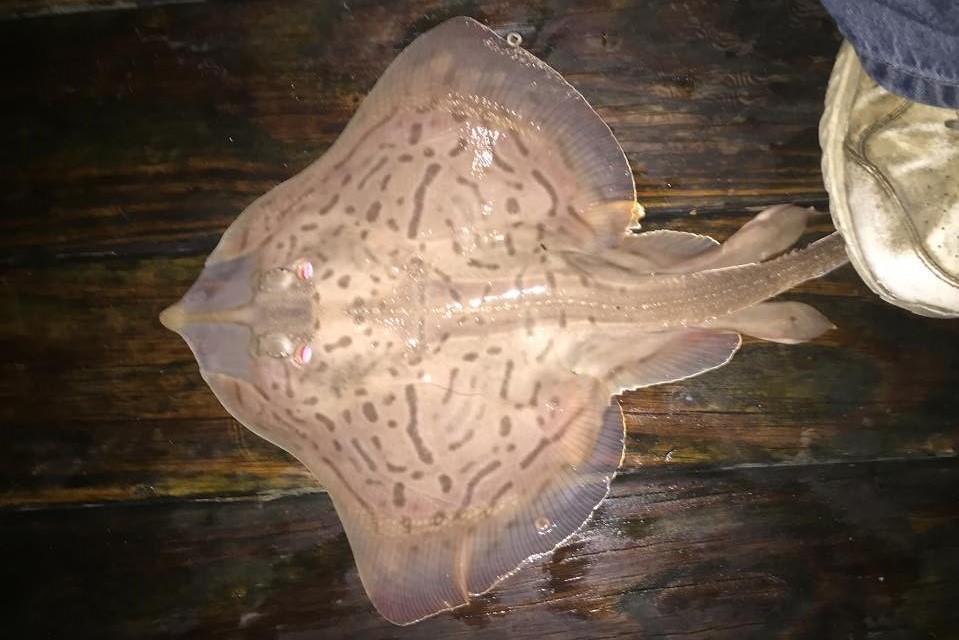
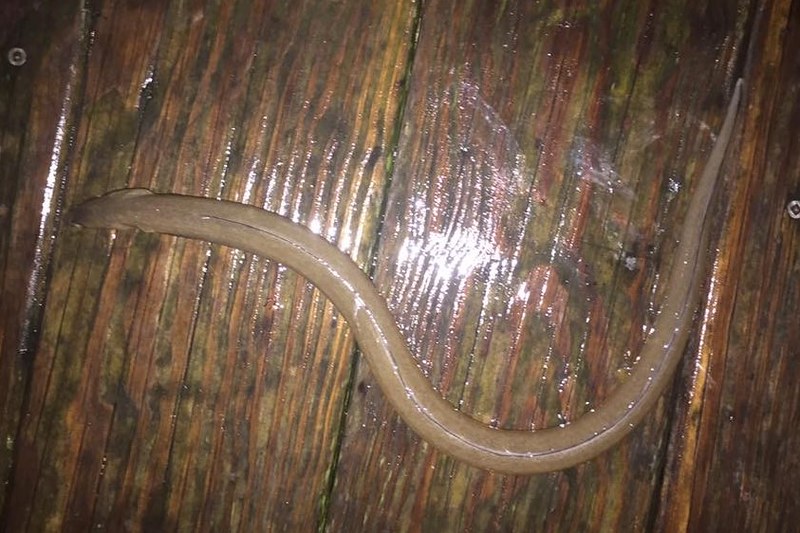
By the time we arrived at the pier I had been awake for nearly 23 hours, so I promptly went to sleep in the front seat of the car. I didn't care how many species I was potentially missing out on - sleep was a necessity. Ali, on the other hand, was eager to fish and joined a couple other fishermen at the end of the pier. As the tide was moving they did pretty well catching rays, skates, eels, and a variety of bottom fish like whitings and croakers. Ali shared these photos with me once I woke up from my near-comatose slumber.

Atlantic Stingray (Dasyatis sabina)


Clearnose Skate (Raja eglanteria)


Shrimp Eel (Ophichthus gomesii)


Around 5am I woke up with a jolt. It was time to fish! I assembled my travel rods and made my way out to join Ali and his new fishing buddies. Right away Ali and the guy next to him hooked up with a nice ray. Ali's hook was in it's mouth, and the other guys' rig was tangled up in Ali's line, so turned out to be an awkward team effort bringing it in.

Southern Stingray (Dasyatis americana)


I wanted a ray quite badly (Atlantic and southern would be new for me), but the bite died down as the tide slowed and the sun began to rise behind the clouds. Our luck of not getting rained on too much ran out when we saw a big storm front approaching. The rest of the day was on and off heavy rain and constant wind.


The bite started off slow once I had bait in the water. My first catch was this silver perch, a species that I only recently added to my lifelist when I was in Louisiana earlier this year.

Silver Perch (Bairdiella chrysoura)


At low tide we caught a few hermit crabs. They were pretty cute, and since we weren't catching many fish we didn't mind them stealing our baits from time to time.


In the late morning the bite picked back up. Unfortunately it mostly consisted of pigfish and pinfish, two species that are ubiquitous to the Atlantic coast. They're handsome fish though, and it was nice to have a more steady bite.

Pigfish (Orthopristis chrysoptera)


Pinfish (Lagodon rhomboides)


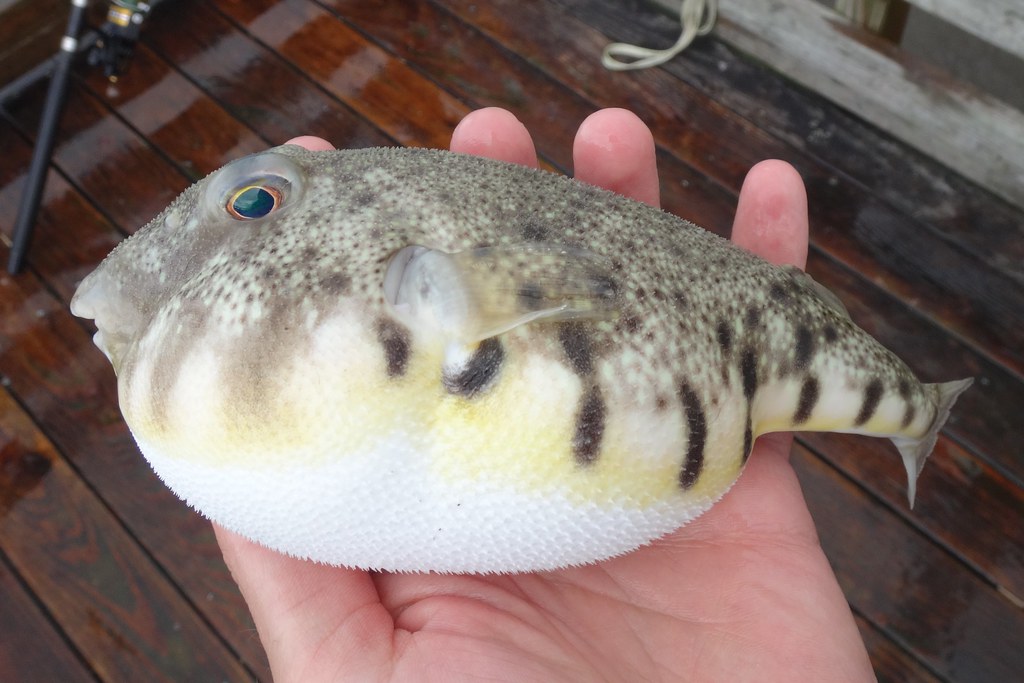
In the early afternoon I finally caught a new lifer, a northern puffer. It was hanging out close to one of the pier's wooden pilings. I'm lucky I got a photo of it, because as soon as I got it over the railing it bit through my 8 lb fluorocarbon line. He posed nicely for a photo and swam off quickly when I released him.

Northern Puffer (Sphoeroides maculatus) - new hook & line species #313


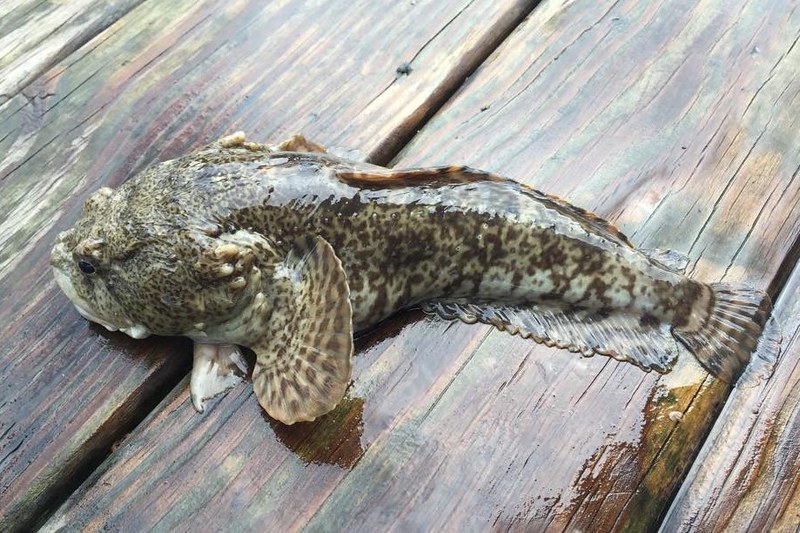
Ali caught his first toadfish when he fished close to one of the pilings. He was quite pleased about it!

Oyster Toadfish (Opsanus tau)


Later in the afternoon the outgoing tide was moving pretty good. As the grass and other debris floated by, we caught a few other interesting species. This spottail pinfish was especially large. I had never seen one with blue pelvic fins.

Spottail Pinfish (Diplodus holbrookii)


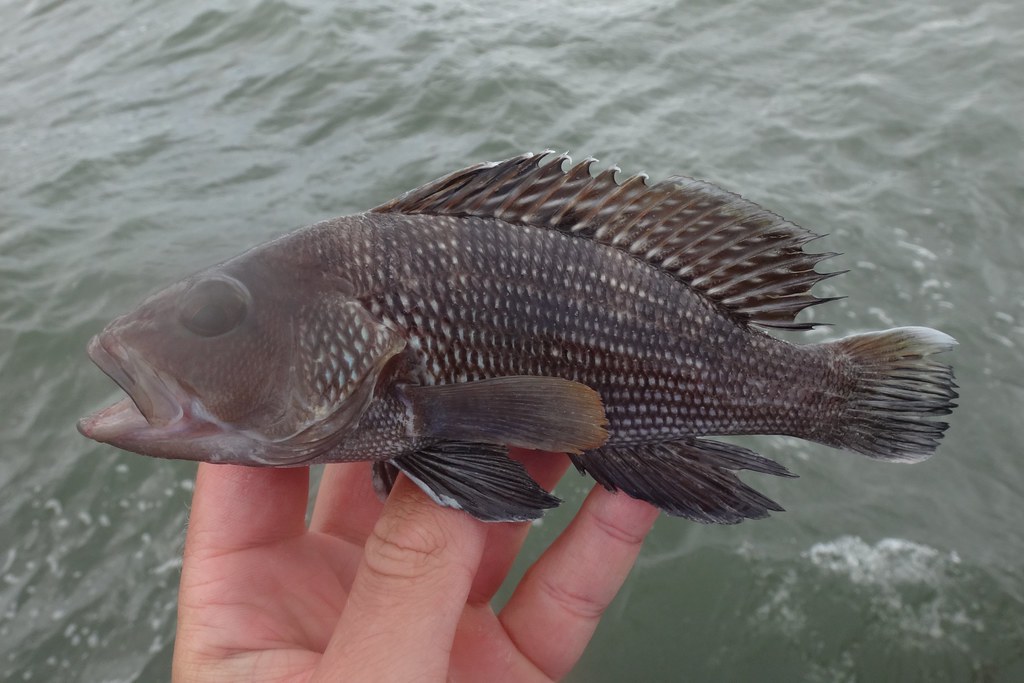
Black Sea Bass (Centropristis striata)


Even though we could have fished quite a while longer, the rain and wind kicked our butt, so we packed up around mid-afternoon. As we moved away from the coast the rain switched from sudden bursts to a steady drizzle. Ali's dog and I were pretty out of it, and I'm glad Ali brought us back safe.


This was a day of fishing unlike anything else I've experience, and I'm happy we did it. I'm also glad I was able to get a lifer! Huge thanks to Ali for driving from Chapel Hill to the coast and finding a somewhat sheltered pier for us to fish.

Saturday, October 3, 2015

Captain Eli and the California tuna

Ruoxi moved to southern California this summer, and last weekend I was able to fly out to see her.  We had a great time, and Ruoxi demonstrated how much she loved me by agreeing to a day of offshore fishing.  On Sunday we drove to Newport Beach to meet up with Eli W, a local species fishing legend and friend of a friend.  Ruoxi and I have met a lot of great people on our fishing trips, and Eli is right up there with the best of the best.


We launched our rental boat before sunrise, and by the time the sky begain to brighten we had purchased bait, a half scoop of anchovies, and motored outside the bay.


We saw people catching fish from the end of a jetty, and several boats were fishing in the area, so Eli told me to tie on a sabiki with a silver spoon on the end and start casting out.  Right away I hooked up with my first lifer of the trip!

Pacific Bonito (Sarda chiliensis) - new hook & line species #306


Ruoxi took over with the same rig, and while I unsuccessfully fished with an imitation shad swimbait, she hooked up with a bonito as well.


Next we headed offshore.  The water changed color from a blueish-brown to the deepest blue you can imagine.  Our depth finder wasn't working, so we didn't know how far down the bottom was, but we knew it was deep.  We stopped whenever we found a floating kelp paddy.  Each one, even the ones no larger than a coffee table, had dozens of yellowtail jack swimming beneath.  We freelined live anchovies to them, and usually it only took a minute or two to hook up.

Yellowtail Jack (Seriola lalandi) - new hook & line species #307


Occasionally we couldn't get the fish to bite.  There didn't seem to be any reason why some schools were biting and others were not.  At one of the bigger paddies, we saw a lone dorado swimming near the surface.  Eli tossed out a bait with one of his light rods, and the dorado hit it!


After a few minutes of fighting, I think Eli regretted using such light gear.  If he tightened his drag, his line would snap, so he had no choice but to take his time and let the dorado run when it wanted to run.  Once or twice it came to the surface and jumped, and Ruoxi was able to get a really cool photo of it in the air.


After a few more minutes, Eli got the dorado up to the boat and was able to grab it by hand.  We were all very excited about the catch!

Dorado (Coryphaena hippurus)


We were headed in the direction of Catalina Island, but we continued to stop at kelp paddies on the way.  We saw a large group of boats in the distance.  Eli excitedly said that there must be a tuna bite.  We caught up with the group, and sure enough there was a large kelp paddy in the middle.  However, several boats were giving up and leaving, and we even heard the captain of a party boat say that the bite had died down.  We stopped and freelined out anchovies anyway.  We also chummed with the ones that had already died in the livewell.  Pretty soon we saw blue and silver torpedos racing through the water.  My heart was pounding as I watched one of them slam my bait.  I let line peel off my reel for a few seconds before I closed the bail and lifted my rod tip up hard to set the hook.


The fight that followed was unlike anything I had ever experienced.  It wasn't even that large of a fish, but with the gear I was using, whenver it wanted to strip line off my reel, it stripped line off my reel.  Eventually I worked it up to the side of the boat, and Eli reached down to grab it by the tail.  My first California tuna!

Skipjack Tuna (Katsuwonus pelamis) - new hook & line species #308


Skipjack tuna would be a new lifer for Eli as well (there aren't many species in California that he hasn't caught), but for some reason we couldn't get any more fish to bite.  While we were fishing, we saw a hammerhead swim by.  It was attracted to all the activity.  I snapped a photo as it swam under my line.  If you look closely you can see my bait out past the end of the braided line (the fluorocarbon leader is invisible in the water).

Smooth Hammerhead (Sphyrna zygaena)


Eli was persistent, and eventually he caught his skipjack tuna.  We were very glad he got one!  It turned out to be the first of many, because the next spot was loaded with them.  Within seconds of your bait hitting the water, a tuna would come racing up and slam it near the surface.  Ruoxi had no problem hooking up with one


After a tiring fight that started with a cut finger and ended with sore muscles, Ruoxi joined the skipjack tuna club as well!


Eli caught one or two yellowfin tuna at this spot, but all I could catch were skipjack.  I was beginning to worry that I wouldn't get my lifer yellowfin.  Eli moved us closer to the kelp paddie, and again I hooked up with a strong fish.  I couldn't tell what it was, but something about the way it pulled was enough for Eli to declare that it was a yellowfin.  The next few minutes were intense.  My forearms were hurting, and I really did not want to lose this fish.  When I brought it close enough to the boat to see it, Eli and I both saw the yellow on the fins.  Eli grabbed it by the tail, and I added yet another tuna species to my lifelist.

Yellowfin Tuna (Thunnus albacares) - new hook & line species #309


With our tuna fishing a success, we continued west until we reached the southern tip of Catalina Island.  The steep slope of the shoreline was impressive.


The dropoff was so steep that even though we were very close to shore, the water depth was still several hundred feet.  Twenty or thirty feet below the boat we could see a large school of halfmoon, a type of sea chub.  They were easy to catch using a sabiki baited with pieces of squid.

Halfmoon (Medialuna californiensis) - new hook & line species #310


When we dropped our baits to the bottom, we caught ocean whitefish, which are a type of tilefish.  I've wanted a tilefish for a long time, so it was great to finally catch my first one, regardless of how small it was.

Ocean Whitefish (Caulolatilus princeps) - new hook & line species #311


As we drifted a little closer to shore the bite changed abruptly from ocean whitefish to kelp bass.  We assumed that the bottom had transitioned to kelp.  This was the only species of fish I caught on the trip that was not a new lifer.

Kelp Bass (Paralabrax clathratus)


Ruoxi wanted a kelp bass as well, so she dropped a sabiki to the bottom and caught one right away.  As usual, hers was bigger than mine.


We were running out of time, but before we wrapped up we moved closer to shore to see if we could catch something else, like a blacksmith or mackerel.  However, the only fish that took my bait was the garibaldi below, which is a protected species in California.  After taking a few photos I quickly released it, and we packed up to head back to Newport Beach.

Garibaldi (Hypsypops rubicundus) - new hook & line species #312


Eli and Ruoxi took turns driving the boat back towards shore, and they both did excellent jobs.  We can't thank Eli enough for being our captain for the day.  Ruoxi and I knew very little about offshore ocean fishing, and Eli was a great teacher.  He showed us how to cast out sabikis and reel in quickly to catch bonito, how to scout out kelp paddies on the open ocean, and how to freeline live bait to catch pelagic fish.  We can't wait for our next offshore trip!


Expect more posts from California in the future!

Edit:  I guess I need to clarify - Eli is not an actual licensed captain.  I didn't pay him for the trip.  We split the cost of the rental boat, gas, and bait.

Monday, September 7, 2015

Hot hot hot in southern Illinois and Missouri

Over the holiday weekend I had plans to meet up with Garren and Gabriele, a recent fishing acquaintance, to visit southern Illinois for gar, bowfin, shovelnose sturgeon, and of course a few micros.  However, Gabrielle had some health issues come up (he'll be fine), so he had to cancel.  Garren and I decided to continue with the trip after making a few modifications to our plan.  We started Saturday morning at the Kaskaskia River Lock & Dam located just before the Kaskaskia River joins the Mississippi River.


I was hoping for buffalo (a black to be precise), but mostly I was curious to see what this spot was like.  Water was low, and we didn't get many bites.  Garren caught a blue catfish and the big drum below.  I skunked out.

Freshwater Drum (Aplodinotus grunniens)


We drover further south to the Shawnee Forrest.  This part of Illinois looks nothing like the rest of the state.  A few hundred yards of floodplain end abruptly with a line of steep, shear bluffs.


We fished a creek that connects a swamp to the Mississippi River.  Garren caught a huge tadpole madtom, and both of us caught a number of bantam sunfish, which are a threatened species in Illinois.  We released them unharmed after taking a few photos.  There were also a few bluegill and warmouth mixed in, but bantams seemed to be the most abundant sunfish in this creek.

Bantam Sunfish (Lepomis symmetricus)


Warmouth (Lepomis gulosus)


For our last stop of the day, we visited a favorite creek that I've been visiting for a number of years.  We caught quite a few species here, including the three below.  This is the only spot in Illinois where you can find bleeding shiners.

Longear Sunfish (Lepomis megalotis)


Bleeding Shiner (Luxilus zonatus)


Slender Madtom (Noturus exilis)


While we were fishing, I heard a car slow down and come to a stop on the bridge behind us.  This isn't an unusual occurrence when you're microfishing in a creek, so I thought nothing of it.  But when I heard, "OHHH BENNNNNNY", I turned around!  There on the bridge was my friend Martini and his friend Steve, who have caught over 500 and 1400 species respectively.  By pure coincidence, they were coming to fish this spot on their road trip from Florida to Washington.  Months ago I had given Martini a handful of my best fishing spots in case he had time to stop and check them out during his road trip.  What are the odds that we all showed up at the same spot at the same time?

Martini and Steve rigged up and got to work catching new species.  It took a bit of effort for them to get their first madtoms and darters, but they both left victorious.

Garren was starting to get microfishing fatigue, but I think he picked up a number of lifers at this spot.  His lifelist has been steadily growing this year.

Once the sun set, we packed up and went in to town for some fast food dinner.  Thanks for treating Steve!  I wish we could have fished the next two days together, but they needed to stay on their itinerary so they would reach Washington on schedule.  Garren and I crossed over into Missouri to stay the night at a motel in Sikeston.

Sunday morning we got on the road early and fished a field drainage ditch nearby.  The water was surprisingly clear, and we saw schools of shiners in the water.


The schools consisted of mostly weed shiners, which was my first new lifer of the trip.  We may have caught a few other species mixed in.

Weed Shiner (Notropis texanus)  - new hook & line species #304


We continued west to Poplar Bluff and stopped to fish the Black River.  There is a long list of species there that would be new for me, but the only one I caught was blacktail shiner.  I was pretty happy to catch a good example of one!

Blacktail Shiner (Cyprinella venusta)  - new hook & line species #305


We saw a number of darters that we were unable to catch.  The other two species we caught were mimic shiners and carmine shiners.

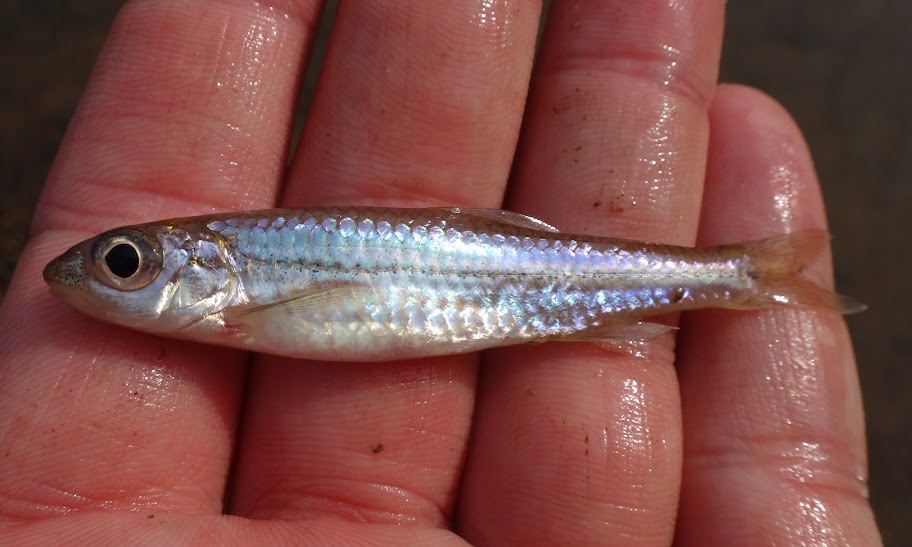
Mimic Shiner (Notropis volucellus)


Carmine Shiner (Notropis percobromus)


Around noon we headed north of town to the Wappapello Dam on the St. Francis River.  Here we met up with our good friend Tyler.  Tyler knows this area like the back of his hand.  We fished in the heat for a long while, bottom fishing with redworms and nightcrawlers in the fast current.  Garren caught a nice redhorse, we both caught catfish and drum, and I caught this nicely patterned spotted bass.  Did I mention it was hot?

Spotted Bass (Micropterus punctulatus)


We fished one last spot in the upper St. Francis River in the afternoon, but I didn't catch anything worth photographing.  Garren caught a few lifers though, and he even jumped in for a swim at one point.  I was overheating, so I took a break to sit on a rock and drink several bottles of water.  We continued north and stayed at a motel south of St. Louis.

Monday morning we fished the Chain of Rocks on the Mississippi River.  I had been looking forward to trying this spot for quite a while.  The water was low enough to see the chain, and we had great conditions for shore fishing.


Here I caught my first wild blue catfish.  The only ones I caught in the past were stocked fish at the Powerton cooling lake.  It was nice to catch one from the mighty Mississippi!

Blue Catfish (Ictalurus furcatus)


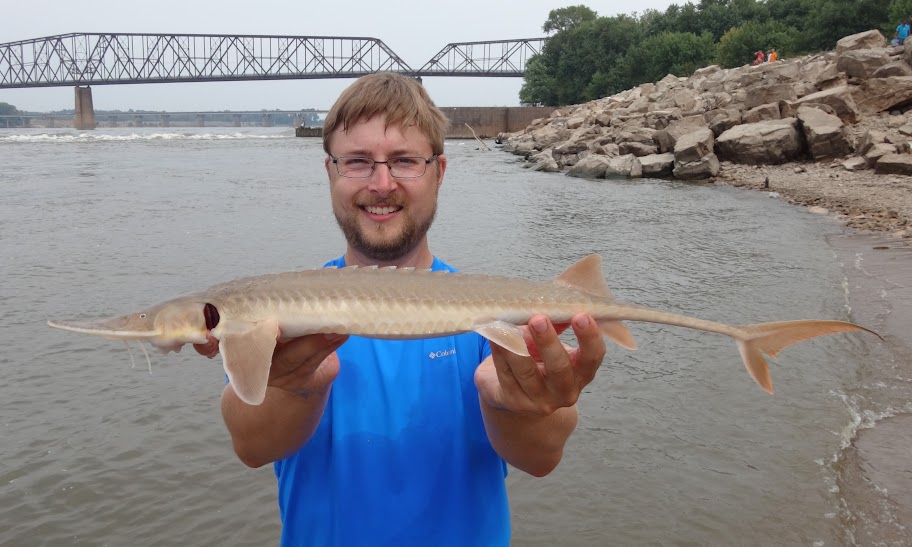
After a while the bite switched from catfish to shovelnose sturgeon.  Garren and I caught five of them in the roughly four hours we were there, and I lost another right by shore.

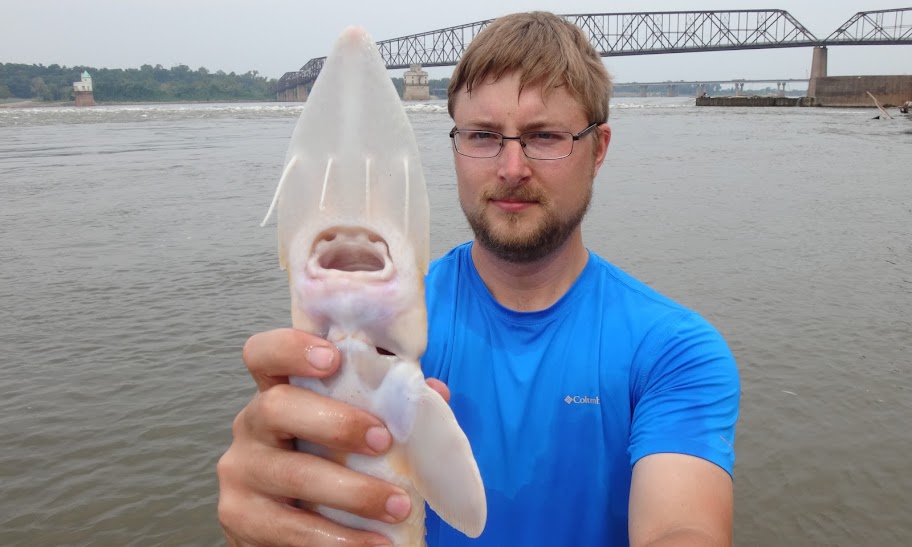
Shovelnose Sturgeon (Scaphirhynchus platorynchus)


Every time we caught a sturgeon, we checked it over carefully to make sure it wasn't the much rarer pallid sturgeon.  If the base of the four barbels forms a straight line, then it's a shovelnose sturgeon.  A curved line means it's a pallid.


One of the shovelnose sturgeon had a tag attached below its dorsal fin.  I still need to call the DNR to report it.  I'm hoping they can tell me some of the fish's history.


In the early afternoon we stopped at the Alton Lock & Dam to fish for a bit.  Garren caught a few micros, and I fished with my standard two jig setup for bigger fish.  Twice I had a big fish on, but somehow they both got off.  I'm not sure if they were foul hooked silver carp or something big that was fair hooked.  Whatever they were, they pulled hard and steadily and didn't shake their heads much.


Feeling tired but successful, we headed back to Garren's in the late afternoon, and I continued on back to Peoria after that.  It was a good trip!