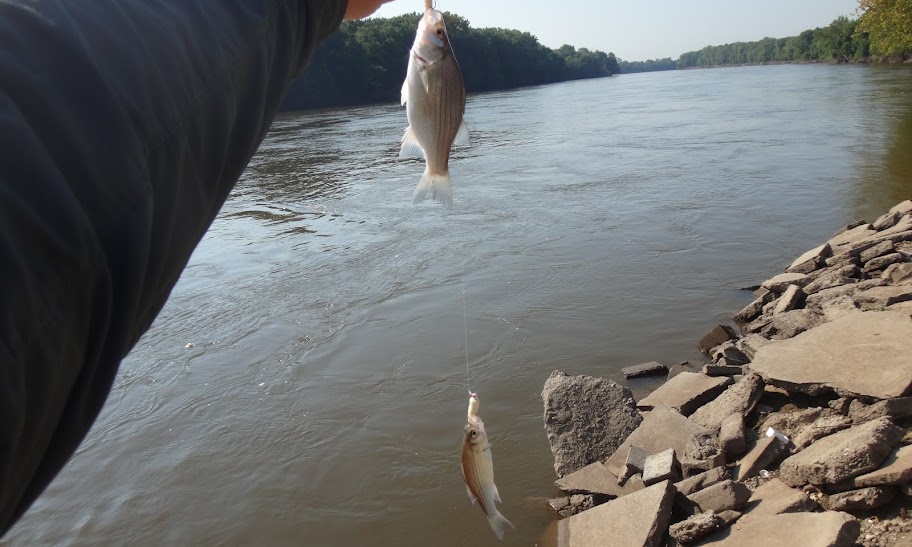
Over the holiday weekend I had plans to meet up with Garren and Gabriele, a recent fishing acquaintance, to visit southern Illinois for gar, bowfin, shovelnose sturgeon, and of course a few micros. However, Gabrielle had some health issues come up (he'll be fine), so he had to cancel. Garren and I decided to continue with the trip after making a few modifications to our plan. We started Saturday morning at the Kaskaskia River Lock & Dam located just before the Kaskaskia River joins the Mississippi River.
I was hoping for buffalo (a black to be precise), but mostly I was curious to see what this spot was like. Water was low, and we didn't get many bites. Garren caught a blue catfish and the big drum below. I skunked out.
Freshwater Drum (Aplodinotus grunniens)
We drover further south to the Shawnee Forrest. This part of Illinois looks nothing like the rest of the state. A few hundred yards of floodplain end abruptly with a line of steep, shear bluffs.
We fished a creek that connects a swamp to the Mississippi River. Garren caught a huge tadpole madtom, and both of us caught a number of bantam sunfish, which are a threatened species in Illinois. We released them unharmed after taking a few photos. There were also a few bluegill and warmouth mixed in, but bantams seemed to be the most abundant sunfish in this creek.
Bantam Sunfish (Lepomis symmetricus)
Warmouth (Lepomis gulosus)
For our last stop of the day, we visited a favorite creek that I've been visiting for a number of years. We caught quite a few species here, including the three below. This is the only spot in Illinois where you can find bleeding shiners.
Longear Sunfish (Lepomis megalotis)
Bleeding Shiner (Luxilus zonatus)
Slender Madtom (Noturus exilis)
While we were fishing, I heard a car slow down and come to a stop on the bridge behind us. This isn't an unusual occurrence when you're microfishing in a creek, so I thought nothing of it. But when I heard, "OHHH BENNNNNNY", I turned around! There on the bridge was my friend Martini and his friend Steve, who have caught over 500 and 1400 species respectively. By pure coincidence, they were coming to fish this spot on their road trip from Florida to Washington. Months ago I had given Martini a handful of my best fishing spots in case he had time to stop and check them out during his road trip. What are the odds that we all showed up at the same spot at the same time?
Martini and Steve rigged up and got to work catching new species. It took a bit of effort for them to get their first madtoms and darters, but they both left victorious.
Garren was starting to get microfishing fatigue, but I think he picked up a number of lifers at this spot. His lifelist has been steadily growing this year.
Once the sun set, we packed up and went in to town for some fast food dinner. Thanks for treating Steve! I wish we could have fished the next two days together, but they needed to stay on their itinerary so they would reach Washington on schedule. Garren and I crossed over into Missouri to stay the night at a motel in Sikeston.
Sunday morning we got on the road early and fished a field drainage ditch nearby. The water was surprisingly clear, and we saw schools of shiners in the water.
The schools consisted of mostly weed shiners, which was my first new lifer of the trip. We may have caught a few other species mixed in.
Weed Shiner (Notropis texanus) - new hook & line species #304
We continued west to Poplar Bluff and stopped to fish the Black River. There is a long list of species there that would be new for me, but the only one I caught was blacktail shiner. I was pretty happy to catch a good example of one!
Blacktail Shiner (Cyprinella venusta) - new hook & line species #305
We saw a number of darters that we were unable to catch. The other two species we caught were mimic shiners and carmine shiners.
Mimic Shiner (Notropis volucellus)
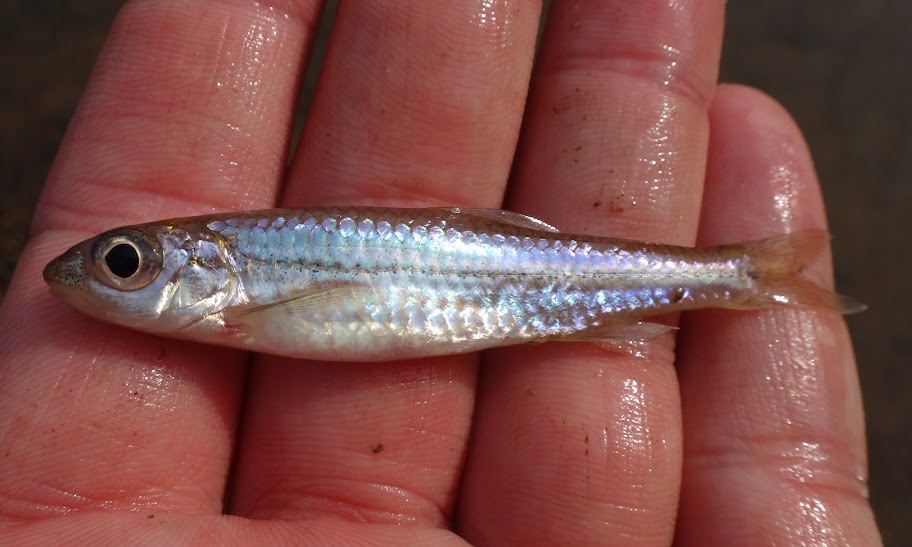
Carmine Shiner (Notropis percobromus)
Around noon we headed north of town to the Wappapello Dam on the St. Francis River. Here we met up with our good friend Tyler. Tyler knows this area like the back of his hand. We fished in the heat for a long while, bottom fishing with redworms and nightcrawlers in the fast current. Garren caught a nice redhorse, we both caught catfish and drum, and I caught this nicely patterned spotted bass. Did I mention it was hot?
Spotted Bass (Micropterus punctulatus)
We fished one last spot in the upper St. Francis River in the afternoon, but I didn't catch anything worth photographing. Garren caught a few lifers though, and he even jumped in for a swim at one point. I was overheating, so I took a break to sit on a rock and drink several bottles of water. We continued north and stayed at a motel south of St. Louis.
Monday morning we fished the Chain of Rocks on the Mississippi River. I had been looking forward to trying this spot for quite a while. The water was low enough to see the chain, and we had great conditions for shore fishing.
Here I caught my first wild blue catfish. The only ones I caught in the past were stocked fish at the Powerton cooling lake. It was nice to catch one from the mighty Mississippi!
Blue Catfish (Ictalurus furcatus)
After a while the bite switched from catfish to shovelnose sturgeon. Garren and I caught five of them in the roughly four hours we were there, and I lost another right by shore.
Shovelnose Sturgeon (Scaphirhynchus platorynchus)
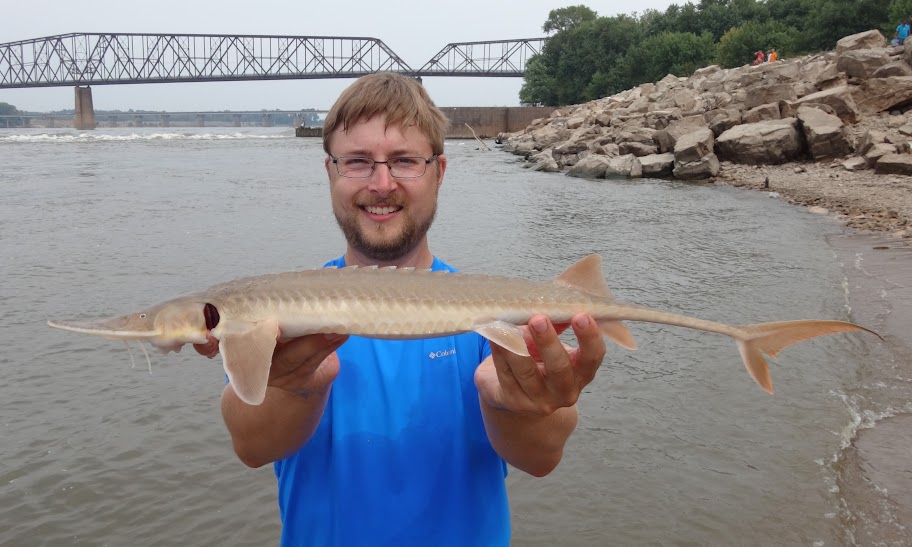
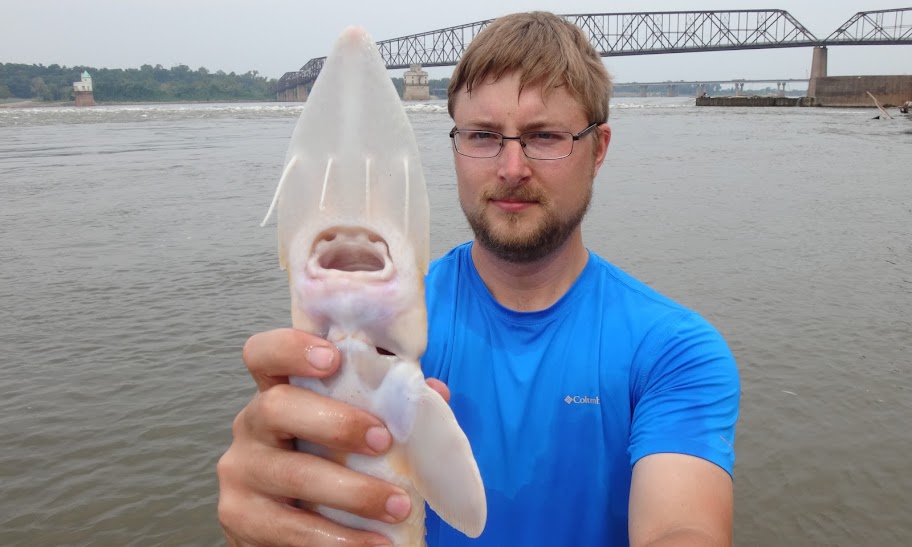
Every time we caught a sturgeon, we checked it over carefully to make sure it wasn't the much rarer pallid sturgeon. If the base of the four barbels forms a straight line, then it's a shovelnose sturgeon. A curved line means it's a pallid.
One of the shovelnose sturgeon had a tag attached below its dorsal fin. I still need to call the DNR to report it. I'm hoping they can tell me some of the fish's history.
In the early afternoon we stopped at the Alton Lock & Dam to fish for a bit. Garren caught a few micros, and I fished with my standard two jig setup for bigger fish. Twice I had a big fish on, but somehow they both got off. I'm not sure if they were foul hooked silver carp or something big that was fair hooked. Whatever they were, they pulled hard and steadily and didn't shake their heads much.
Feeling tired but successful, we headed back to Garren's in the late afternoon, and I continued on back to Peoria after that. It was a good trip!
Monday, September 7, 2015
Sunday, August 23, 2015
Hitting #300 with the last of the Nocomis
A week after my Illinois blitz, I was back on the road again. This time I was teaming up with Miciah to revisit parts of Tennessee that we had fished in February and some areas near the KY / TN border. We started our trip in Clarksville at the same spot where we skunked out trying for redtail chubs in February. This time the fishing was much better, but it still took us a while to find them. Miciah caught a great looking one first, and then I followed with the tank below. It looks like he survived an attack from a bass when he was younger. I don't know how big redtail chubs get, but this must be right up near the top in terms of size.
Redtail Chub (Nocomis effusus) - new hook & line species #300
It would have been neat to catch them in spring when their tubercles were showing. You can see the marks on its head where they used to be.
Next we headed south to another spot we visited in February. Soon after arriving it began raining pretty steadily, but luckily we were able to hang out under the highway bridge and stay dry. My photos from this spot didn't turn out very well due to the low light, but I did the best I could.
Scarlet Shiner (Lythrurus fasciolaris)
Fantail Darter (Etheostoma flabellare)
One of the fish we caught at this spot was blackfin darter. There are very few photos of this species online, and none of them are high resolution, so I was really hoping to get a good photo. The one I caught refused to put his first dorsal fin up. The photo below is the best of the ones I took.
Blackfin Darter (Etheostoma nigripinne) - new hook & line species #301
My last fish at this spot turned out to be another lifer. Saffron darters are incredibly colorful in the spring when they are spawning, but they are pretty drab the rest of the year. I'd love to come back and see them when they're at their peak!
Saffron Darter (Etheostoma flavum) - new hook & line species #302
We visited one more spot in the upper Duck River drainage before calling it a day. This spot was full of redband darters. We caught quite a few, and while most weren't coloful, a few still had bright red bands.
Redband Darter (Etheostoma luteovinctum)
We strategically stayed the night at a motel near the Cordell Hull Dam on the Cumberland River in the morning. At first light we drove to the spillway to fish for striped bass. Miciah already had one on his lifelist, but he was a good sport, giving up precious time from fishing for darters.
The stripers weren't cooperating, but I caught several big skipjack herring. These guys fight like mini crazed tarpon, shaking their heads and jumping over and over. They were a blast to catch, but I was quite jealous when Miciah caught a juvenile striped bass right before we left.
Skipjack Herring (Alosa chrysochloris)
Next we drove north to a small stream near the KY / TN border. It was loaded with fish, and we quickly got out our Tanago hooks. We caught a lot of species, but unfortunately none of them were new to us. The lighting was perfect for good photos though!
Rainbow Darter (Etheostoma caeruleum)
Western Blacknose Dace (Rhinichthys obtusus)
Banded Sculpin (Cottus carolinae)
Tennessee Shiner (Notropis leuciodus)
While we were fishing, we noticed small suckers with fine black stripes, and we knew right away what they were - blackfin suckers! We saw dozens of them, but there was no way to catch them on hook & line. They were too spooky, and there were just too many minnow species that were eager to attack our baits. Before we left, I netted a few with my dip net so I could get photos of them (there are very few online). I also netted some splendid darters, another species that we saw but were unable to catch. Both were stunning species, and the splendid darters would be much more colorful in spring.
Blackfin Sucker (Thoburnia atripinnis)
Splendid Darter (Etheostoma barrenense)
Further into Kentucky, we stopped at a spot that Miciah had fished before. There were a number of darter species in the sampling data that would be new to us, but we weren't able to find them. I think Miciah caught an orangethroat darter split that was a new lifer for him. I couldn't find one for myself. I caught an orangefin darter that Miciah needed but couldn't find. Funny how it works that way sometimes.
Smallmouth Bass (Micropterus dolomieu)
Orangefin Darter (Etheostoma bellum)
Greenside Darter (Etheostoma blennioides)
To be honest I expected more than three lifers on this trip, but the scenery was fantastic, the fishing was great, I broke through the 300 barrier, and Miciah and I both succeeded in finishing the Nocomis genus by catching the redtail chubs. I have no complaints!
Redtail Chub (Nocomis effusus) - new hook & line species #300
It would have been neat to catch them in spring when their tubercles were showing. You can see the marks on its head where they used to be.
Next we headed south to another spot we visited in February. Soon after arriving it began raining pretty steadily, but luckily we were able to hang out under the highway bridge and stay dry. My photos from this spot didn't turn out very well due to the low light, but I did the best I could.
Scarlet Shiner (Lythrurus fasciolaris)
Fantail Darter (Etheostoma flabellare)
One of the fish we caught at this spot was blackfin darter. There are very few photos of this species online, and none of them are high resolution, so I was really hoping to get a good photo. The one I caught refused to put his first dorsal fin up. The photo below is the best of the ones I took.
Blackfin Darter (Etheostoma nigripinne) - new hook & line species #301
My last fish at this spot turned out to be another lifer. Saffron darters are incredibly colorful in the spring when they are spawning, but they are pretty drab the rest of the year. I'd love to come back and see them when they're at their peak!
Saffron Darter (Etheostoma flavum) - new hook & line species #302
We visited one more spot in the upper Duck River drainage before calling it a day. This spot was full of redband darters. We caught quite a few, and while most weren't coloful, a few still had bright red bands.
Redband Darter (Etheostoma luteovinctum)
We strategically stayed the night at a motel near the Cordell Hull Dam on the Cumberland River in the morning. At first light we drove to the spillway to fish for striped bass. Miciah already had one on his lifelist, but he was a good sport, giving up precious time from fishing for darters.
The stripers weren't cooperating, but I caught several big skipjack herring. These guys fight like mini crazed tarpon, shaking their heads and jumping over and over. They were a blast to catch, but I was quite jealous when Miciah caught a juvenile striped bass right before we left.
Skipjack Herring (Alosa chrysochloris)
Next we drove north to a small stream near the KY / TN border. It was loaded with fish, and we quickly got out our Tanago hooks. We caught a lot of species, but unfortunately none of them were new to us. The lighting was perfect for good photos though!
Rainbow Darter (Etheostoma caeruleum)
Western Blacknose Dace (Rhinichthys obtusus)
Banded Sculpin (Cottus carolinae)
Tennessee Shiner (Notropis leuciodus)
While we were fishing, we noticed small suckers with fine black stripes, and we knew right away what they were - blackfin suckers! We saw dozens of them, but there was no way to catch them on hook & line. They were too spooky, and there were just too many minnow species that were eager to attack our baits. Before we left, I netted a few with my dip net so I could get photos of them (there are very few online). I also netted some splendid darters, another species that we saw but were unable to catch. Both were stunning species, and the splendid darters would be much more colorful in spring.
Blackfin Sucker (Thoburnia atripinnis)
Splendid Darter (Etheostoma barrenense)
Further into Kentucky, we stopped at a spot that Miciah had fished before. There were a number of darter species in the sampling data that would be new to us, but we weren't able to find them. I think Miciah caught an orangethroat darter split that was a new lifer for him. I couldn't find one for myself. I caught an orangefin darter that Miciah needed but couldn't find. Funny how it works that way sometimes.
Smallmouth Bass (Micropterus dolomieu)
Orangefin Darter (Etheostoma bellum)
Greenside Darter (Etheostoma blennioides)
To be honest I expected more than three lifers on this trip, but the scenery was fantastic, the fishing was great, I broke through the 300 barrier, and Miciah and I both succeeded in finishing the Nocomis genus by catching the redtail chubs. I have no complaints!
Sunday, August 16, 2015
Illinois weekend blitz to #300
With only five species left to hit #300, I came up with the idea to do a weekend blitz to try to catch five new species without leaving Illinois. I had my eye on the Embarras River, because in the past two years I've seen and failed to catch quite a few species in it. I hit the road after work on Friday so I wouldn't have to drive so far Saturday morning. I stopped by the Mackinaw River, which is close to home. My targets were banded darter and freckled madtom, but my first catch turned out to be one of the fish I was hoping to get out of the Embarras.
Slenderhead Darter (Percina phoxocephala) - new hook & line species #296
The next morning I headed to the dam in Charleston. I knew most of my lifers would be micros, but I started off bottom fishing for larger species. My first catch was a redhorse, probably an intergrade between shorthead redhorse (Moxostoma macrolepidotum) and smallmouth redhorse (Moxostoma breviceps). It had the sharp concave dorsal fin of a smallmouth, but its fin ray counts indicated shorthead. I need smallmouth for my lifelist, but I'll wait until I get a 100% pure one before I add it.
Shorthead / Smallmouth Redhorse (Moxostoma sp.)
I switched to microfishing, hoping to catch a freckled madtom. Brindled madtoms outnumber them, and that's what I ended up catching.
Brindled Madtom (Noturus miurus)
I needed a change of scenery, so I moved to Kickapoo Creek on the south end of Charleston. Sampling data showed lots of eastern sand darters, and sure enough I saw dozens of them. Please don't ask me if I caught one though...
The sand darters weren't cooperating, so I looked in the pools for other species. I found this handsome dusky darter hanging out in pile of rocks.
Dusky Darter (Percina sciera) - new hook & line species #297
Some of the most greedy fish were these juvenile spotted bass. As you read futher, you'll see that I caught quite a few juvenile fish on this trip.
Spotted Bass (Micropterus punctulatus)
My next catch was a species that I'm surprised I hadn't caught earlier, a bullhead minnow. It's a relative of bluntnose minnow but built a little sturdier. Just two more species to go!
Bullhead Minnow (Pimephales vigilax) - new hook & line species #298
I wanted to check out the Embarras further downstream where it begins to slow down before joining the Wabash River on the IL / IN border. I found a good access spot in the town of Newton. Sure enough, the river looked completely different from the stretch in Charleston.
I drifted a small piece of worm on a size #14 hook along the bottom. It looked like decent habitat for silver chubs, but I wasn't sure if they would come this far upstream. After half a dozen channel catfish ranging from somewhat small to very small, I caught a surprise. It was a juvenile grass carp with its side covered in teeth marks.
Grass Carp (Ctenopharyngodon idella)
My next fish was the one I was looking for, a silver chub! I was pretty happy to finally catch one, because I had failed to catch one in the Wisconsin River when I lived in Wisconsin. One more to go!
Silver Chub (Macrhybopsis storeriana) - new hook & line species #299
I stayed the night in a motel near the IL / IN border, and in the morning I started out fishing the Wabash River in St. Francisville. I wasn't quite sure what my targets were, but I hadn't fished this stretch of the river before so maybe something would surprise me. I started off with a two jig setup that caught the attention of the juvenile white bass near the boat ramp.
White Bass (Morone chrysops)
I used my other rod with a bottom rigged nightcrawler. It got the attention of drum, lots and lots of drum. They're not very exciting when you're looking for new species, but a couple of them were pretty big and fought well. The one below was 18 inches and quite fat.
Freshwater Drum (Aplodinotus grunniens)
I gave the boat ramp some more attention, and I caught this juvenile skipjack herring. It wouldn't hold still for a photo.
Skipjack Herring (Alosa chrysochloris)
When I switched to a Tanago hook, all I could catch were these juvenile common carp. They were certainly the smallest carp I'd ever caught!
Common Carp (Cyprinus carpio)
I had lost hope that I would catch a new lifer in the Wabash, so I packed up the car and headed back to the Embarras River in Charleston. If I looked hard enough, I figured I could catch a freckled madtom under one of the rocks near shore. Sure enough, I saw a small, darkly colored catfish and followed it around until I caught it. I went the next four hours thinking I had caught my 300th species. However, once I looked at the photo on my laptop, I realized something was wrong. The adipose fin was separate from the caudal fin, and the lower jaw was even with the upper jaw. It was a juvenile flathead catfish!
Flathead Catfish (Pylodictis olivaris)
Thinking I had my last lifer secured, I relaxed for a while and fished blindly in a pool below a riffle. My first fish was this logperch.
Logperch (Percina caprodes)
Next was a longear sunfish. The ones in the Embarras River look pretty good!
Longear Sunfish (Lepomis megalotis)
I let my bait drift downstream under a bobber. There was a big swirl of water, my bobber went under, and then I spent the next ten minutes fighting this silver carp. There was a school of them feeding in the pool, and my hook had snagged its dorsal fin.
Silver Carp (Hypophthalmichthys molitrix)
That was it for my blitz. One more species to go...
Slenderhead Darter (Percina phoxocephala) - new hook & line species #296
The next morning I headed to the dam in Charleston. I knew most of my lifers would be micros, but I started off bottom fishing for larger species. My first catch was a redhorse, probably an intergrade between shorthead redhorse (Moxostoma macrolepidotum) and smallmouth redhorse (Moxostoma breviceps). It had the sharp concave dorsal fin of a smallmouth, but its fin ray counts indicated shorthead. I need smallmouth for my lifelist, but I'll wait until I get a 100% pure one before I add it.
Shorthead / Smallmouth Redhorse (Moxostoma sp.)
I switched to microfishing, hoping to catch a freckled madtom. Brindled madtoms outnumber them, and that's what I ended up catching.
Brindled Madtom (Noturus miurus)
I needed a change of scenery, so I moved to Kickapoo Creek on the south end of Charleston. Sampling data showed lots of eastern sand darters, and sure enough I saw dozens of them. Please don't ask me if I caught one though...
The sand darters weren't cooperating, so I looked in the pools for other species. I found this handsome dusky darter hanging out in pile of rocks.
Dusky Darter (Percina sciera) - new hook & line species #297
Some of the most greedy fish were these juvenile spotted bass. As you read futher, you'll see that I caught quite a few juvenile fish on this trip.
Spotted Bass (Micropterus punctulatus)
My next catch was a species that I'm surprised I hadn't caught earlier, a bullhead minnow. It's a relative of bluntnose minnow but built a little sturdier. Just two more species to go!
Bullhead Minnow (Pimephales vigilax) - new hook & line species #298
I wanted to check out the Embarras further downstream where it begins to slow down before joining the Wabash River on the IL / IN border. I found a good access spot in the town of Newton. Sure enough, the river looked completely different from the stretch in Charleston.
I drifted a small piece of worm on a size #14 hook along the bottom. It looked like decent habitat for silver chubs, but I wasn't sure if they would come this far upstream. After half a dozen channel catfish ranging from somewhat small to very small, I caught a surprise. It was a juvenile grass carp with its side covered in teeth marks.
Grass Carp (Ctenopharyngodon idella)
My next fish was the one I was looking for, a silver chub! I was pretty happy to finally catch one, because I had failed to catch one in the Wisconsin River when I lived in Wisconsin. One more to go!
Silver Chub (Macrhybopsis storeriana) - new hook & line species #299
I stayed the night in a motel near the IL / IN border, and in the morning I started out fishing the Wabash River in St. Francisville. I wasn't quite sure what my targets were, but I hadn't fished this stretch of the river before so maybe something would surprise me. I started off with a two jig setup that caught the attention of the juvenile white bass near the boat ramp.
White Bass (Morone chrysops)
I used my other rod with a bottom rigged nightcrawler. It got the attention of drum, lots and lots of drum. They're not very exciting when you're looking for new species, but a couple of them were pretty big and fought well. The one below was 18 inches and quite fat.
Freshwater Drum (Aplodinotus grunniens)
I gave the boat ramp some more attention, and I caught this juvenile skipjack herring. It wouldn't hold still for a photo.
Skipjack Herring (Alosa chrysochloris)
When I switched to a Tanago hook, all I could catch were these juvenile common carp. They were certainly the smallest carp I'd ever caught!
Common Carp (Cyprinus carpio)
I had lost hope that I would catch a new lifer in the Wabash, so I packed up the car and headed back to the Embarras River in Charleston. If I looked hard enough, I figured I could catch a freckled madtom under one of the rocks near shore. Sure enough, I saw a small, darkly colored catfish and followed it around until I caught it. I went the next four hours thinking I had caught my 300th species. However, once I looked at the photo on my laptop, I realized something was wrong. The adipose fin was separate from the caudal fin, and the lower jaw was even with the upper jaw. It was a juvenile flathead catfish!
Flathead Catfish (Pylodictis olivaris)
Thinking I had my last lifer secured, I relaxed for a while and fished blindly in a pool below a riffle. My first fish was this logperch.
Logperch (Percina caprodes)
Next was a longear sunfish. The ones in the Embarras River look pretty good!
Longear Sunfish (Lepomis megalotis)
I let my bait drift downstream under a bobber. There was a big swirl of water, my bobber went under, and then I spent the next ten minutes fighting this silver carp. There was a school of them feeding in the pool, and my hook had snagged its dorsal fin.
Silver Carp (Hypophthalmichthys molitrix)
That was it for my blitz. One more species to go...
Subscribe to:
Comments (Atom)