Shelbyville is becoming one of my favorite spots to fish when the other rivers in Illinois are high. June was the rainiest in Illinois history, so needless to say, the rivers are high right now! The water level at Shelbyville was the highest I've seen, but the water was still fairly clear. I started off throwing a jig close to the spillway and found that crappie were biting.
Black Crappie (Pomoxis nigromaculatus)
When I switched to a piece of nightcrawler on a small hook, I caught sunfish and yellow bass. The yellow bass are especially abundant here.
Bluegill (Lepomis macrochirus)
Longear Sunfish (Lepomis megalotis)
Yellow Bass (Morone mississippiensis)
I rigged up a sturdier rod with a baitfeeder reel and fish finder rig. Before I chummed the area, I used a whole nightcrawler on a #4 Octopus circle hook. My first catch wasn't what I was expecting!
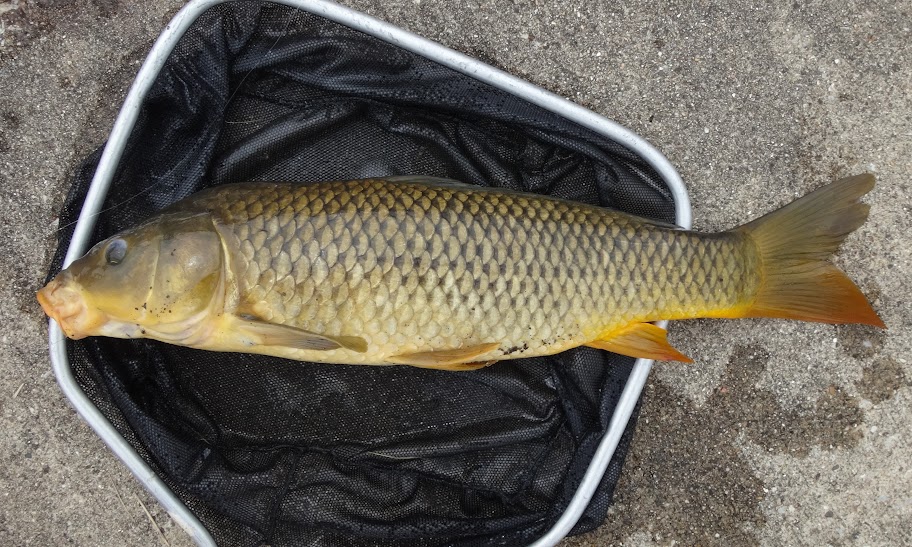
I chummed the concrete in front of me with corn and alfalfa pellets. While I waited for fish to arrive, I continued fishing with nightcrawlers. Based on what I caught, carp were the first fish to arrive in my chum area.
Common Carp (Cyprinus carpio)
I held the 12 ft crappie rod in my hands while I kept an eye on the baitfeeder rod sitting on the concrete. Similar to last time, I rigged up the crappie rod with a #10 Octopus hook and one or two pieces of corn. It wasn't getting much action, but I saw the baitfeeder rod twitch every so often. After a few stronger taps I put tension on the line and brought in this fish, a surprise lifer!
River Carpsucker (Carpiodes carpio) - new hook & line species #294
River carpsuckers are similar to quillback (see the previous post), but they have rounder snouts and their eyes are closer to the front of their heads.
The easiest way to tell the two species apart is to look at the lower lip. If there is a nipple in the center, then it's a river carpsucker. No nipple, and it's a quillback.
After a while the bite changed from carp to buffalo. They seem to arrive a bit late, but once they show up, they really show up in force. Using two rods baited with corn, I caught seven buffalo over the course of the afternoon.
Smallmouth Buffalo (Ictiobus bubalus)
Despite the rain in the morning, it got pretty hot in the afternoon. When I finished the last of my three bottles of water, I decided to pack up and call it a day. I threw a jig one last time and caught another crappie. All fish were catch, photo, release today!
Sunday, July 12, 2015
Monday, June 29, 2015
Shelbyville Dam buffalo
Yesterday I was on a mission. Step #1 was to drive to Shelbyville. Step #2 was to fill a cooler with buffalo. Step #3 was to drive back home. I arrived at the spillway around 10am, and the first thing I noticed was a school of quillback feeding on a submerged concrete ledge. This looked like an opportunity!
The only baits I brought were alfalfa pellets and canned corn. Quillback typically don't go for larger baits, so I used a scrap of corn skin on a #10 Gamakatsu Octopus hook. I had brought a 12 foot crappie rod in case there were shad I could target, and it turned out to be the perfect length for dropping a small bait in front of the feeding school of quillback. On the first pass one of the fish inhaled the scrap of corn skin and I set the hook. After reeling in I held the rod behind my back with my left hand and netted the fish using my dip net in my right hand.
Quillback (Carpiodes cyprinus)
Once the school formed back up, I noticed a darker fish hanging out with the quillback. I assumed it was a buffalo, so I put a whole piece of corn on the same #10 hook and dropped it about a foot in front of the fish. It went straight for the corn and pretty soon was in the net as well.
Smallmouth Buffalo (Ictiobus bubalus)
Illinois allows two rods per person, so I set up my other rod with a baitfeeder reel and a fish finder rig with a #4 Gamakatsu Octopus circle hook. Throughout the course of the day, I only caught common carp with this rig. They were a lot better looking than the ones at Carlyle, a lot less beat up.
Common Carp (Cyprinus carpio)
It seems that a fish finder rig with a circle hook is not the best way to catch buffalo. When a carp feels the hook, it bolts and sets the hook on its own. They're almost too easy (see my post from Carlyle a month or two ago). Buffalo, on the other hand, don't bolt when they feel the hook, and I suspect that they often succeed at spitting out the bait before you realize a fish is on.
I baited the concrete ledge with alfalfa pellets and more canned corn. Pretty soon I could see a sizable school of quillback, buffalo, and common carp show up to feed. It was a sight to see! I used the crappie rod, dropping one or two piece of corn down to where I could see a cluster of buffalo. It worked like a charm!
It was a lot of fun catching big fish on light tackle. I usually think it's silly when people brag about catching big fish on light tackle, but in this case it turned out to be a very effective method. There weren't any snags to worry about, so I was able to play the fish out until I could reach them with the net. The guy next to me took a photo of my biggest fish.
Smallmouth Buffalo (Ictiobus bubalus)
It turns out that buffalo come in all shapes and sizes. The next one I caught was rather ugly. I don't mean to be disrespectful, but it really was ugly.
Some of the other buffalo were much better looking. The smaller ones had blue and brown iridescence on their sides and were quite aesthetically pleasing.

With my cooler full of buffalo, I put away the corn and tied a #2 Mepps spinner on one of my other rods. I got a few nips from small yellow or white bass, but for the most part not much was biting. Finally I got a solid hit and caught this shortnose gar. I've never eaten a gar, and I had a cooler full of fish and ice, so I tossed him in as well. The fillets are in the fridge for tomorrow night!
Shortnose Gar (Lepisosteus platostomus)
Well hello there handsome fellow.
The only baits I brought were alfalfa pellets and canned corn. Quillback typically don't go for larger baits, so I used a scrap of corn skin on a #10 Gamakatsu Octopus hook. I had brought a 12 foot crappie rod in case there were shad I could target, and it turned out to be the perfect length for dropping a small bait in front of the feeding school of quillback. On the first pass one of the fish inhaled the scrap of corn skin and I set the hook. After reeling in I held the rod behind my back with my left hand and netted the fish using my dip net in my right hand.
Quillback (Carpiodes cyprinus)
Once the school formed back up, I noticed a darker fish hanging out with the quillback. I assumed it was a buffalo, so I put a whole piece of corn on the same #10 hook and dropped it about a foot in front of the fish. It went straight for the corn and pretty soon was in the net as well.
Smallmouth Buffalo (Ictiobus bubalus)
Illinois allows two rods per person, so I set up my other rod with a baitfeeder reel and a fish finder rig with a #4 Gamakatsu Octopus circle hook. Throughout the course of the day, I only caught common carp with this rig. They were a lot better looking than the ones at Carlyle, a lot less beat up.
Common Carp (Cyprinus carpio)
It seems that a fish finder rig with a circle hook is not the best way to catch buffalo. When a carp feels the hook, it bolts and sets the hook on its own. They're almost too easy (see my post from Carlyle a month or two ago). Buffalo, on the other hand, don't bolt when they feel the hook, and I suspect that they often succeed at spitting out the bait before you realize a fish is on.
I baited the concrete ledge with alfalfa pellets and more canned corn. Pretty soon I could see a sizable school of quillback, buffalo, and common carp show up to feed. It was a sight to see! I used the crappie rod, dropping one or two piece of corn down to where I could see a cluster of buffalo. It worked like a charm!
It was a lot of fun catching big fish on light tackle. I usually think it's silly when people brag about catching big fish on light tackle, but in this case it turned out to be a very effective method. There weren't any snags to worry about, so I was able to play the fish out until I could reach them with the net. The guy next to me took a photo of my biggest fish.
Smallmouth Buffalo (Ictiobus bubalus)
It turns out that buffalo come in all shapes and sizes. The next one I caught was rather ugly. I don't mean to be disrespectful, but it really was ugly.
Some of the other buffalo were much better looking. The smaller ones had blue and brown iridescence on their sides and were quite aesthetically pleasing.

With my cooler full of buffalo, I put away the corn and tied a #2 Mepps spinner on one of my other rods. I got a few nips from small yellow or white bass, but for the most part not much was biting. Finally I got a solid hit and caught this shortnose gar. I've never eaten a gar, and I had a cooler full of fish and ice, so I tossed him in as well. The fillets are in the fridge for tomorrow night!
Shortnose Gar (Lepisosteus platostomus)
Well hello there handsome fellow.
Saturday, June 6, 2015
2015 NANFA convention part 8 - the perfect wrap up
Thanks to Levi, Mike, and Greenwood, Pat and I had a plan for our last day of fishing. We left Tahlequah early in the morning and drove up to southwest Missouri. Our first two spots were creeks flowing through city parks. The first was a tributary of the Neosho River. Here we caught yet another orangethroat darter split, the plateau darter. We noticed that once you went outside the range of rainbow darters, the orangethroat darter splits were huge! We also caught fantail darters, banded sculpin, and cardinal shiners.
Plateau Darter (Etheostoma squamosum) - new hook & line species #290
Fantail Darter (Etheostoma flabellare)
Our second spot was a tributary of the James River in the White River drainage. We really enjoyed the easy access in these town parks.
The target at this spot was autumn darter, which is similar to the sunburst darters in Oklahoma. Pat was able to catch one, but I didn't have any luck with them. We both caught tons of Ozark darters though, and we were surprised at how different they were from the Buffalo River drainage ones from earlier in the trip. In fact, these were the most bizarre orangethroat splits we have seen.
Ozark Darter (Etheostoma sp. cf. spectabile)
The darter above had really bold red spots along its back as well as faint ones on its belly. The one below was one of the largest we caught. We couldn't get past how odd these darters looked.
Our last fishing spot was the North Fork White River. Mike and Greenwood had fished here earlier in the week, and they told us they were able to catch Ozark bass, yoke darter, and checkered madtom! Pat and I didn't waste any time getting rigged up. I fished a black jig with a chunk of redworm on the hook, and after dropping it beside a few boulders I got a hit and caught an Ozark bass. Pat caught his just a minute or two later!
Ozark Bass (Ambloplites constellatus) - new hook & line species #291
We also caught longear sunfish, and I caught my biggest fish of the trip, a smallmouth bass. Don't laugh, I know it's small...
Smallmouth Bass (Micropterus dolomieu)
We were quickly losing daylight, so we hurried down to the riffle to look for yoke darters. We actually found them right away, but they were too difficult to catch. The current was just too strong - we couldn't keep our baits in place long enough for a darter to bite. We moved up to a slower stretch and only caught rainbow darters. We hunted around for a different riffle to try, and with the last bit of light we found a better riffle and each caught a single yoke darter.
Yoke Darter (Etheostoma juliae) - new hook & line species #292
Once it was dark, Miciah and Levi showed up to join us. They wanted checkered madtoms as badly as we did. Pat and I tried fishing a small side pool downstream of the riffle, but all we caught were longear sunfish, Ozark bass, and hornyhead chubs. We knew we weren't leaving without checkered madtoms, so we took our time and enjoyed the evening.
We gave up on the small pool and headed back upstream to where we caught the Ozark bass. We fished in the deep pool, letting our baits sit on the bottom. Every few minutes we'd check our lines to see if anything was on. After pulling up a few pesky crayfish, I felt something slightly (and I do mean slightly) bigger, and I pulled up my last lifer of the trip, a checkered madtom! Pat soon caught one as well, and after we took off Miciah and Levi caught theirs as well.
Checkered Madtom (Noturus flavater) - new hook & line species #293
This was the perfect wrap up to a long road trip. I want to give a huge thanks to Pat, Ryan, Tyler, Levi, Miciah, Josh, Joy, Isaac, Mike, Greenwood, and all the folks at the NANFA convention for making this such an incredible trip!
Plateau Darter (Etheostoma squamosum) - new hook & line species #290
Fantail Darter (Etheostoma flabellare)
Our second spot was a tributary of the James River in the White River drainage. We really enjoyed the easy access in these town parks.
The target at this spot was autumn darter, which is similar to the sunburst darters in Oklahoma. Pat was able to catch one, but I didn't have any luck with them. We both caught tons of Ozark darters though, and we were surprised at how different they were from the Buffalo River drainage ones from earlier in the trip. In fact, these were the most bizarre orangethroat splits we have seen.
Ozark Darter (Etheostoma sp. cf. spectabile)
The darter above had really bold red spots along its back as well as faint ones on its belly. The one below was one of the largest we caught. We couldn't get past how odd these darters looked.
Our last fishing spot was the North Fork White River. Mike and Greenwood had fished here earlier in the week, and they told us they were able to catch Ozark bass, yoke darter, and checkered madtom! Pat and I didn't waste any time getting rigged up. I fished a black jig with a chunk of redworm on the hook, and after dropping it beside a few boulders I got a hit and caught an Ozark bass. Pat caught his just a minute or two later!
Ozark Bass (Ambloplites constellatus) - new hook & line species #291
We also caught longear sunfish, and I caught my biggest fish of the trip, a smallmouth bass. Don't laugh, I know it's small...
Smallmouth Bass (Micropterus dolomieu)
We were quickly losing daylight, so we hurried down to the riffle to look for yoke darters. We actually found them right away, but they were too difficult to catch. The current was just too strong - we couldn't keep our baits in place long enough for a darter to bite. We moved up to a slower stretch and only caught rainbow darters. We hunted around for a different riffle to try, and with the last bit of light we found a better riffle and each caught a single yoke darter.
Yoke Darter (Etheostoma juliae) - new hook & line species #292
Once it was dark, Miciah and Levi showed up to join us. They wanted checkered madtoms as badly as we did. Pat and I tried fishing a small side pool downstream of the riffle, but all we caught were longear sunfish, Ozark bass, and hornyhead chubs. We knew we weren't leaving without checkered madtoms, so we took our time and enjoyed the evening.
We gave up on the small pool and headed back upstream to where we caught the Ozark bass. We fished in the deep pool, letting our baits sit on the bottom. Every few minutes we'd check our lines to see if anything was on. After pulling up a few pesky crayfish, I felt something slightly (and I do mean slightly) bigger, and I pulled up my last lifer of the trip, a checkered madtom! Pat soon caught one as well, and after we took off Miciah and Levi caught theirs as well.
Checkered Madtom (Noturus flavater) - new hook & line species #293
This was the perfect wrap up to a long road trip. I want to give a huge thanks to Pat, Ryan, Tyler, Levi, Miciah, Josh, Joy, Isaac, Mike, Greenwood, and all the folks at the NANFA convention for making this such an incredible trip!
Friday, June 5, 2015
2015 NANFA convention part 7 - fishing in the sun
On our third and final day in Oklahoma, Pat and I joined forces with Miciah and Levi to fish some spots an hour south of Tahlequah. Our first stop was a tributary of Sallisaw Creek. The combination of crystal clear water and rock walls made this a very scenic spot.
Here we caught species we had already seen on the trip - longear sunfish, green sunfish, plains darter, sunburst darter, and cardinal shiner. We never got tired of the colorful darters! It's a shame I couldn't get the fins on the plains darter below to stand up, because it was one of the best specimens I caught.
Sunburst Darter (Etheostoma mihileze)
Plains Darter (Etheostoma pulchellum)
We spent a little time in the main Sallisaw Creek, but soon moved east to Little Lee Creek near the Arkansas border. This spot had great access and wide variety of habitats. My first catch was a shiner that I've been looking for each time I've visited the Ozarks, a wedgespo shiner. It was easy to tell apart from the more common bigeye shiner - it had a more silvery body and a clear triangle-shaped wedge at the base of its tail.
Wedgespot Shiner (Notropis greenei) - new hook & line species #287
In the deeper section of the creek above the riffle we found steelcolor shiners. They are very fast swimmers, and in order to catch them you have to call them over to you. What I would do is smack my split shot against the water several times. When the steelcolor shiners would race over to investigate, I'd put my bait in front of the biggest male I saw. I am VERY excited to replace my lifelist photo with the one below!
Steelcolor Shiner (Cyprinella whipplei)
We found logperch sitting on the bottom in a shallow smooth section of the creek above the riffle. Once you got your bait past the shiners, they were pretty easy to catch. The orange in the dorsal fin suggests that they're Ozark logperch, but from what I hear the taxonomy of the midwest logperch is pretty messy.
Ozark Logperch (Percina fulvitaenia)
In the same area where we caught the logperch, we also caught small fish that looked similar to bluntnose minnows. They had narrow bodies, pointy heads, and yellow iridescence, and we were able to identify them as slim minnows. We were excited to get to see this species!
Slim Minnow (Pimephales tenellus) - new hook & line species #288
I have to thank Miciah for my last species of the day. We couldn't find any redfin darters out in the riffle, but Miciah was able to find some in the very shallow side pools. They were tough to catch, but several of us each caught one. Mine refused to put its fins up for a photo, so the one below will have to do.
Redfin Darter (Etheostoma whipplei) - new hook & line species #289
Three new lifers was much better than I was expecting! In the late afternoon we packed up our vehicles and drove back to Tahlequah to get ready for the NANFA banquet. At the banquet we assembled a pretty large crew of species anglers. It must have been the largest group of people who can catch darters on hook & line together in one place at one time! From left to right below are Mike Berg, Miciah McNelius, Mike Channing, Greenwood Champ, Levi Cain, Josh Leisen, Joy Leisen, myself, and Pat Kerwin.
Here we caught species we had already seen on the trip - longear sunfish, green sunfish, plains darter, sunburst darter, and cardinal shiner. We never got tired of the colorful darters! It's a shame I couldn't get the fins on the plains darter below to stand up, because it was one of the best specimens I caught.
Sunburst Darter (Etheostoma mihileze)
Plains Darter (Etheostoma pulchellum)
We spent a little time in the main Sallisaw Creek, but soon moved east to Little Lee Creek near the Arkansas border. This spot had great access and wide variety of habitats. My first catch was a shiner that I've been looking for each time I've visited the Ozarks, a wedgespo shiner. It was easy to tell apart from the more common bigeye shiner - it had a more silvery body and a clear triangle-shaped wedge at the base of its tail.
Wedgespot Shiner (Notropis greenei) - new hook & line species #287
In the deeper section of the creek above the riffle we found steelcolor shiners. They are very fast swimmers, and in order to catch them you have to call them over to you. What I would do is smack my split shot against the water several times. When the steelcolor shiners would race over to investigate, I'd put my bait in front of the biggest male I saw. I am VERY excited to replace my lifelist photo with the one below!
Steelcolor Shiner (Cyprinella whipplei)
We found logperch sitting on the bottom in a shallow smooth section of the creek above the riffle. Once you got your bait past the shiners, they were pretty easy to catch. The orange in the dorsal fin suggests that they're Ozark logperch, but from what I hear the taxonomy of the midwest logperch is pretty messy.
Ozark Logperch (Percina fulvitaenia)
In the same area where we caught the logperch, we also caught small fish that looked similar to bluntnose minnows. They had narrow bodies, pointy heads, and yellow iridescence, and we were able to identify them as slim minnows. We were excited to get to see this species!
Slim Minnow (Pimephales tenellus) - new hook & line species #288
I have to thank Miciah for my last species of the day. We couldn't find any redfin darters out in the riffle, but Miciah was able to find some in the very shallow side pools. They were tough to catch, but several of us each caught one. Mine refused to put its fins up for a photo, so the one below will have to do.
Redfin Darter (Etheostoma whipplei) - new hook & line species #289
Three new lifers was much better than I was expecting! In the late afternoon we packed up our vehicles and drove back to Tahlequah to get ready for the NANFA banquet. At the banquet we assembled a pretty large crew of species anglers. It must have been the largest group of people who can catch darters on hook & line together in one place at one time! From left to right below are Mike Berg, Miciah McNelius, Mike Channing, Greenwood Champ, Levi Cain, Josh Leisen, Joy Leisen, myself, and Pat Kerwin.
Thursday, June 4, 2015
2015 NANFA convention part 6 - Tahlequah, OK
For our second day in Tahlequah, we decided to stay in town, fish a couple spots, and then meet up with the rest of the NANFA folks in the afternoon. In the morning Pat and I headed down to a lower stretch of Tahlequah Creek. Right away we noticed dozens of longnose gar spawning. The water was crystal clear. Pat and I tied on rope lures to target some of the gar that weren't spawning, but by the time we started fishing for them the water had started to become cloudy. What was going on?
Pat got a hit on his rope lure. He walked with the fish downstream for a bit to let the rope fibers tangle in its teeth and then tightened up his line. All he had to do at that point was walk the fish back to shore and land it. Pat was pretty happy, as this was the longest fish of the trip!
Longnose Gar (Lepisosteus osseus)
By now the water was completely opaque. Something was going on. We could see a white colored film on the surface of the water. I couldn't get any hits on my rope lure, and we packed up and left. As we drove away from the spot, we realized that the J. M. Hicks Wastewater Treatment Facility was directly upstream of the spot we were fishing. Gross.
We drove back to the middle of town to fish an upstream stretch of Tahlequah Creek. This stretch of the creek looked like it had undergone a restoration project recently.
The most common fish here were redbelly dace. It was hard to catch anything else! A few of them had good colors, and many of them also had black spots along their backs. We also caught a few creek chubs, redspot chubs, cardinal shiners, and plains darters.
Southern Redbelly Dace (Chrosomus erythrogaster)
Creek Chub (Semotilus atromaculatus)
Cardinal Shiner (Luxilus cardinalis)
In the afternoon we headed over to the Illinois River where the NANFA convention was getting started. We enjoyed chatting about fish with other enthusiasts. They had a big aquarium set up with fish from the river. See the baby paddlefish in the upper right?
After the party split up, Pat and I headed back to the park we fished the day before. We didn't have any real ambitions for new lifers, but maybe we'd turn up something interesting like a slim minnow. You never know. My first catch was a slender madtom. After that we caught more of the same, plains darters, fantail darters, sunburst darters, and longear sunfish. Once again I failed to catch a big banded sculpin I saw, so I bent down and grabbed it with my hands.
Slender Madtom (Noturus exilis)
Sunburst Darter (Etheostoma mihileze)
Banded Sculpin (Cottus carolinae)
It was a zero lifer day, but Pat and I got to know Tahlequah a lot better, and we called it a day early so we'd be well rested for the next day. Stay tuned!
Pat got a hit on his rope lure. He walked with the fish downstream for a bit to let the rope fibers tangle in its teeth and then tightened up his line. All he had to do at that point was walk the fish back to shore and land it. Pat was pretty happy, as this was the longest fish of the trip!
Longnose Gar (Lepisosteus osseus)
By now the water was completely opaque. Something was going on. We could see a white colored film on the surface of the water. I couldn't get any hits on my rope lure, and we packed up and left. As we drove away from the spot, we realized that the J. M. Hicks Wastewater Treatment Facility was directly upstream of the spot we were fishing. Gross.
We drove back to the middle of town to fish an upstream stretch of Tahlequah Creek. This stretch of the creek looked like it had undergone a restoration project recently.
The most common fish here were redbelly dace. It was hard to catch anything else! A few of them had good colors, and many of them also had black spots along their backs. We also caught a few creek chubs, redspot chubs, cardinal shiners, and plains darters.
Southern Redbelly Dace (Chrosomus erythrogaster)
Creek Chub (Semotilus atromaculatus)
Cardinal Shiner (Luxilus cardinalis)
In the afternoon we headed over to the Illinois River where the NANFA convention was getting started. We enjoyed chatting about fish with other enthusiasts. They had a big aquarium set up with fish from the river. See the baby paddlefish in the upper right?
After the party split up, Pat and I headed back to the park we fished the day before. We didn't have any real ambitions for new lifers, but maybe we'd turn up something interesting like a slim minnow. You never know. My first catch was a slender madtom. After that we caught more of the same, plains darters, fantail darters, sunburst darters, and longear sunfish. Once again I failed to catch a big banded sculpin I saw, so I bent down and grabbed it with my hands.
Slender Madtom (Noturus exilis)
Sunburst Darter (Etheostoma mihileze)
Banded Sculpin (Cottus carolinae)
It was a zero lifer day, but Pat and I got to know Tahlequah a lot better, and we called it a day early so we'd be well rested for the next day. Stay tuned!
Subscribe to:
Comments (Atom)


